Zitierweise / cite as:
Payer, Alois <1944 - >: Chronik Thailands = กาลานุกรมสยามประเทศไทย. -- Chronik 1809 - 1824 (Rama II.). -- Fassung vom 2015-05-07. -- URL: http://www.payer.de/thailandchronik/chronik1809.htm
Erstmals publiziert: 2013-06-29
Überarbeitungen: 2015-05-07 [Ergänzungen] ; 2015-04-21 [Ergänzungen] ; 2015-03-31 [Ergänzungen] ; 2015-03-15 [Ergänzungen] ; 2015-03-03 [Ergänzungen] ; 2015-01-28 [Ergänzungen] ; 2015-01-13 [Ergänzungen] ; 2014-12-21 [Ergänzungen] ; 2014-11-11 [Ergänzungen] ; 2014-10-20 [Ergänzungen] ; 2014-08-27 [Ergänzungen] ; 2014-02-26 [Ergänzungen] ; 2013-12-18 [Ergänzungen] ; 2013-11-25 [Ergänzungen] ; 2013-11-07 [Ergänzungen] ; 2013-10-09 [Ergänzungen] ; 2013-10-03 [Ergänzungen] ; 2013-09-27 [Ergänzungen] ; 2013-09-15 [Ergänzungen] ; 2013-08-26 [Ergänzungen] ; 2013-08-23 [Ergänzungen] ; 2013-08-20 [Ergänzungen] ; 2013-08-17 [Ergänzungen] ; 2013-07-06 [Ergänzungen] ; 2013-06-30 [Ergänzungen]
©opyright: Dieser Text steht der Allgemeinheit zur Verfügung. Eine Verwertung in Publikationen, die über übliche Zitate hinausgeht, bedarf der ausdrücklichen Genehmigung des Herausgebers.
Dieser Text ist Teil der Abteilung
Thailand von
Tüpfli's Global Village Library
ช้างตายทั้งตัวเอาใบบัวปิดไม่มิด
|
Gewidmet meiner lieben Frau Margarete Payer die seit unserem ersten Besuch in Thailand 1974 mit mir die Liebe zu den und die Sorge um die Bewohner Thailands teilt. |
1809-03-04 - 1817-03-04

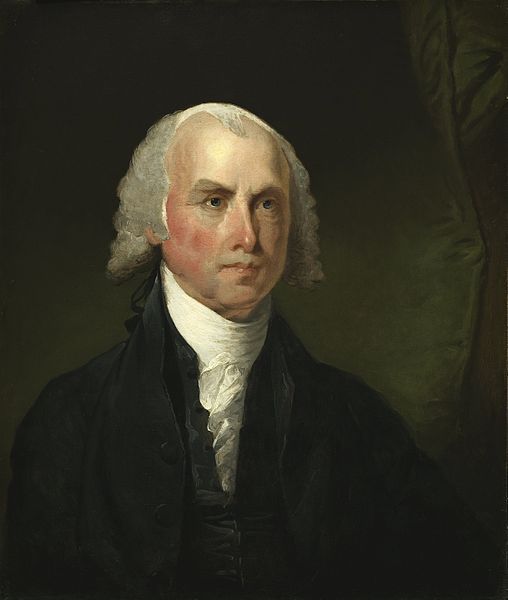
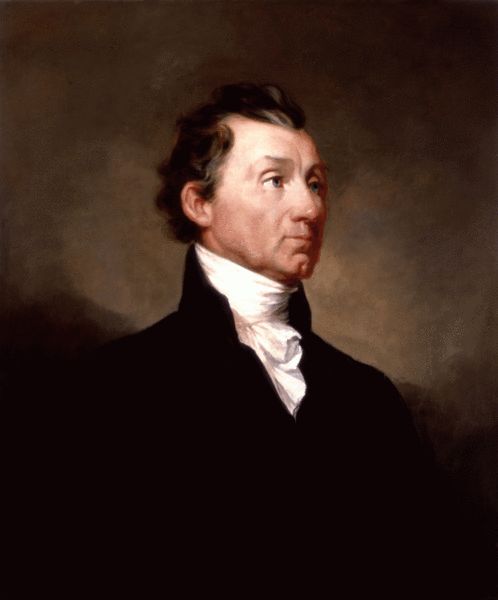
James Madison (1751 - 1836) ist Präsident der USA.
Abb.: James Madison 1821 / von Gilbert Stuart (1755 - 1828)
[Bildquelle: Wikipedia. -- Public domain]
1809-09-07 - 1824-07-21

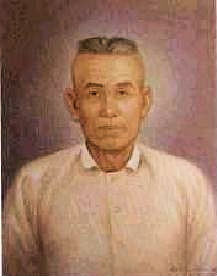
Rama II.: Phra Bat Somdet Phra Poramenthramaha Isarasundhorn Phra Buddha Loetla Nabhalai - พระบาทสมเด็จพระปรเมนทรมหาอิศรสุนทรฯ พระพุทธเลิศหล้านภาลัย
Statistik:
- 38 Söhne
- 35 Töchter, alle bleiben unverheiratet
- die 73 Kinder stammen von 38 Müttern
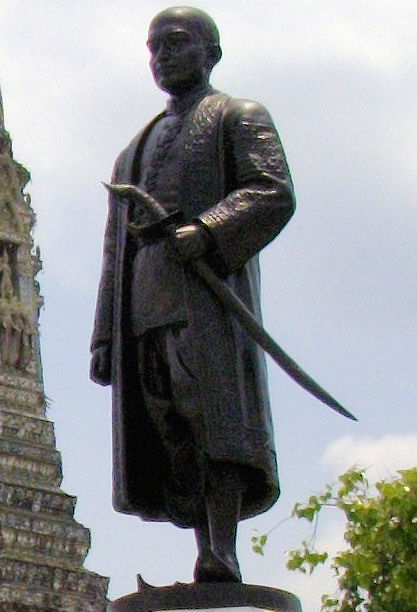
Abb.: Rama II. -- vor Wat Arun - วัดอรุณ,
Bangkok - กรุงเทพฯ
[Bildquelle: Xiengyod / Wikimedia. -- GNU FDLicense]
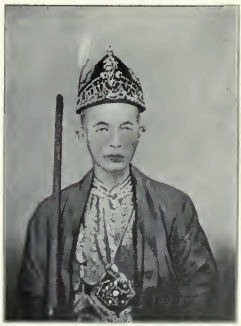
Abb.: Rama II.
[Bildquelle:
Twentieth century impressions of Siam : its history, people, commerce,
industries, and resources / ed. in chief: Arnold Wright. -- London [etc.] :
Lloyds, 1908. -- S. 55]
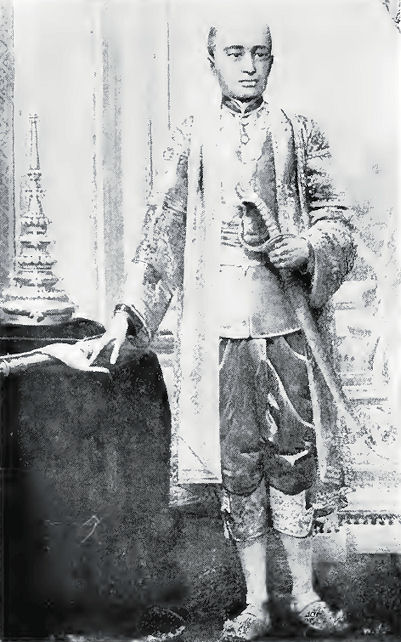
Abb.: Rama II.
"Phra Phuttaloetla (später: Rama II., vollständiger Name: Phrabat Somdet Phra Phuttaloetla Naphalai − Thai: พระบาทสมเด็จพระพุทธเลิศหล้านภาลัย; * 26. Februar 1768 in Ratchaburi; † 21. Juli 1824 in Bangkok/Siam, heute: Thailand) war von 1809−1824 König von Siam. Rama II. wurde als Isarasunthon in der Zeit der Belagerung Ayutthayas geboren, als sein Vater, der spätere Begründer der Chakri-Dynastie, als Offizier in Ratchaburi stationiert war. Er wuchs in der anschließenden Zeit der Anarchie im Lande auf. Dennoch war er kein Freund von Gewalt und vermied sie während seiner Regentschaft, wo immer es ging. Seine Aufgaben sah er in der Festigung der Verwaltungsstrukturen des Landes und in der Förderung von Kultur (insbesondere Architektur, Literatur und Musik) sowie der Erneuerung der Religion. Auch die Wirtschaft förderte er, zum Beispiel indem er jeden Landbesitzer unter Androhung der Enteignung verpflichtete, sein Land zu kultivieren. Hierzu ließ er eine Landesvermessung durchführen, die ganz Siam erfasste.
Als gläubiger Buddhist erneuerte er die Festtage des Visaka Bucha, dem Geburts-, Erleuchtungs- und Sterbetag des Buddha. Rama II. war wie sein Vater Phra Phuttayodfa Chulalok (später: Rama I.) ein großer Freund der Literatur und übersetzte unter anderem die buddhistische Tripitaka aus dem Pali ins Thailändische. Er ließ den Wat Arun in Thonburi restaurieren und vergrößern, entwarf selbst das anmutige und lebensnahe Buddha-Abbild in der Ordinationshalle (Ubosot).
In Rama II. wirkte das Gefühl des großen Kulturverlustes nach der Zerstörung Ayutthayas fort. In der Zeit der Konsolidierung wollte man so viel wie möglich wieder aufbauen und dem Land Kunstwerke und Tradition zurückgeben.
Rama II. war wie alle Könige der Chakri-Dynastie sehr fruchtbar: er hatte insgesamt 73 Kinder, 38 Jungen und 35 Mädchen, 51 von ihnen wurden vor seiner Thronbesteigung geboren. Keine seiner Töchter heiratete. Jedoch sein 61. Sohn, Prinz Pramoj war der Vorfahre von Seni Pramoj und von Kukrit Pramoj, beide wurden später Premierminister von Thailand. Die gegenwärtige Königin Sirikit ist ein Nachkomme des 49. Sohns von Rama II., Prinz Nuam, der die Snidwongse-Familie begründete.
Nur wenige Tage nach der Ordination seines Sohnes Prinz Mongkut, dem späteren König Rama IV., zum Mönch im Wat Bowonniwet wurde Rama II. sehr krank. Er ließ sich zunächst mit traditioneller thailändischer Medizin behandeln, was aber zu keiner Besserung führte. Die zu spät hinzugezogenen Hofärzte konnten am 21. Juli 1824 nur noch seinen Tod feststellen. Sein Sohn Prinz Chestabodin wurde wenig später als sein Nachfolger zum König Nang Klao (später Rama III.) gekrönt."
[Quelle: http://de.wikipedia.org/wiki/Rama_II. -- Zugriff am 2011-10-06]
Namen und Titel:
- 1767–1782: Nai Chim (ฉิม)
- 1782–1808: Somdet Phra Chao Lukya Thoe Chaofa Krom Luang Itsarasunthon (สมเด็จพระเจ้าลูกยาเธอ เจ้าฟ้ากรมหลวงอิศรสุนทร)
- 1808–1809: Krom Phraratchawang Bowon Maha Itsarasunthon (Krom Phrarajawang Bovorn Sathan Mongkol - กรมพระราชวังบวรสถานมงคล)
1809–1824: Phrabat Somdet Phra Borommarajadhiraj Ramadhibodi (พระบาทสมเด็จพระบรมราชาธิราชรามาธิบดี ศรีสินทรบรมมหาจักรพรรดิราชาธิบดินทร์ ธรณินทราธิราช รัตนากาศภาสกรวงศ์ องค์ปรมาธิเบศ ตรีภูวเนตรวรนายก ดิลกรัตนราชชาติอาชาวศรัย สมุทัยดโรมนต์ สากลจักรวาฬาธิเบนทร สุริเยนทราธิบดินทร์ หริหรินทรา ธาดาธิบดี ศรีวิบูลยคุณอกนิษฐ ฤทธิราเมศวรมหันต บรมธรรมิกราชาธิราชเดโชชัย พรหมเทพาดิเทพนฤบดินทร์ ภูมิทรปรมาธิเบศ โลกเชษฐวิสุทธิ รัตนมกุฎประกาศ คตามหาพุทธางกูรบรมบพิตร พระพุทธเจ้าอยู่หัว)
Posthumously renamed by King Mongkut as: Phra Bat Somdet Phra Borommarajabongjet Mahesvarasundorn Phra Buddha Loetla Nabhalai (พระบาทสมเด็จพระบรมราชพงศ์เชษมเหศวรสุนทร พระพุทธเลิศหล้านภาลัย)
[Quelle: th.Wikipedia + en.Wikipedia]
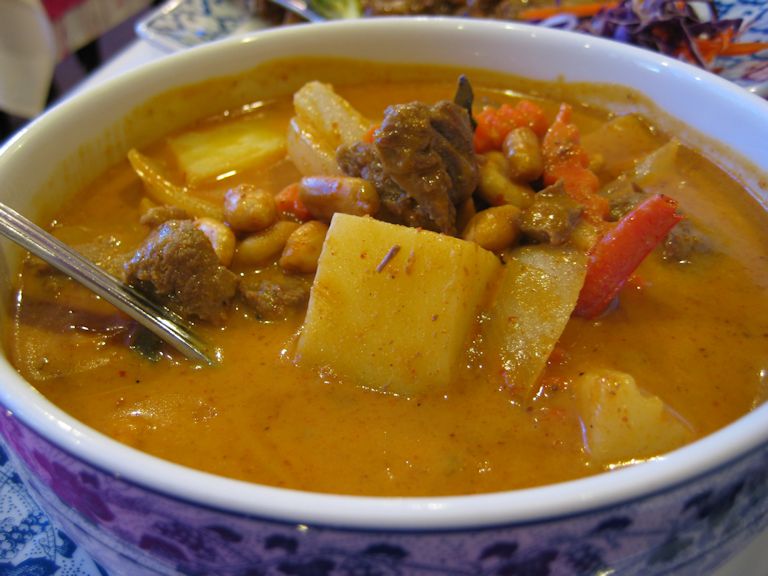
Rama II. schrieb u.a. ein Gedicht über eine Köchin, die wunderbaren Kaeng Masaman (แกงมัสมั่น) zubereiten konnte.
Abb.: Kaeng Masaman (แกงมัสมั่น), USA, 2008
[Bildquelle: Ernesto Andrade. -- http://www.flickr.com/photos/20688578@N00/2925664079. -- Zugriff am 2012-06-19. -- Creative Commons Lizenz (Namensnennung, keine Bearbeitung)]
"Kaeng Masaman (Thai: แกงมัสมั่น; Aussprache: [kæŋ mát-sà-màn], wörtl.: Moslem-Suppe, auch „Gaeng Matsaman“ oder „Massaman Curry“) ist ein Gericht der südlichen Thai-Küche. Kaeng Masaman wurde von den Thais in Zentralthailand als eines der hier entstandenen Gerichte beansprucht, es ist jedoch in Südthailand weitaus häufiger anzutreffen. König Phuttaloetla Naphalai (Rama II.) war von diesem Gericht so beeindruckt, dass er darüber, genauer gesagt, über eine Köchin, ein Gedicht schrieb. Das Gedicht ist jedem thailändischen Schüler bekannt, wird es doch bereits in der Grundschule auswendig gelernt. Es zeigt, dass indisch beeinflusste Gerichte zu Beginn des 19. Jahrhunderts bereits einen festen Platz in der thailändischen Küche eingenommen hatten. Die Tatsache, dass ein König es zur Inspiration zu einem Gedicht benutzte, beweist auch, dass das Rezept für ein „Moslem-Curry“ seit langem in der thailändischen Ess-Kultur akzeptiert war.
Die ersten Zeilen des Gedichts lauten:
มัสมั่นแกงแก้วตา หอมยี่หร่ารสแรงร้อน - Masaman, Juwel in meinen Augen, duftender Kreuzkümmel, scharfer Geschmack.ชายใดได้กลืนแกง แรงอยากให้ใฝ่ฝันหา - Jeder Mann, der von ihrem Curry kostet, kann nicht umhin, von ihr zu träumen."
[Quelle: http://de.wikipedia.org/wiki/Kaeng_Masaman. -- Zugriff am 2012-06-19]
Heartily spiced and so hot;
Whoever tastes it once,
Will look for it all his life.
Fish soup with a piece of stomach
Floating rich and fragrant,
Inviting me to take spoonfuls
Of that heavenly dish.
Pleated dumpling you have dressed,
Being fairly reminiscent
Of yourself and pleated outfits,
With a carefully folded knot.
And pomegranate, just for the thought of it.
Pomegranate seeds glitter brightly,
Like precious stones on a dish,
Some are fully red,
And inviting as your little ring.
O my love was like Golden Drop,
Fully wrapped in Golden Roll;
For two years we kept a secret,
Known to just the two of us.
How beautiful is Crown Cake
Wearing its name like a gold crown;
I muse with longing;
For the chain worn over your shoulder.
Sprig of purple has a lovely smell,
Spreading around like a lotus,
I see your breast cloth
Resting purple on the flowers.
Golden Rain falls in shiny threads,
Like your silk woven out of egg.
I remember my beloved,
Sewing with such golden Chinese silk.(Translation by Montri Umavijani: Facts of Thai Cultural Life, Foreign News Division, Government Public Relations Department. -- http://thailand.prd.go.th/ebook/kitchen/intro.html. -- Zugriff am 2013-06-29]
มัสมั่นแกงแก้วตา หอมยี่หร่ารสแรงร้อน
ชายใดได้กลืนแกง แรงอยากให้ใฝ่ฝันหาตับเหล็กลวกหล่อนต้ม เจือน้ำส้มโรยพริกไทย
โอชาจะหาไหน ไม่มีเทียบเปรียบมือนางหมูแนมแหลมเลิศรส พร้อมพริกสดใบทองหลาง
พิศห่อเห็นรางชาง ห่างห่อหวนป่วนใจโหยก้อยกุ้งปรุงประทิ่น วางถึงลิ้นดิ้นแดโดย
รสทิพย์หยิบมาโปรย ฤๅจะเปรียบเทียบทันขวัญเทโพพื้นเนื้อท้อง เป็นมันย่องล่องลอยมัน
น่าซดรสครามครัน ของสวรรค์เสวยรมย์ความรักยักเปลี่ยนท่า ทำน้ำยาอย่างอกงขม
กลอ่อมกล่อมเกลี้ยงกลม ชมไม่วายคล้ายคล้ายเห็นข้าวหุงปรุงอย่างเทศ รสพิเศษใส่ลูกเอ็น
ใครหุงปรุงไม่เป็น เช่นเชิงมิตรประดิษฐ์ทำเหลือรู้หมูป่าต้ม แกงคั่วส้มใส่ระกำ
รอยแจ้งแห่งความขำ ช้ำทรวงเศร้าเจ้าตรากตรอมช้าช้าพล่าเนื้อสด ฟุ้งปรากฏรสหื่นหอม
คิดความยามถนอม สนิทเนื้อเจือเสาวคนธ์ล่าเตียงคิดเตียงน้อง นอนเตียงทองทำเมืองบน
ลดหลั่นชั้นชอบกล ยลอยากนิทรคิดแนบนอนเห็นหรุ่มรุมทรวงเศร้า รุ่มรุ่มเร้าคือไฟฟอน
เจ็บไกลในอาวรณ์ ร้อนรุมรุ่มกลุ้มกลางทรวงรังนกนึ่งน่าซด โอชารสกว่าทั้งปวง
นกพรากจากรังรวง เหมือนเรียมร้างห่างห้องหวนไตปลาเสแสร้งว่า ดุจวาจากระบิดกระบวน
ใบโศกบอกโศกครวญ ให้พี่เคร่าเจ้าดวงใจผักโฉมชื่อเพราะพร้อง เป็นโฉมน้องฤๅโฉมไหน
ผักหวานซ่านทรวงใน ใคร่ครวญรักผักหวานนาง
Königinnen:
- Sri Suriyendra (ศรีสุริเยนทรา, 1767 - 1836)
- Sri Sulalai (กรมสมเด็จพระ ศรีสุลาไลย, 1770 - 1837)
"Queen Sri Suriyendra (Thai: ศรีสุริเยนทรา; RTGS: —Si Suriyenthra—) (1767–1836) was the queen of Siam, wife of Buddha Loetla Nabhalai, who was her own cousin, and mother of Mongkut (พระบาทสมเด็จพระปรเมนทรมหามงกุฎฯ พระจอมเกล้าเจ้าอยู่หัว, 1804 - 1868) and Pinklao (พระบาทสมเด็จพระปิ่นเกล้าเจ้าอยู่หัว, 1808 - 1866). She was later named upon the coronation of her son Mongkut as Krom Somdet Phra Sri Suriyendramataya. Princess Bunreod was a daughter of Princess Sri Sudarak (เจ้าฟ้ากรมพระศรีสุดารักษ์) (sister of Buddha Yodfa Chulaloke) and her Chinese husband[1] Chao Krua Ngern (เจ้าขรัวเงิน). Princess Bunreod lived with her mother in the Grand Palace (พระบรมมหาราชวัง) and grew up with her maternal female cousins, the daughters of Buddha Yodfa Chulaloke.
Princess Bunreod had an affair with her cousin, Prince Isarasundhorn, a son and heir apparent to King Buddha Yodfa Chulaloke. In 1801, the King discovered the princess' four-month pregnancy and banished her from the Grand Palace to live with her brother Prince Thepharirak. Prince Isarasundhorn begged his father to no avail to return the princess to the palace. The couple eventually settled at the Old Palace (Thonburi Palace) and Princess Bunreod became the prince's consort. The baby died, however, shortly after birth. With Prince Isarasundhorn (the future Buddha Loetla Nabhalai), she bore three sons:
- The first, born in 1801, died shortly after birth;
- Prince Mongkut, or later King Mongkut (or King Rama IV), born in 1804;
- Prince Chutamani, or later King Pinklao, born in 1808.
Following Prince Isarasundhorn's coronation as Buddha Loetla Nabhalai, Princess Bunreod was raised to Queen Sri Suriyendra. She was not the only wife as the Siamese monarchs was allowed have many consorts in accordance with tradition. Sri Suriyendra shared her husband with Princess Consort Kunthon and Princess Riam (เจ้าจอมมารดาเรียม, 1770 - 1837, Mother of King Jessadabodindra (or King Rama III) and a number of the king's concubines.
Her son, Prince Mongkut became a monk in 1824, the same year that Buddha Loetla Nabhalai died. It was her son Mongkut who was to be crowned according to tradition. However, the nobility decided to offer the crown to Prince Tub, who became King Jessadabodindra (Rama III) (the Prince was a son of concubine, but had been extremely experienced in government). Mongkut then remained a monk to avoid court intrigues.
Sri Suriyendra then left the Grand Palace for the Old Palace (Wang Derm) to live with her son Prince Isaret (previously Prince Chutamani). She stayed there until her death in 1836, she did not live to see her son Mongkut crowned."
[Quelle: http://en.wikipedia.org/wiki/Sri_Suriyendra. -- Zugriff am 2012-03-30]
"Chao Chom Manda Riam (Thai: เจ้าจอมมารดาเรียม), later Krom Somdet Phra Sri Sulalai (Thai: กรมสมเด็จพระศรีสุลาไลย, 1770 - 1837), was a royal concubine of King Buddha Loetla Nabhalai, the king of Siam. Her family was Muslim from the Southern part of the Kingdom, and her very name is the shortened version of "Maryam" an Arabic name. She married Prince Isarasundhorn as the second concubine and gave birth to Prince Tub (later Prince Jessadabodindra) in 1787. In 1809, Prince Isarasundhorn was crowned as King Buddha Loetla Nabhalai. Chao Chom Manda Riam then moved to the Royal Grand Palace (พระบรมมหาราชวัง) and presided over the royal kitchen. Prince Jessadabodindra was trusted by the king to handle various state affairs. In 1824, King Buddha Loetla Nabhalai died. According to the tradition, the throne would go to Prince Mongkut, the son of Queen Sri Suriyendra. However, the nobility instead enthroned Prince Jessadabodindra because he had served the king in Krom Tha (Ministry of Trade and Foreign Affairs) for years and was proved to be competent to rule.
As her son was crowned, Chao Chom Manda Riam was raised to Krom Somdet Phra Sri Sulalai (HRH Princess Mother Sri Sulalai), thus a member of the royalty. She died in 1837."
[Quelle: http://en.wikipedia.org/wiki/Sri_Sulalai. -- Zugriff am 2012-03-30]
Rama II. verfasst den Roman Inao (อิเหนา) beruhend auf der altjavanischen Panji-Erzählung.
1809-09-07 - 1817-07-16

Somdet Phra Bawornrajchao Maha Senanurak (สมเด็จพระบวรราชเจ้ามหาเสนานุรักษ์; 1773 - 1817) ist Front Palace (Uparaj) (กรมพระราชวังบวรสถานมงคล).
"Somdet Phra Bawornrajchao Maha Senanurak (Thai: สมเด็จพระบวรราชเจ้ามหาเสนานุรักษ์; March 29, 1773 - July 16, 1817) was the Front Palace (กรมพระราชวังบวรสถานมงคล) appointed by Buddha Loetla Nabhalai as the titular heir to the throne as he was the brother to the king. Maha Senanurak was known for his leadership of Siamese campaign against Burmese invasion of Thalang (( تلوڠ = Phuket - ภูเก็ต) in 1809. Life
Chui was born to Chao Phraya Chakri (future King Buddha Yodfa Chulaloke or Rama I) and his wife Nak (future Queen Amarindra - อมรินทรา, 1737 - 1826) in 1773. In 1782, Chao Phraya Chakri crowned himself as the first monarch of the Chakri dynasty of Siam at Bangkok. Chui was then made a prince. He was later awarded the title Krom Khun Senanurak. Prince Senanurak was known to be close to his only true brother Prince and Front Palace Isarasundhorn (future Buddha Loetla Nabhalai or Rama II).[1] In 1807 Prince Isarasundhorn made his brother Prince Senanurak as his Successor to the Front Palace (Thai: พระบัณฑูรน้อย). In 1809, King Buddha Yodfa Chulalok died, as a result the Front Palace Isarasundhorn ascended the throne as King. The new King appointed Prince Senanurak as the next the Front Palace and Vice King, and also as his successor.
Soon after in 1809, King Bodawpaya (ဘိုးတော်ဘုရား, 1745 - 1819) of Burma sent his troops to invade Thalang or modern Phuket. Buddha Loetla Nabhalai sent Maha Senanurak to counter this last Burmese invasion of Siam.
Around the same time Prince Kasatranuchit, a son of King Taksin (ตากสิน) of Thonburi (ธนบุรี)and his sister Princess Chimyai, staged a rebellion to reclaim the throne. The rebellion was quickly suppressed by Prince Jessadabodindra (เจษฎาบดินทร์, future King Rama III). Maha Senanurak's wife, Princess Samleewan, a daughter of Taksin, was executed for treason.
DeathFront Palace Maha Senanurak fell ill and died in 1817. For the rest of his reign King Rama II refused to appoint a new Front Palace, leading perhaps to the brief confusion in succession between his sons Jessadabodindra and Mongkut at his death in 1824."
[Quelle: http://en.wikipedia.org/wiki/Boworn_Maha_Senanurak. -- Zugriff am 2012-03-29]
1809-09

Gescheiterter Putschversuch eines Sohns von König Taksin (สมเด็จพระเจ้าตากสินมหาราช, 1734 - 1782) um die Thronfolge. Der Thronprätendent wird hingerichtet.
1809
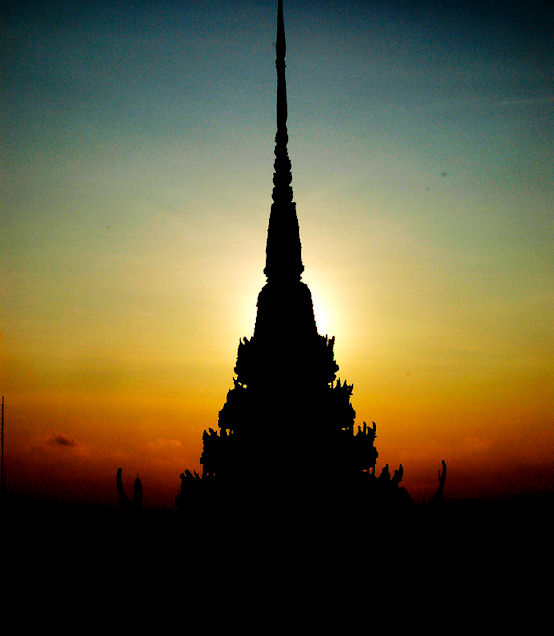
Beginn des Baus des Prang (พระปรางค์) von Wat Arun (วัดอรุณ).
Abb.: Prang (พระปรางค์) von Wat Arun (วัดอรุณ) bei Sonnenaufgang
[Bildquelle: colorourworld. -- http://www.flickr.com/photos/9085818@N05/2402196959/. -- Zugriff am 2011-10-24. -- Creative Commons Lizenz (Namensnennung, keine kommerzielle Nutzung, share alike)]
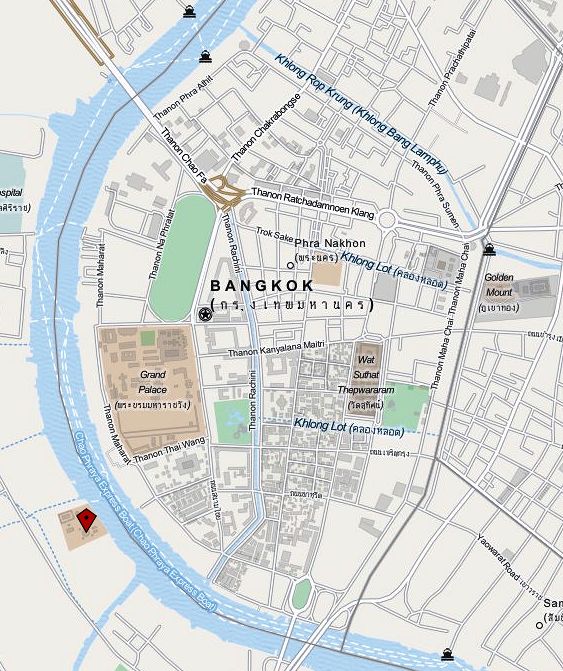
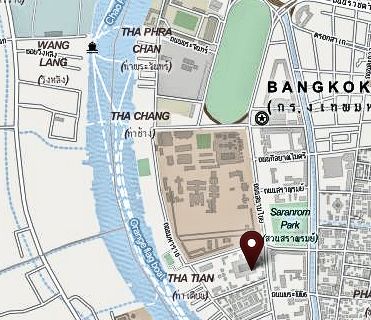
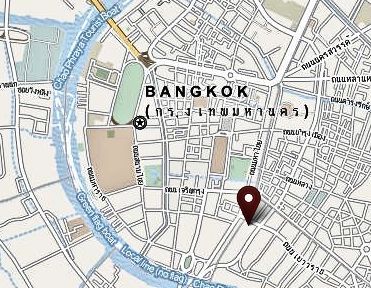
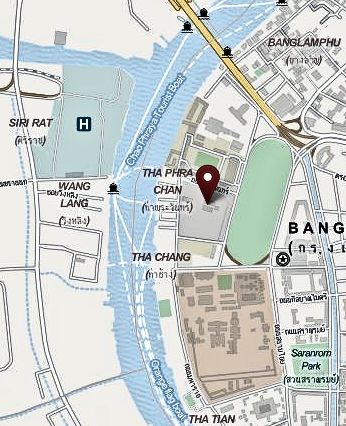
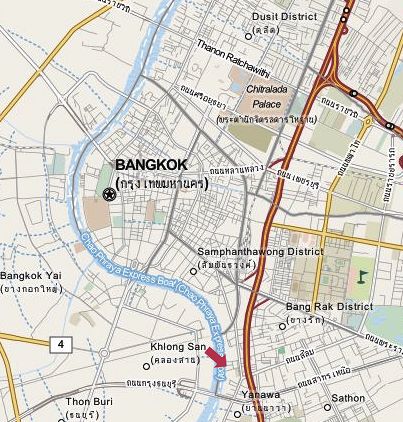
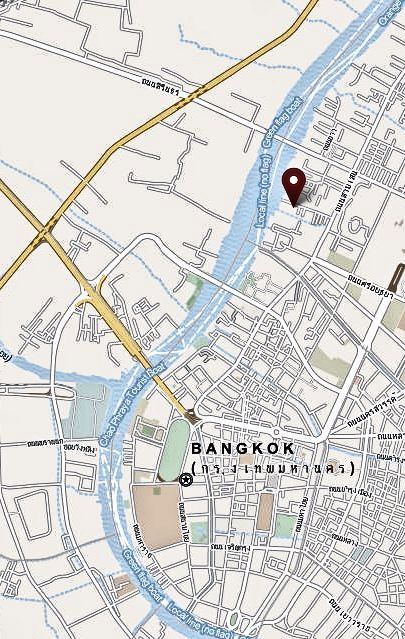
Abb.: Lage von Wat Arun (วัดอรุณ)
[Bildquelle: OpenStreetMap. -- Creative Commons Lizenz (Namensnennung, share alike)]
"Wat Arun (Thai วัด อรุณ, Tempel der Morgenröte, ehemals: Wat Chaeng - วัดแจ้ง) ist ein buddhistischer Tempel (Wat) in Bangkoks Ortsteil Bangkok Yai am westlichen Ufer des Chao Phraya-Flusses. Der vollständige Name des Tempels lautet Wat Arun Ratchawararam Ratchaworamahaviharn (วัดอรุณราชวรารามราชวรมหาวิหาร). Historisches
Der Tempel wurde während der Ayutthaya-Periode (อาณาจักรอยุธยา) errichtet und hieß ursprünglich Wat Makok (วัดมะกอก - Oliven-Tempel). Als nach dem Fall Ayutthayas Thonburi (ธนบุรี) die Hauptstadt des neuen siamesischen Reiches wurde, baute König Taksin (ตากสินมหาราช, 1734 - 1782) im Jahre 1768 seinen Palast auf dem Gebiet des alten Fort Wichayen (วิชาเยนทร์), welches bereits seit Anfang des 16. Jahrhunderts den Eingang per Schiff zum siamesischen Reich bewacht. In das Palastgelände eingeschlossen wurden zwei Tempel, Wat Makok und Wat Tai Talad (heute Wat Moli Lokayaram). In beiden Tempel durften sodann keine Mönche mehr leben, wie es heute auch im Wat Phra Kaeo der Fall ist, der auf dem Gelände des Grand Palace liegt. Der König änderte dabei den Namen von Wat Makok in Wat Chaeng (วัดแจ้ง). Als Chao Phraya Chakri, der spätere König Phra Puttha Yotfa Chulalok (Rama I.) den Smaragd-Buddha (พระแก้วมรกต), den er in Vientiane (ວຽງຈັນ) erbeutet hatte, in einer feierlichen Prozession in die Hauptstadt brachte, bekam die heilige Buddha-Statue im Tempel des Königs, im Wat Chaeng seine vorläufige Unterkunft.
Nach dem Sturz von Taksin dem Großen baute König Puttha Yotfa Chulalok dem Smaragd-Buddha einen neuen Tempel auf dem gegenüber liegenden Flussufer, wohin er 1784 umzog. Anschließend reduzierte er das Palastgelände und lud neue Mönche ein, in die verwaisten Tempel einzuziehen. Während der Regierungszeit von König Puttha Yotfa Chulalok restaurierte der Kronprinz – der zukünftige Rama II. – den Tempel Wat Chaeng, indem er den damals nur 16m hohen Prang auf die heutige Größe erhöhte, wie es einer grandiosen „Hauptstadt der Engel“ würdig ist. Als König Phuttaloetla Naphalai (Rama II.) gab er dem Tempel den Namen Wat Arunratchatharam. Die Umbauarbeiten wurden erst unter König Nang Klao (Rama III.) beendet. König Mongkut (Rama IV.) gab ihm den heutigen Namen Wat Arunratchawararam.
Der Phra Racha Wang Derm, der „ursprüngliche Palast“ von König Taksin, wie er heute noch heißt, ist restauriert worden. Er liegt direkt südlich des Wat Arun auf dem Gelände der thailändischen Marine, wie auch die Überreste vom Wichayen Fort, welches später umbenannt wurde in Wichaiprasit Fort. Die alten Befestigungen des Forts sind heute noch vom Fluss aus an der Mündung von Klong Bangkok Yai zu sehen. Der direkte Zutritt ist für die Öffentlichkeit nicht mehr möglich.
Der zentrale Prang [Bearbeiten]Den Mittelpunkt vom Wat Arun bildet Phra Prang (พระปรางค์), wie der zentrale Prang ehrfurchtsvoll genannt wird. Vier steile Treppen an den vier Seiten verbinden insgesamt vier Ebenen, auf denen der Phra Prang umrundet werden kann. Auf der untersten Ebene befinden sich an den vier Ecken des quadratischen Grundrisses vier kleinere Prang. Sie sind dem Windgott Phra Phai gewidmet, dessen Statue auf einem weißen Pferd sitzend aus kleinen Alkoven in alle vier Himmelsrichtungen blickt. Die Treppenaufgänge sind jeweils von übergroßen Steinstatuen chinesischer Krieger flankiert. Die zweite Ebene wird von Dämonen (Yakshas) als Karyatiden getragen. Hier befinden sich an den vier Seiten vier portalartige Mondop, in denen wichtige Stationen im Leben des Buddha abgebildet sind wie z.B. seine Geburt und die Erleuchtung. Zwischen diesen Ebenen sind kleine Nischen eingerichtet, in den Kinnara- und Kinnari-Figuren (mythologische Wesen - halb Mensch, halb Vogel, Bewohner des Himaphan-Waldes an den Hängen des Berges Meru) abgebildet sind. Die dritte Ebene wird von Affen getragen, Charakteren aus dem Ramakien-Epos. Auch hier gibt es Nischen mit Kinnari-Figuren. Die vierte und oberste Ebene schließlich wird von Devatas, himmlischen Wesen, getragen. Über den Treppen befinden sich auf allen vier Seiten kleine Alkoven mit Statuen des Hindu-Gottes Indra, dem Herrscher des Tavatimsa-Himmels (ดาวดึงส์). Er reitet auf seinem traditionellen Reittier, dem dreiköpfigen Elefanten Erawan (เอราวัณ). Die Spitze des Turms wird von Figuren des Gottes Vishnu getragen, der auf dem mystischen Vogel Garuda (ครุฑ) reitet. Auf der Spitze des Turms ist - wie traditionell für einen Prang üblich - ein Vajra angebracht, die „Waffe Indras“, die wiederum von einer goldenen Krone gekrönt wird, die ursprünglich für eine Buddha-Statue vorgesehen war. König Nang Klao (Rama III.) jedoch ordnete an, dass bei der Einweihung der Vergrößerung des Phra Prang diese Krone zuoberst gesetzt werden solle.
Die Höhe des Prang wird in unterschiedlichen Quellen mit 66 oder 67 m, 80 m bis 86 m angegeben. Der Umfang bemisst sich auf 234 m.
Der gesamte Komplex ist mit einem Mosaik aus buntem chinesischen Porzellan und Muscheln überzogen, insgesamt etwa eine Million Teile, die sich zu Blumenmustern arrangieren."
[Quelle: http://de.wikipedia.org/wiki/Wat_Arun. -- Zugriff am 2012-04-10]
1809/1810
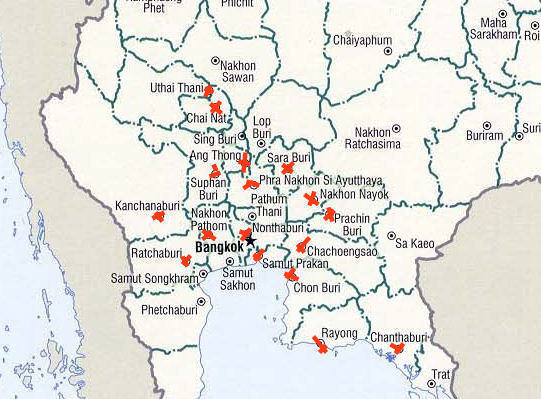
Pachtzahlung der Steuerpächter für die Steuer auf Glücksspiele:
Stadt Pacht (in Baht) für Recht der Steuererhebung Nakhon Chaisi (Nakhon Pathom - นครปฐม)
880 Ratchaburi - ราชบุรี 1160 Kanchanaburi - กาญจนบุรี 280 Suphanburi - สุพรรณบุรี 800 Ang Thong - อ่างทอง 360 Phrom Buri - พรหมบุรี 160 San Buri - สรรบุรี, Chainat - ชัยนาท 1280 Uthai Thani - อุทัยธานี, Phichit - พิจิตร 80 Saraburi - สระบุรี 600 Chachoengsao - ฉะเชิงเทรา 440 Nakhon Nayok - นครนายก 80 Prachinburi - ปราจีนบุรี 200 Bang Plasoi - บางปลาสร้อย (Chonburi - ชลบุรี) 1200 Bang Lamung - บางละมุง 160 Rayong - ระยอง 180 Chanthaburi - จันทบุรี 8000 [Datenquelle: Terwiel, Barend Jan <1941 - >: Through travellers' eyes : an approach to early nineteenth century Thai history. -- Bangkok : Duang Kamol, 1989. -- S. 104, 135, 163, 190]
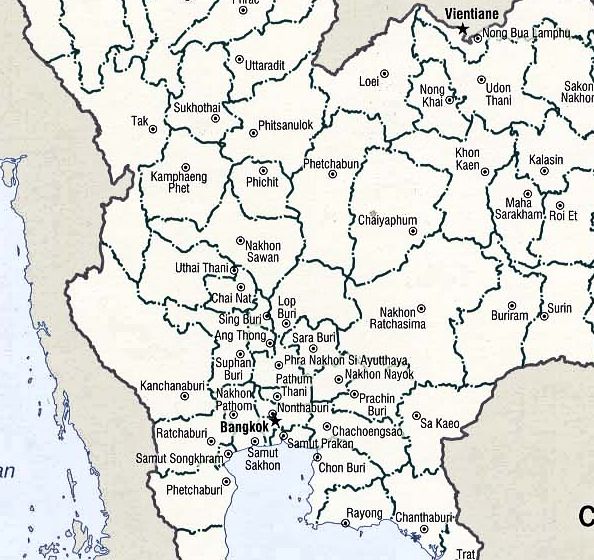
Abb.: Lage der genannten Städte
[Bildquelle: CIA. -- Public domain]
1809/1810
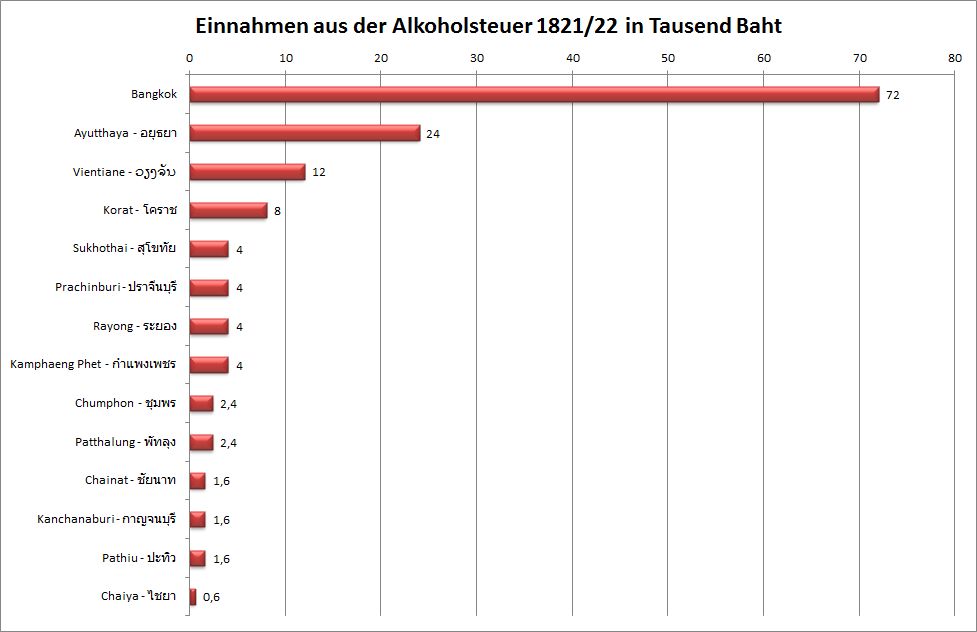
Pachtzahlung der Steuerpächter für die Steuer auf Alkohol:
Stadt Pacht (in Baht) für Recht der Steuererhebung Bangkok, Paknam - ปากน้ำ (Samut Prakan - สมุทรปราการ) 80.000 Ayutthaya - อยุธยา, Phrom Buri - พรหมบุรี, In Buri - อินทร์บุรี, Singburi - สิงห์บุรี 30.400 Saraburi - สระบุรี, Lopburi - ลพบุรี, San Buri - สรรบุรี, Ang Thong - อ่างทอง, Nakhon Sawan - นครสวรรค์, Chainat - ชัยนาท 6.560 Uthai Thani - อุทัยธานี, Kamphaeng Phet - กำแพงเพชร 1.452 Phetchabun -เพชรบูรณ์ 416 Tha Rong, Phichit - พิจิตร 1.544 Bang Plasoi - บางปลาสร้อย (Chonburi - ชลบุรี) 6.530 Bang Lamung - บางละมุง, Chanthaburi - จันทบุรี 16.000 [Datenquelle: Terwiel, Barend Jan <1941 - >: Through travellers' eyes : an approach to early nineteenth century Thai history. -- Bangkok : Duang Kamol, 1989. -- a.a.O.]
1809-09ff.

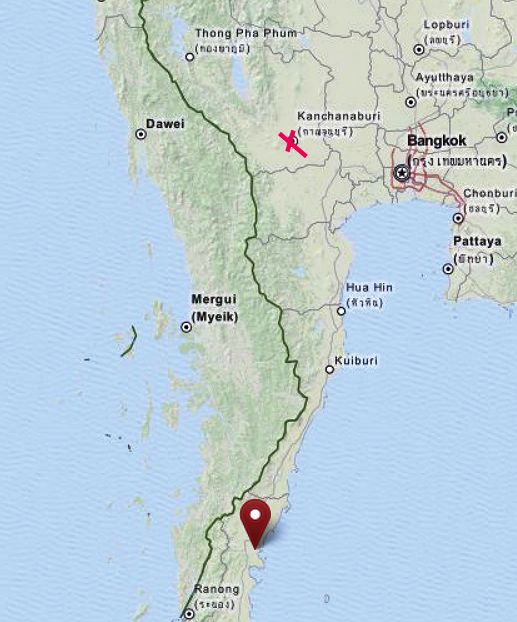
Angriff der Südarmee Burmas auf Süd-Siam. Die Südarmee wird in zwei Flügel geteilt:
- Ostflügel: 18.000 Mann: erobert Chumpon (ชุมพร)
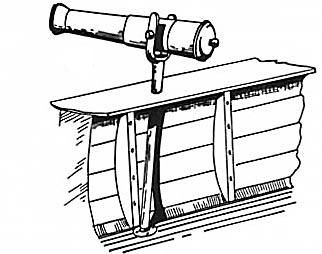
- Westflügel: 300 Kriegsboote, 10.000 Mann, 20 Kanonen, 200 Drehbassen, 3.500 Vorderlader mit Bajonetten.
Die meisten birmanischen Soldaten sind nur mit Schwertern und Speeren ausgerüstet.
Siam sendet den Hauptteil seiner Armee nach Kanchanaburi (กาญจนบุรี), um die Birmanen dort abzuwehren.
Eine siamesische Armee von über 5.000 Mann stoppt den birmanischen Vormarsch nördlich von Chumporn und treibt den birmanischen Ostflügel nach Süden Richtung Phuket (ภูเก็ต).
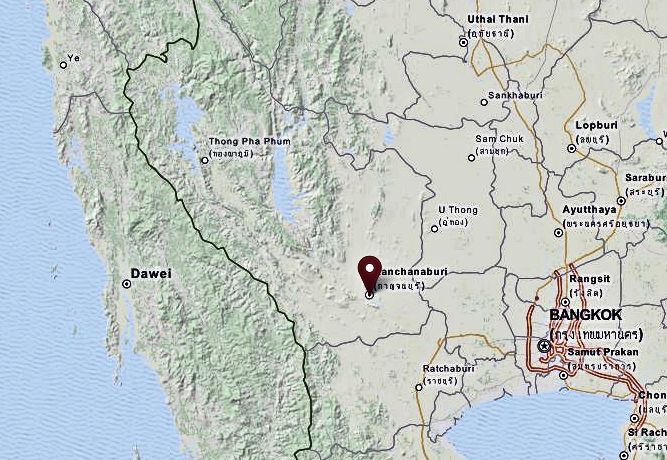
Abb.: Lage von Chumpon (ชุมพร) und Kanchanaburi (กาญจนบุรี)
[Bildquelle: OpenStreetMap. -- Creative Commons Lizenz (Namensnennung, share alike)]
Abb.: Drehbasse
1809-10-Anfang
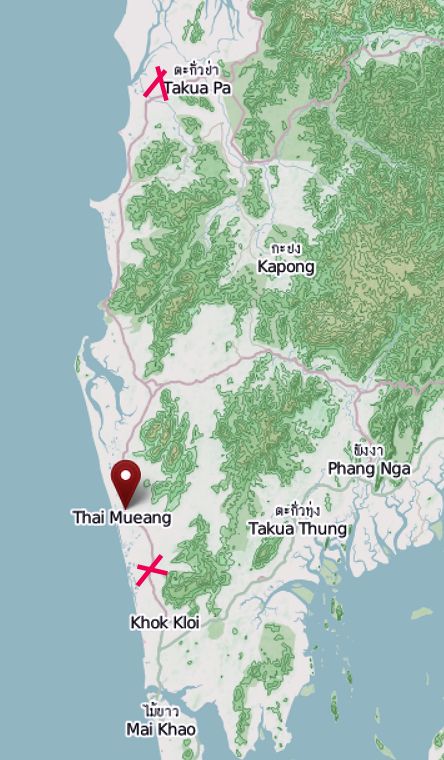
70 birmanische Kriegsboote und 3.000 Mann nehmen Ta Kuapa (ตะกั่วป่า) ein. Am darauffolgenden Tag nehmen 100 birmanische Kriegsboote mit 4.000 Mann Na Toei (นาเตย, bei Thai Mueang - ท้ายเหมือง) und Bangkhli (บางคลี) ein.
Ein birmanischer Kriegsgefangener berichtet:
"The town [Ta Kuapa - ตะกั่วป่า] did not put up any resistance, the people simply fled. We captured 13 four-inch caliber cannon, two swivel guns and nine muskets with about 2,000 sat of paddy, which was loaded aboard the ships. We also captured two old women." "There [Na Toei - นาเตย und Bangkhli - บางคลี] was no resistance; the people fled. We captured 20 cannon, five swivel guns, 13 muskets and 3,000 sat of paddy rice."
[Zitiert in: Mackay, Colin <1936 - >: A history of Phuket and the surrounding region. -- Bangkok : White Lotus, 2013. -- 438 S. : Ill. ; 25 cm. -- ISBN 978-974-480-195-1. -- S. 232]
Abb.: Lage von Ta Kuapa (ตะกั่วป่า), Na Toei (นาเตย) und und Bangkhli (บางคลี)
[Bildquelle: OpenStreetMap. -- Creative Commons Lizenz (Namensnennung, share alike)]
1809-11
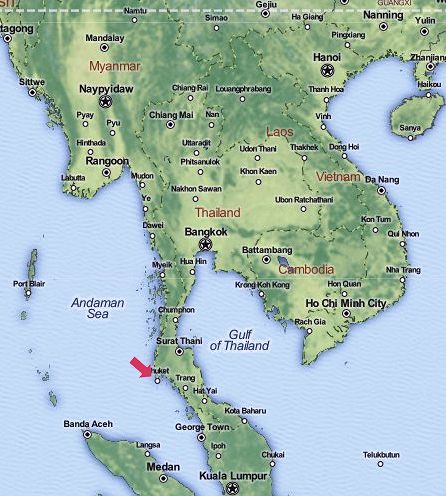
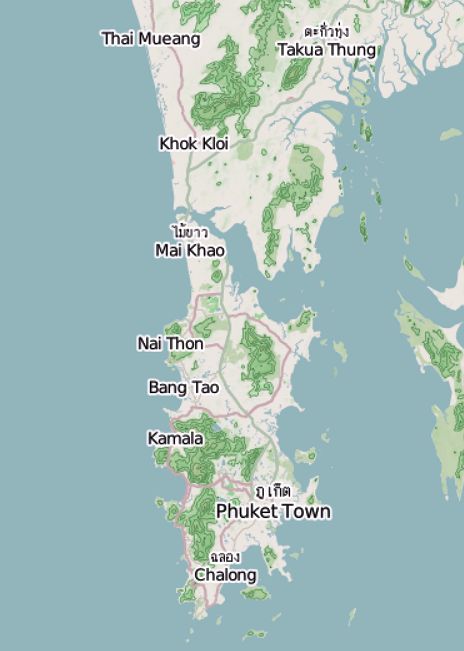
Erste Invasionen Burmas auf Phuket (ภูเก็ต).
Abb.: Lage von Phuket (ภูเก็ต)
[Bildquelle: OpenStreetMap. -- Creative Commons Lizenz (Namensnennung, share alike)]
Abb.: Karte von Phuket (ภูเก็ต)
[Bildquelle: OpenStreetMap. -- Creative Commons Lizenz (Namensnennung, share alike)]Der birmanische Kommandant der Invasionsflotte berichtet über die erste Invasion Phukets:
"General Nga-u ... ordered me to embark my 3,000 men and told Singkha Turiang to take another 3,000 men ... the two forces being ordered to meet up at Pak Pra [ปากพระ], a thousand men were left to guard the boats. My force crossed over to the village of Sakhu [สาคู] (on Phuket) where it met a Siamese patrol and a brief skirmish ensued before the Siamese withdrew. We pursued them as far as Ban Takkien [Ban Takian - บ้านตะเคียน] while the Siamese retreated to their fort at Thalang [ถลาง]. We set up camp at Ban Takkien and ... proceeded to invest Thalang by setting up fifteen stockades to cut off the town." [Zitiert in: Mackay, Colin <1936 - >: A history of Phuket and the surrounding region. -- Bangkok : White Lotus, 2013. -- 438 S. : Ill. ; 25 cm. -- ISBN 978-974-480-195-1. -- S. 233]
1809-12-17
Zweite Invasion Phukets (ภูเก็ต) durch Burma
1810 - 1825
Jao Sumon Devaraj (เจ้าสุมนเทวราช) ist Herrscher von Nan (น่าน)
1810
Erhebung der Sklaven und Frondienstpflichtigen:
"Another early decision was the ordering of a complete census of manpower, which involved checking the numbers of people for whom each nāi [นาย] was responsible, the tattooing of appropriate symbols on the wrists of subjects who had not yet been tattooed or who had changed status, and the making of a new written record. In the decree, the king decided on the following measures:
- The settling of all disputes regarding people’s registered status, during the general registration drive.
- The general announcement to reach all the run-away phrai [ไพร่], prisoners-of-war, and debt-slaves who were in hiding, to return to their old patrons. If they gave themselves up they would not be punished. If the phrai luang [ไพร่หลวง] and redeemable slaves felt unable to return to their old patrons, on this one occasion they could choose themselves a new patron. However, once they had chosen, they could not use this right again. Moreover, this right was only given to phrai in Bangkok and its immediate surroundings; provincial people had to remain in their provinces.
- The forceful arrest and imprisonment of those runaway people who did not give themselves up voluntarily-
- The tattooing of all people according to their patrons, and the punishment of all those who connived to circumvent the registration.
- The lowering of the period of corvée [ราชการ] for phrai luang in the provinces to one month of service in every four months, releasing them to work for themselves the other three months."
[Quelle: Terwiel, Barend Jan <1941 - >: A history of modern Thailand 1767 - 1942. -- St. Lucia [u. a.] : Univ. of Queensland Press, 1983. -- 379 S. ; 22 cm. -- S. 100f..]
1810

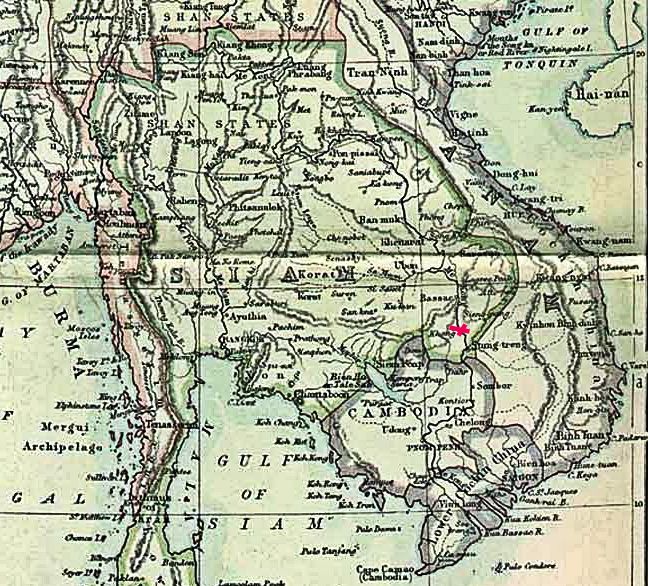
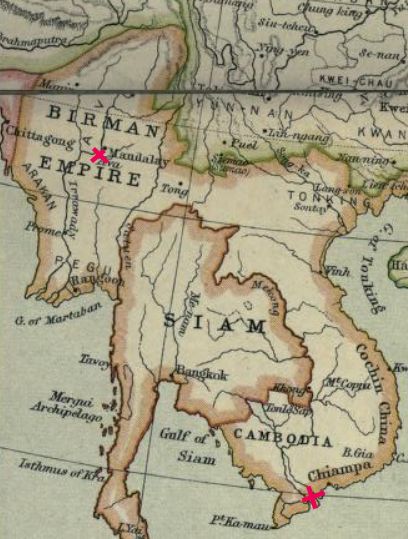
Einwanderung von Kambodschanern auf der Insel Khong (ໂຂງ) im Fürstentum Champasak (ຈຳປາສັກ)
Abb.: Lage von Khong (ໂຂງ), 1885
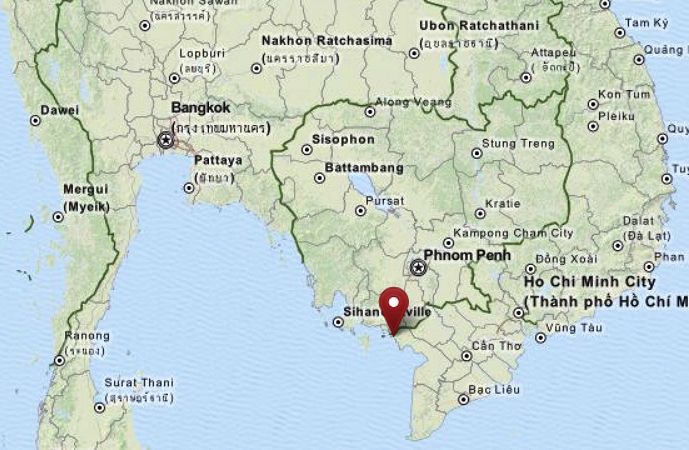
1810 (?)

Siam muss die Hafenstadt Hatien (河仙 / ព឵ម - Piem) an Vietnam (越南) abtreten.
Abb.: Lage von Hatien (河仙 / ព឵ម - Piem)
[Bildquelle: OpenStreetMap. -- Creative Commons Lizenz (Namensnennung, share alike)]
1810

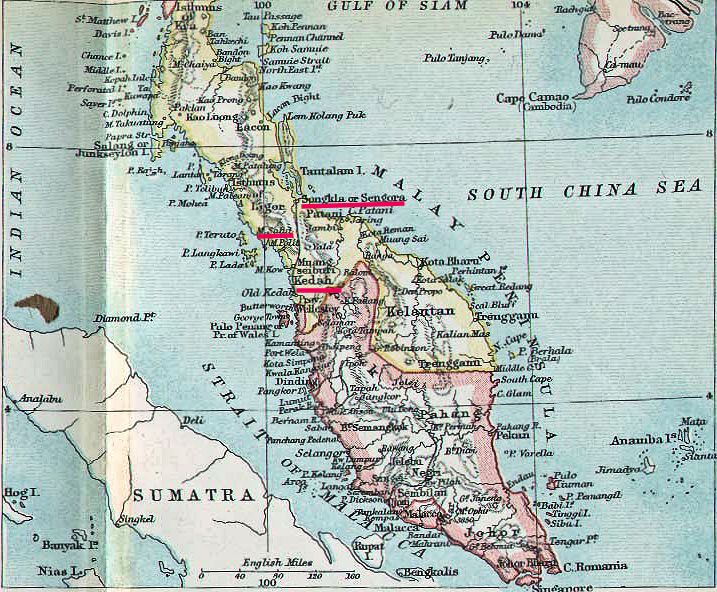
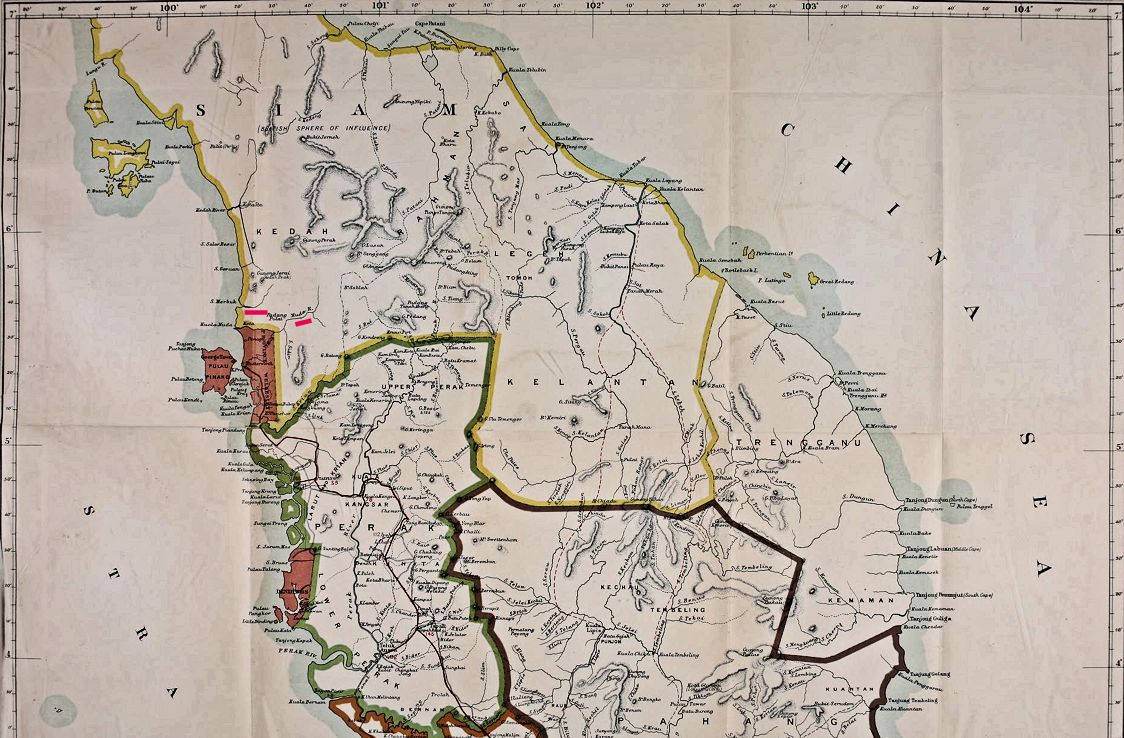
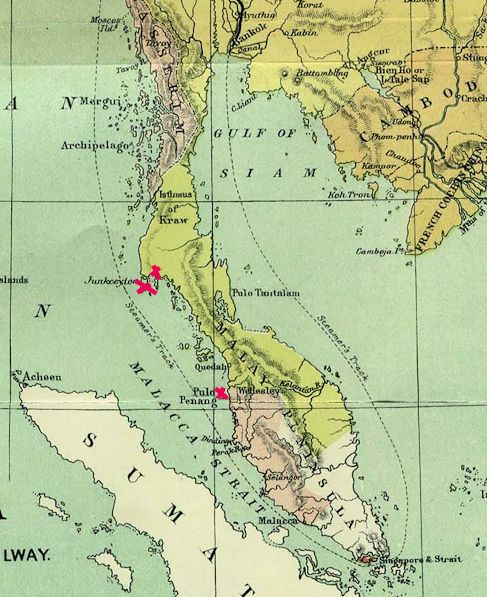
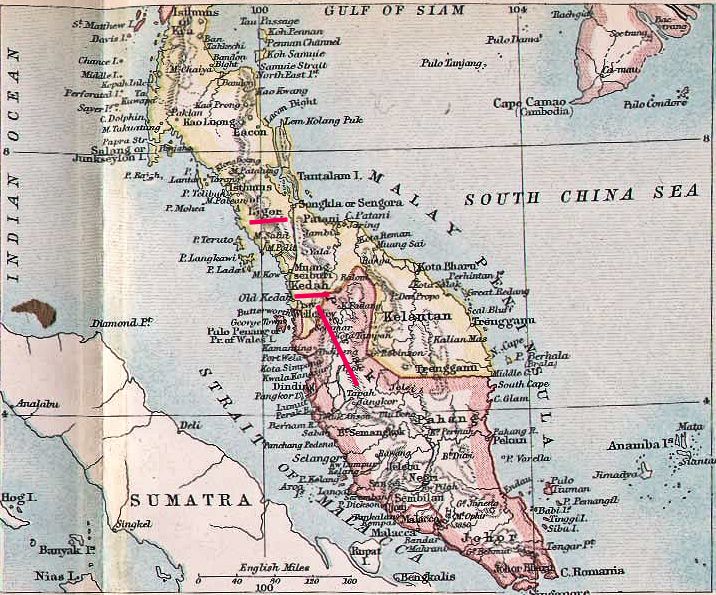
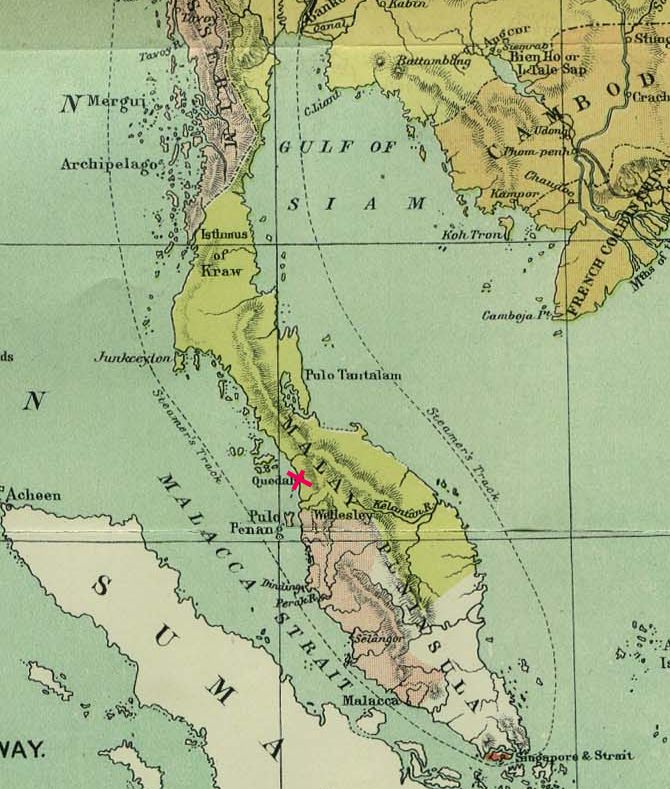
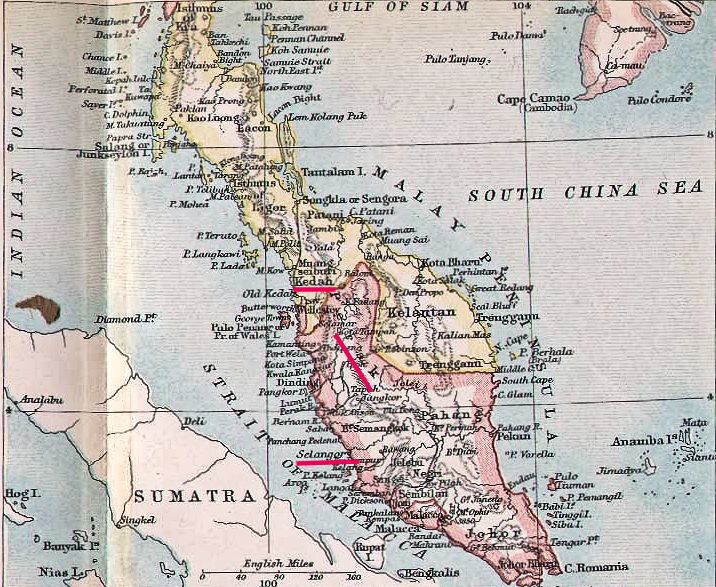
Der Gouverneur von Satun (สตูล / ساتون, Teil von Kedah), Tunku Bisnu ibni al-Marhum Sultan ‘Abdu’llah al-Mukarram Shah, der Bruder des Sultans von Kedah (قدح) geht nach Bangkok und stellt dort die Loyalität des Sultans von Kedah, Sultan Ahmad Tajuddin Halim Shah II, in Frage. Er wird dabei vom Gouverneur von Singora / Songkhla (สงขลา) unterstützt. Bangkok unterstellt darum 1811 Satun unter Singora. Tunku Bisnu bekommt die Herrschaft über die Flußtäler des Yan-, Merbok und Muda-Flusses.
Abb.: Lage von Satun (สตูล / ساتون), Kedah (قدح) und Singora / Songkhla (สงขลา)
[Bildquelle: Constables Hand Atlas of India, 1893. -- Pl. 59]
Abb.: Lage des Merbok- und Muda-Flusses
[Bildquelle: Swettenham, Frank Athelstane <1850 - 1946>: British Malaya, 1907. -- Beilage]
1810
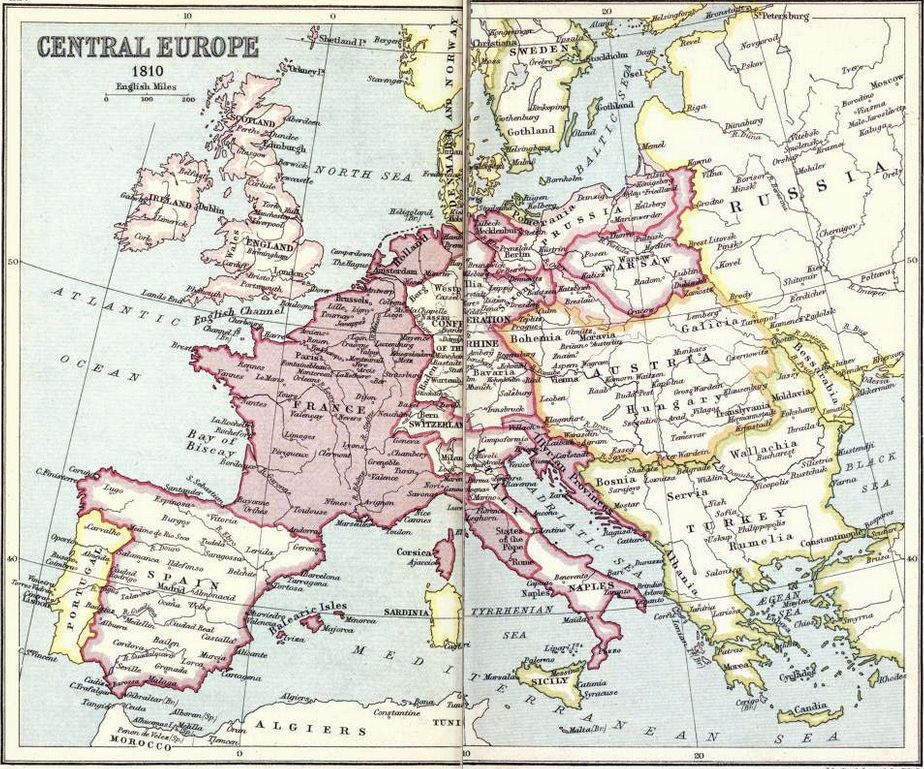
Abb.: Zentraleuropa 1810
[Bildquelle: Bartholomew, J. G. <1860 - 1920>: A literary & historical atlas
of Europe. -- London, o. J.]
1810-01
Eine alliierte siamesisch-malaiische Flotte kommt zur Befreiung Phukets (ภูเก็ต) von der birmanischen Besatzung. Verschiedene Schlachten.
1810-01-22

Der französische Missionar Jean-Baptiste-René Rabeau M.E.P. (1766 - 1810) schreibt aus Phuket (ภูเก็ต) an den Missionar Michel-Pierre Rectenwald M.E.P. (1755 - 1822) in Penang:
".... One will have already perhaps received news at Poulo-Pinang [Pulau Penang] of the storming and burning of the town and fortress of Junk- Ceylon [= Phuket - ภูเก็ต]. This news is unfortunately all too true. After a very bloody siege of four weeks, the fortress, the hope and refuge of all the inhabitants of the island, has been burnt and taken by the enemy; some of the inhabitants have been killed, a great number made prisoners, and the majority scattered about in the forests. "As for myself, I had arrived at Junk Ceylon on a Saturday, towards midnight. The following day after I
had celebrated the holy mass, I received intimation that the sign of war had been seen; that the Burmese were already disembarked, I at once took my prayer-book, and a bag of medicine which I carried with me for the relieving of the unfortunate, and I fled into the citadel. I remained there all the time of the siege, I was always in perpetual fright; but thanks to God, I received no injury. I was busy tending to the sick, visiting those who listened to the words of God, and to preach everybody the holy name of Jesus Christ. God had chosen and called to Him three adults, two of whom were Buddhist priests, and twenty small children, I baptized them all in the night when the fortress fell into the hands of the enemy."After a lot of deliberations and useless efforts in order to retain the Christians united together for the prayer, they absolutely wanted to go out of the citadel. I followed them; but having met the enemy in the middle of the citadel, the Burmese with the naked swords and spears in hand, kept us in a small hut, where we waited for a sure death. Then in accordance with the resolution I had taken at the beginning, I advanced towards them, holding a cross in my right hand, and the picture of the Holy Virgin in my left, and I said to them: ‘I am a priest of living God; I never do harm to anybody.’ God touched their heart; they put their hands on my head and on those of the Christians who followed me, and they made us sit down; they then tied us up and took my long clothe and my prayer-book, afterwards they untied us, and under the protection of one of their chiefs, they led us to a camp, put fetters to our feet and closed the exits. I remained in the open air until about ten o’clock in the morning; they would not spare us any threat nor any opprobrium. They have divested me of all my clothes, except my pants...."
These men were carried off to Mergui [မြိတ်မြို့] and then to Rangoon [ရန်ကုန်], so he related."
[Zitiert in: Manich Jumsai [มานิจ ชุมสาย] <1908 - 2009>: Popular history of Thailand. -- Bangkok : Chalermnit, 1972. -- S. 441ff.]
1810-03-10
In einer Seeschlacht bei Pak Pra (ปากพระ) schlagt die siamesisch-malaiische Flotte die Birmanen. Phuket (ภูเก็ต) wird befreit.
1810-06 - 1810-09
Dritte Invasion Burmas auf Phuket (ภูเก็ต). Nach zwei Monaten geben die Birmanen auf. Sie hinterlassen ein entvölkertes Land.
Von den 12.000 bis 15.000 Einwohnern vor der Invasion
3000 sterben an Kriegshandlungen oder Hunger
5000 werden von den Birmanen als Kriegssklaven verschleppt
5000 fliehen nach Phang Nga (พังงา)
Entlang der Küste gibt es weiterhin zahlreiche Attacken von Norden und von Süden, um Sklaven zu machen. Darum bleibt Phuket lange entvölkert.
1810-06-28


Die Generalversammlung der Kongregationalisten in Massachusetts (USA) gründet das American Board of Commissioners for Foreign Missions (ABCFM). Dieses wird aufgrund eines Antrags von Karl Gützlaff (1803 - 1851, Niederländische Missionsgesellschaft) Und Jacob Tomlin (1793 - 1880, London Missionary Society) 1831 Rev David Abeel (1804 - 1846) und Mr. Jacob Tomlin (1793 - 1880) nach Siam schicken, um die Situation zu erkunden. ABCFM sowie das American Baptist Board entsenden darauf Missionare nach Siam, unter anderen:
1833: John Taylor Jones (1802 – 1851) und seine Frau Eliza Grew Jones (1803 – 1838)
1834: Charles Robinson mit Gattin
1834: Stephen Johnson mit Gattin
1835: Dan Beach Bradley (1804 - 1873) mit Gattin Emilie, geb. Royce (1811 - 1845)
1835: William Dean (1807 - 1895) mit Gattin Theodosia Ann, geb. Barker (1819 - 1843)
1839: Jesse Caswell (1809-1848) mit Gattin Anna Turrill, geb. Hemenway (1812 - 1848)
1811 - 1834
Der katholische Bischof Esprit-Marie-Joseph Florens (1762 - 1834) ist Apostolischer Vikar für Siam.
1811
Nu (เจ้านู) Herrscher von Champasak (ຈຳປາສັກ)
"Nu (voller Thronname Somdet Brhat Chao Anuya; * im späten 18. Jahrhundert; † 1811) war 1811 für drei Tage Herrscher des von Siam abhängigen Königreichs Champasak. Nu war Sohn von Prinz No Mueang und damit Enkel von König Pothi von Champasak (reg. 1737 bis 1791). Nu wurde am Hofe und in Bangkok ausgebildet, wo er als Geisel am Hof von König Rama I. weilte. 1811 wurde er von den Siamesen zum König bestellt, doch starb er drei Tage nach seiner Inthronisation. Er hinterließ drei Söhne.
Im Anschluss folgte ein zweijähriges Interregnum, das durch die Einsetzung von König Phom Ma Noi (reg. 1813 bis 1820) beendet wurde."
[Quelle: http://de.wikipedia.org/wiki/Nu_%28Champasak%29. -- Zugriff am 2011-10-15]
1811
Birmanische Invasion in Phuket (ภูเก็ต).
1811
Erhebung und Registrierung des Grundbesitzes von Klöstern und Laien. Dient der Erhebung von Grundsteuern
1811
Verbot des Erwerbs und des Rauchens von Opium.
1811
Totenriten für und Kremation von König Rama I.
10.000 Mönche erhalten Almosen. Von den acht Himmelsrichtungen um den Meru werden Münzen in Zitronen ausgeworfen. Alte und Arme über 70 Jahre erhalten Kleidung. Es gibt Freilichtbühnen, Boxkämpfe und Feuerwerk. Es ist wirklich sanuk (สนุก).
Für die Kremation mussten folgende Mengen an Waldprodukten beigetragen werden:
Ratchaburi
ราชบุรีKanchanaburi
กาญจนบุรีSuphanburi
สุพรรณบุรีSchwere Balken 159 25 29 Mittlere Balken 300 200 150 Ngiw-Bäume (งิ้ว - Kapok-Bäume) 50 10 20 Ulok-Bäume (อุโลก - Hymenodictyon orixense) 50 10 20 Bambus 20.000 5.000 5.000 Matten 400 70 100 Rattan 1.000 400 400 Häute 30 10 10 Lederschnüre 30 10 10 Phluang-Holz (พลวง - Dipterocarpus spec.) 100 100 100 Kapok (in krams) 45 15 30 Bienenwachs (in krams) 120 60 60 [Datenquelle: Terwiel, Barend Jan <1941 - >: Through travellers' eyes : an approach to early nineteenth century Thai history. -- Bangkok : Duang Kamol, 1989. -- S. 104]
Schwere Balken Kleine Balken Bambus Matten Rattan Sandelholz Wachs (in Baht) Weiße Tücher Blätter der Nipa-Palme
Nypa fruticans WurmbAyutthaya - อยุธยา 2 40 1.000 20 0 0 2,5 70 Ang Thong - อ่างทอง 13 50 1.000 20 300 0 2,5 80 Phrom Buri - พรหมบุรี 5 30 500 20 200 0 2,5 20 Sing Buri - สิงห์บุรี 4 50 700 20 120 0 2,5 40 In Buri - อินทร์บุรี 19 50 2.000 0 300 0 0 60 San Buri - สรรค์บุรี 16 80 2.000 30 650 0 5 100 Chainat - ชัยนาท 20 60 3.000 30 600 3 3,25 70 Manoram - มโนรมย 0 20 2.000 15 700 0 2,5 10 Uthai Thani - อุทัยธานี 27 70 10.000 60 1.200 4 15 200 Nakhon Sawan - นครสวรรค์ 21 100 8.000 40 1.000 3 15 100 Kamphaeng Phet - กำแพงเพชร 15 140 10.000 70 0 7 37,5 300 Phichit - พิจิตร 14 50 5.000 30 1.100 5 15 70 Lopburi - ลพบุรี 1 40 500 15 300 0 2,5 30 Phra Phutthabat - พระพุทธบาท 29 60 100 20 500 100 0 Saraburi - สระบุรี (Laoten) 85 200 12.000 200 0 0 0 0 Saraburi - สระบุรี (Siamesen) 7 40 6.000 20 100 50 2,5 50 Khamphran - คำพราน 0 10 500 7 150 0 0 Chai Badan - ชัยบาดาล 1 30 1.500 15 150 0 0 20 Bua Chum - บัวชุม 2 40 2.000 25 200 2 2,5 30 Tha Rong - ท่าโรง 0 30 1.000 20 300 2 2,5 20 Phetchabun - เพชรบูรณ์ 29 150 10.000 100 0 10 5 700 Chachoengsao - ฉะเชิงเทรา 17 130 500 30 400 4 2,5 140.000 Nakhon Nayok - นครนายก 3 50 500 20 500 50 5 Prachinburi - ปราจีนบุรี 12 110 800 30 900 3 2,5 [Datenquelle: Terwiel, Barend Jan <1941 - >: Through travellers' eyes : an approach to early nineteenth century Thai history. -- Bangkok : Duang Kamol, 1989. -- S. 136, 138, 163]
Abb.: Übersichtskarte zu den oben genannten Orten
[Bildquelle: CIA. -- Public domain]
1811 - 1813-05-13

Siamesische Strafexpedition nach Kambodscha, weil dieses sich geweigert hatte, Siam mit Truppen gegen Burma zu unterstützen. Ab 1812-04 ist Kambodscha von Siam besetzt. Als 1813 vietnamesische Truppen einrücken, zieht sich Siam bis 1813-05-13 zurück. Die vietnamesischen Truppen bleiben in Kambodscha und ihr General hat großen Einfluss auf den kambodschanischen König Ang Chan (ឧទ័យរាជាទី២, r. 1813-05-13 - 1835-01-07).
1811-02-10

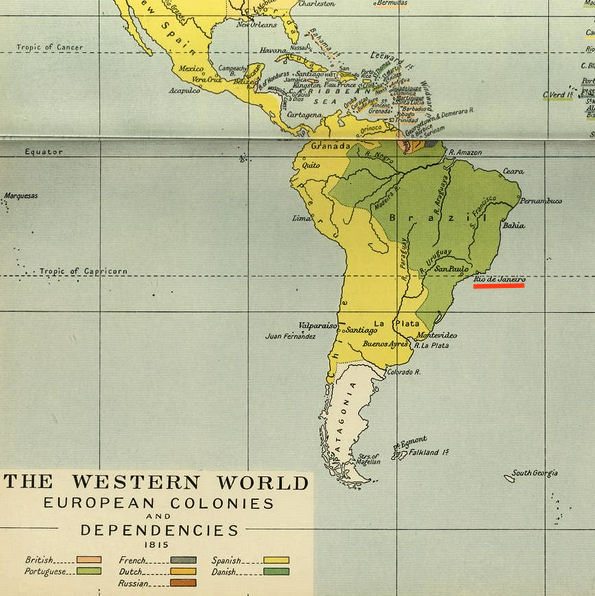
Ankunft eines portugiesischen Schiffs unter dem Kommando von Francisco Pedro de Lemos. Er überbringt einen Brief des Kronrats in Lissabon, in dem dieser mitteilt, dass der portugiesische Hof jetzt [seit 1808] in Rio de Janeiro (Brasilien) residiert.
Abb.: Lage von Rio de Janeiro
[Bildquelle: The Cambridge modern history atlas. -- Cambridge, 1912]
1811

In Siam gibt es an Christen:
1 französischer priester
7 einheimische Katecheten
3000 Katholiken
1811-09


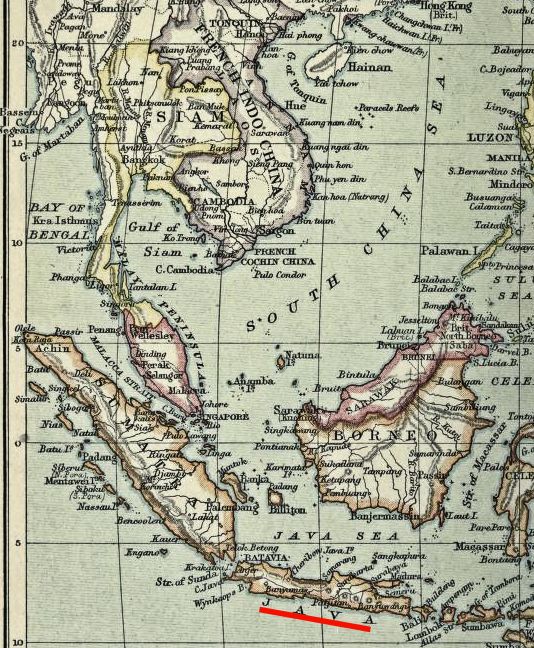
Großbritannien besetzt das seit 1810 französische (ehemals niederländische) Java.
Abb.: Lage von Java
[Bildquelle: Bartholomew, J. G. <1860 - 1920>: A literary & historical atlas of Asia. -- London, o. J.]
1811-10-06
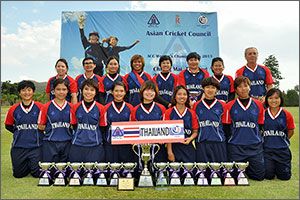
Erster Frauen-Cricket-Match: Hampshire gegen Surrey.
Abb.: Thailand national women's cricket team, 2013
[Bildquelle: http://www.asiancricket.org/index.php/members/thailand. -- Zugriff am 2013-08-17. -- Fair use]
1812
Birmanische Invasion in Phuket (ภูเก็ต).
1812

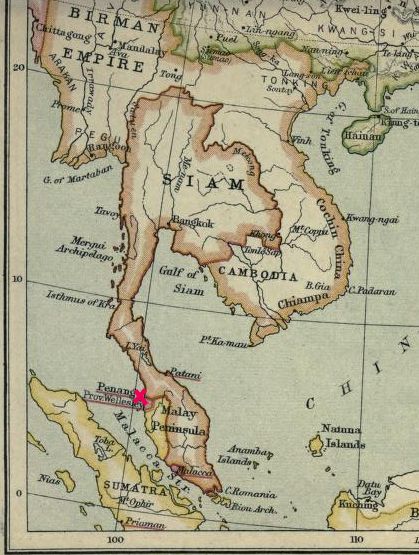
Die britische East India Company gibt ihre Pläne auf, Penang zum Flottenstützpunkt auszubauen. Penang ist zwar ausgezeichnet als Hafen geeignet, doch kann man dort keine Docks bauen. Auch sind die Bäume auf der Insel für Schiffsbau ungeeignet. Geeignetes Holz müsste aus Burma importiert werden.
Abb.: Lage von Penang
[Bildquelle: Bartholomew, J. G. <1860 - 1920>: A literary & historical atlas of Asia. -- London, o. J.]
1812
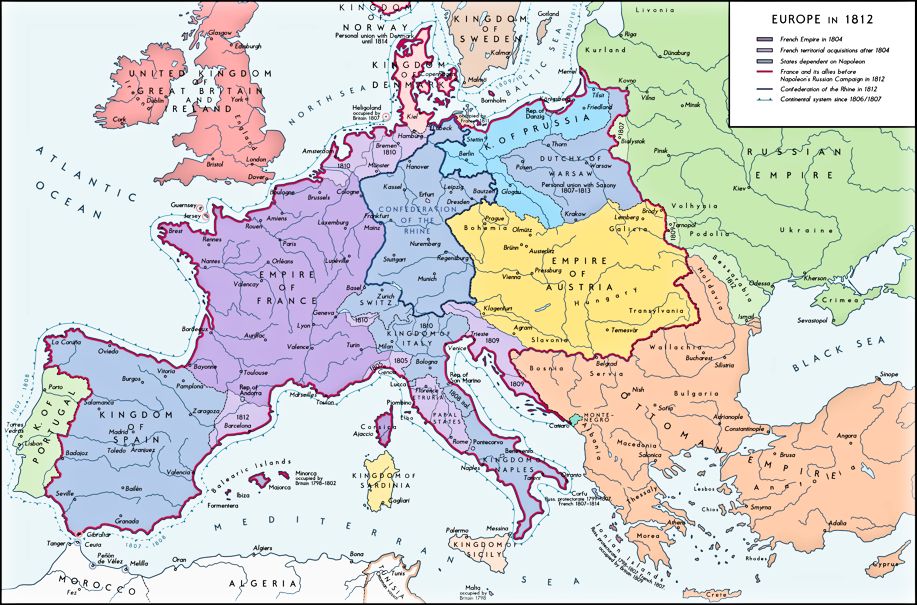
Europa 1812 zur Zeit der größten Macht Frankreichs:
Abb.: Europa 1812 vor dem Russlandfeldzug Napoleons
[Bildquelle. Alexander Altenhof / Wikipedia -- Creative Commons Lizenz (Namensnennung, share alike)]
1812


Angriffskrieg Napoleons (1769 - 1821) gegen Russland. Endet mit der völligen Vernichtung von Napoleons Armee.
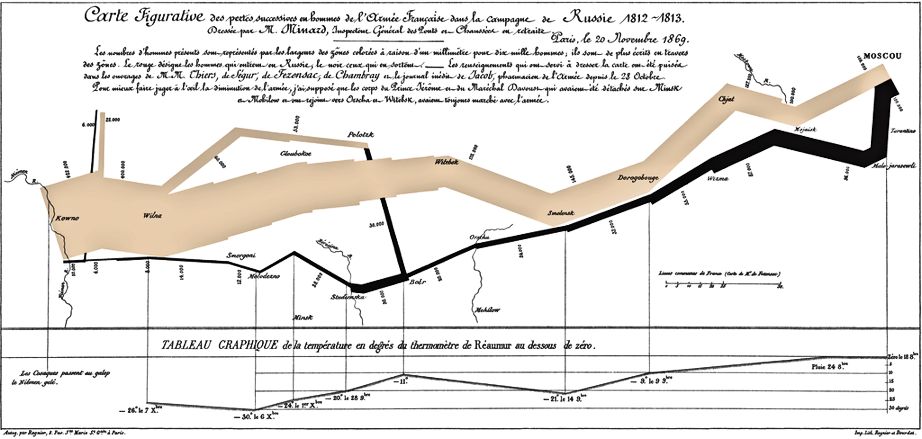
Abb.: Karte von Charles Minards aus dem Jahre 1869. Diese zeigt den Verlust an
Soldaten, die Truppenbewegungen und die Temperaturen im Laufe von Napoleons
Russlandfeldzug., 1869
Übersetzung der Legende:
"Bildhafte Karte der fortlaufenden Verluste an Männern der französischen Armee im Russlandfeldzug 1812-1813.
Ausgeführt von Herrn Minard, Generalinspektor der Ponts et Chaussées [die ehemals in Frankreich für Straßen- und Brückenbau zuständige Behörde] im Ruhestand. Paris, der 20. November 1869.Die Zahl der Männer wird durch die Breiten der farbigen Bereiche dargestellt, wobei ein Millimeter zehntausend Männern entspricht; sie sind zusätzlich im Verlauf der Bereiche beschriftet. Rot bezeichnet die Männer, die nach Russland einmarschieren, schwarz diejenigen, die es verlassen. —— Die Informationen, deren man sich zum erzeugen der Karte bedient hat, wurden den Werken der Herren Thiers, de Ségur, de Fezensac, de Chambray und dem unveröffentlichten Tagebuch von Jacob (Apotheker der Armee seit dem 28. Oktober) entnommen. Um das Schrumpfen der Armee dem Auge besser vorzuführen, habe ich unterstellt, dass die Korps des Prinzen Jérôme und des Marschalls Davoust, die sich bei Minsk und Mobilow abgespalten haben und später bei Orscha und Witebsk wieder hinzugekommen sind, die ganze Zeit mit der Armee mitmarschiert sind.
Der Massstab ist in "lieues communes de France", ein Maß, das 4,444 Kilometern entspricht, und die Temperaturen in Réaumur, die jeweils 1,25 Grad Celsius entsprechen, angegeben."
[Quelle von Abb. und Übersetzung: Wikipedia. -- Public domain]
1812

Glasgow: Durch Zufall läuft ein Dampfschiff erstmals rückwärts. Damit wird die Manövrierfähigkeit der Dampfschiffe enorm verbessert.
1812
London: der englische Boxer John Jackson (1769 - 1845) gründet den Pugilistic Club, der als erster Boxclub der Welt gilt.
1812-06-08 - 1827-04-09
Robert Banks Jenkinson, 2nd Earl of Liverpool (1770 - 1828) ist Prime Minister Großbritanniens.
1813 - 1819
Manoi (เจ้าหมาน้อย) Herrscher von Champasak (ຈຳປາສັກ)
"Manoi oder Phom Ma Noi (voller Thronname Somdet Brhat Chao Bhumi Maha Nawi; * im späten 18. Jahrhundert; † 1821 in Bangkok) war von 1813 bis 1820 Prinzgouverneur im von den Siamesen beherrschten Königreich Champasak. Manoi war ein Neffe von König Sayakumane (reg. 1738 bis 1791), sein Vater war dessen jüngster Bruder Prinz (Anga Sadet Chafa Jaya) Raja Varman Suringha (Sourinhô). Seine Ausbildung erhielt er im Elternhaus sowie in Bangkok. Er wurde nach dem Tod seines Cousins Nu 1813 zum Chao Mueang Nakhon Champasak (Prinzgouverneur von Champasakti) ernannt. Nachdem er einen größeren Aufstand im Süden des Reiches nicht eindämmen konnte, flüchtete er nach Bangkok, wo er seine letzten Tage verbrachte.
Manoi starb 1821 und hinterließ sechs Söhne."
[Quelle: http://de.wikipedia.org/wiki/Manoi. -- Zugriff am 2011-10-15]
1813/14
Kedah (قدح) bittet die British East India Company (EIC) um Intervention zu seinen Gunsten bei Siam. Die EIC lehnt ab
Offizieller Bericht der EIC:
"In the year 1818-1814 an application was received by the Government of Prince of Wales’s Island [Penang] from the King of Queda [قدح], for the friendly interference of the British Government in his favour with his superior, the King of Siam. On that occasion, the Government of Prince of Wales Island referred the question to the consideration of the Supreme Government [der EIC], when it was determined that, whatever might be the claim which the King of Qaeda might he thought to possess to the attention and regard of the British Government, our mediation for the adjustment of the differences subsisting between Siam and that country might lead us into an embarrassing participation in the interests and concerns of one or both States; and the Government of Penang was accordingly instructed to limit its proceedings to opening a communication with the King of Siam, and addressing a letter to him, framed in conformity with the views and principles which were distinctly laid down for its guidance." [Zitiert in: Frankfurter, Oscar <1852 - 1922>: The unofficial mission of John Morgan, merchant, to Siam in 1821. -- In: Journal of the Siam Society. -- 11,1 (1914/15). S. 2f.]
1813

Feierliche rituelle Badezeremonie (Nāhānatitthamaṅgala - นาหานะดิดถัมงคล) an Prinz Mongkut (เจ้าฟ้ามงกุฎ สมมติเทวาวงศ์พงษ์อิศรกษัตริย์, 1804 - 1868)
1813/1814
Hinter Wat Pho (วัดโพธิ์) ist ein Großbrand.
Abb.: Lage von Wat Pho (วัดโพธิ์)
[Bildquelle: OpenStreetMap. -- Creative Commons Lizenz (Namensnennung, share alike)]
1813

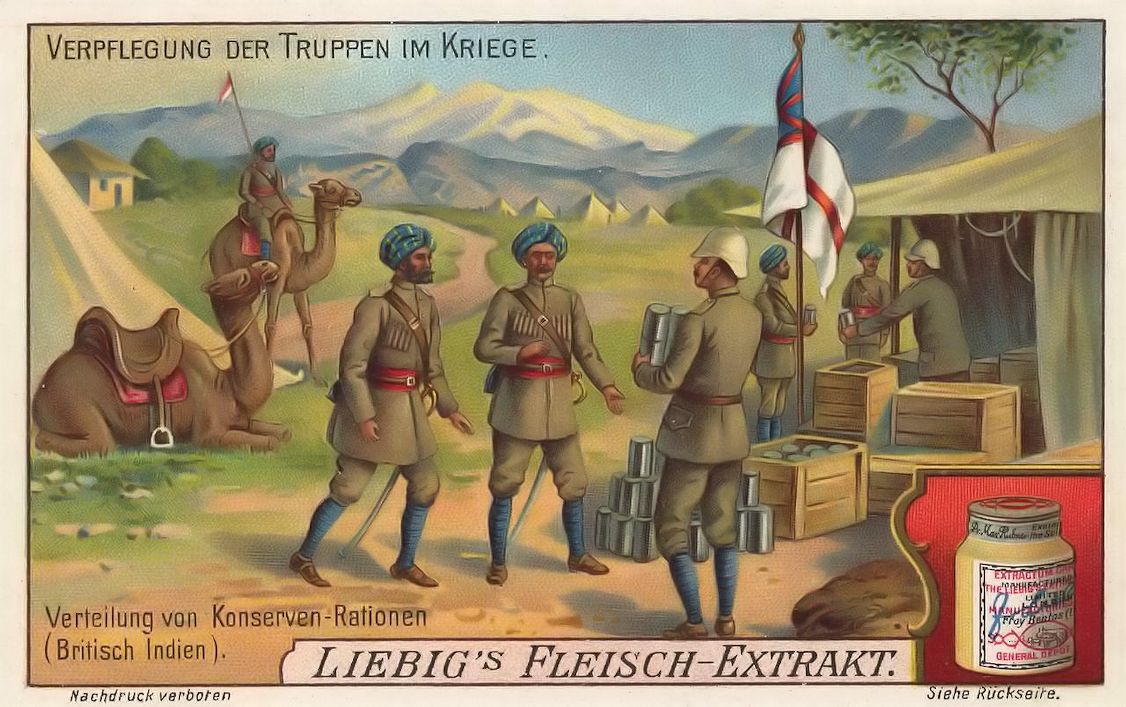
Bryan Donkin und John Hall gründen in London (Großbritannien) die erste Fabrik für Konserven in Blechdosen (tin can) und beliefern damit die Britische Armee. Für die Beschichtung des Blechs braucht man Zinn (-> Weißblech). Dadurch steigt die Nachfrage nach Zinn.
Abb.: Verpflegung der Truppen im Kriege: Verteilung von Konserven-Rationen (Britisch Indien)
[Bildquelle: Liebig's Sammelbilder, 1913]
1813
Die deutschen Musiker und Instrumentenbauer Heinrich Stölzel (1777 - 1844) und Friedrich Blühmel (1777 - 1845) erfinden die Drehbüchsenventile für Trompete und somit die erste chromatische Ventiltrompete.
Abb.: Plakat 2012
[Fair use]
1813-05-13 - 1835-01-07
Ende der Besetzung Kambodschas durch siamesische Truppen. Der Favorit Vietnams, Ang Chan (ឧទ័យរាជាទី២, r. 1813-05-13 - 1835-01-07), ist König von Kambodscha.
1813-07-21
The East India Company Act 1813 (Charter Act of 1813) beendet das Handelsmonopol der East India Company mit Ausnahme für Tee und für den Chinahandel
"The East India Company Act 1813, also known as the Charter Act of 1813, was an Act of the Parliament of the United Kingdom which renewed the charter issued to the British East India Company, and continued the Company's rule in India. However, the Company's commercial monopoly was ended, except for the tea trade and the trade with China. Reflecting the growth of British power in India, 1. The Act expressly asserted the Crown's sovereignty over British India.
2. It allotted Rs 100,000 to promote education in India.
3. Christian missionaries were allowed to come to British India and preach their religion.
The power of the provincial governments and courts in India over European British subjects was also strengthened by the Act.[2] Financial provision was also made to encourage a revival in Indian literature and for the promotion of science.[3]
The Company's charter had previously been renewed by the Charter Act of 1793, and was next renewed by the Government of India Act 1833."
[Quelle: http://en.wikipedia.org/wiki/Charter_Act_of_1813. -- Zugriff am 2013-06-13]
1813-10-04 - 1823-01-09

The Earl of Moira (1754 - 1826) ist Governor-General of the Presidency of Fort William (Kolkata, Bengal, Indien)
1813-11-16

Die Niederlage erheben sich gegen die französische Herrschaft. Am 1813-12-01 wird Willem Frederik Prins van Oranje-Nassau (1772 - 1843) zum König der Niederlande ausgerufen.
1814 - 1816-03-04

Gurkha-Krieg (Anglo-Nepalese War - नेपाल अंग्रेज युद्ध) zwischen dem nepalesischen Königreich Gorkha (गोर्ख राज्य) und der britischen Ostindien-Kompanie.
1814
Siam annektiert die kambodschanischen Provinzen
- Prey Sa
- Stung Por
- Melou Prey
- Tonle Repou
- Stung Treng (ស្ទឹងត្រែង)
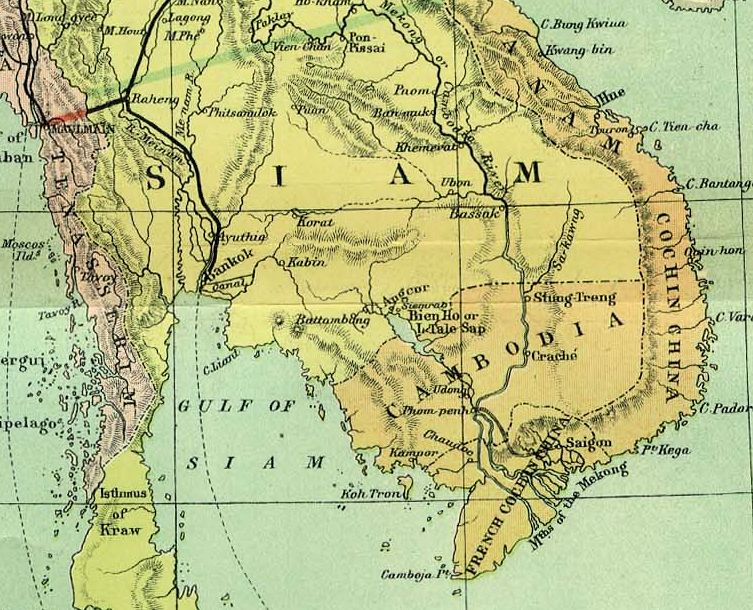
Abb.: Kambodscha 1886
[Bildquelle: Map of Indo-China showing proposed Burma-Siam-China Railway. -- In. Scottish Geographical Magazine. -- 2 (1886)]
1814


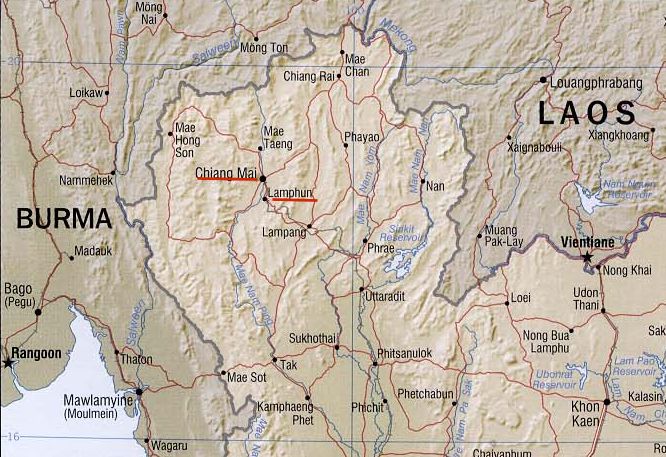
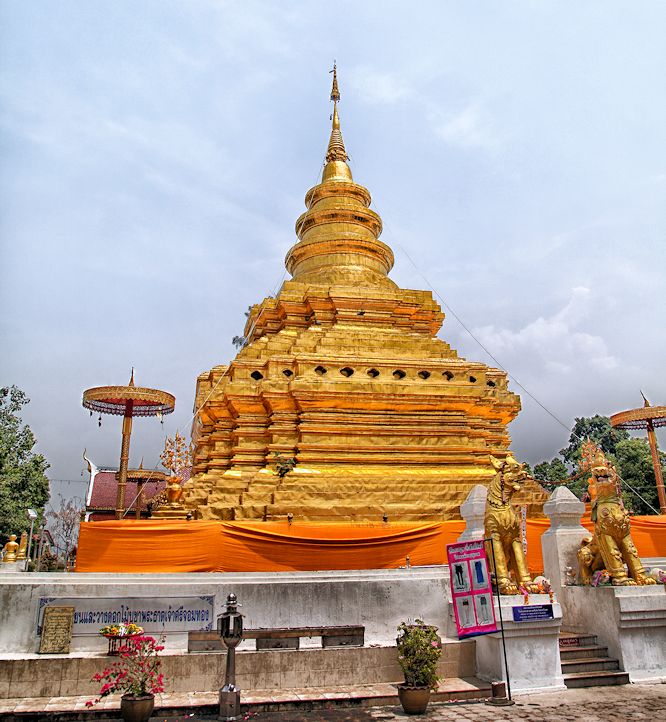
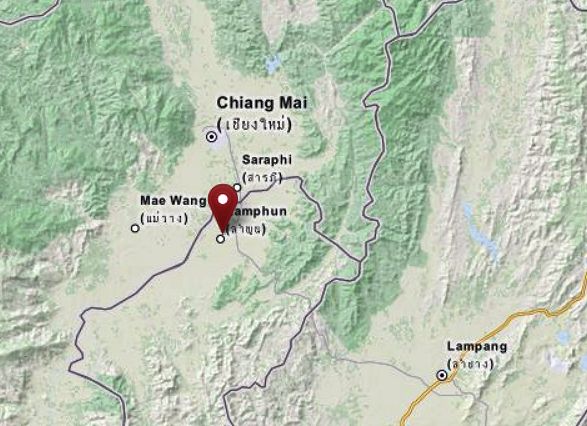
König Kawila (พระเจ้าบรมราชาธิบดีกาวิละ, 1742 - 1816) von Chiang Mai (ᨩ᩠ᨿᨦᩉ᩠ / เชียงใหม่) erhält von Rama II. die Führung über das eigenständige Fürstentum Lamphun (ลำพูน), wo ein jüngerer Bruder Kawilas regiert.
Abb.: Lage von Chiang Mai (เชียงใหม่) und Lamphun (ลำพูน)
[Bildquelle: CIA. -- Public domain]
1814
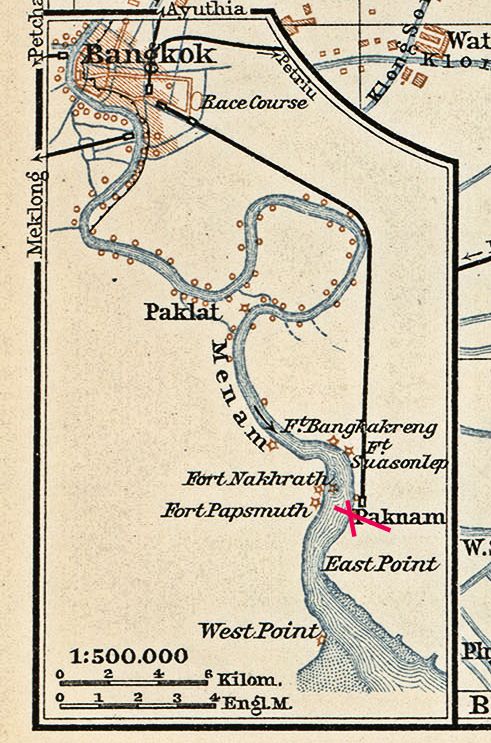
Bau von Befestigungsanlagen zwischen Bangkok und dem Meer.
1814
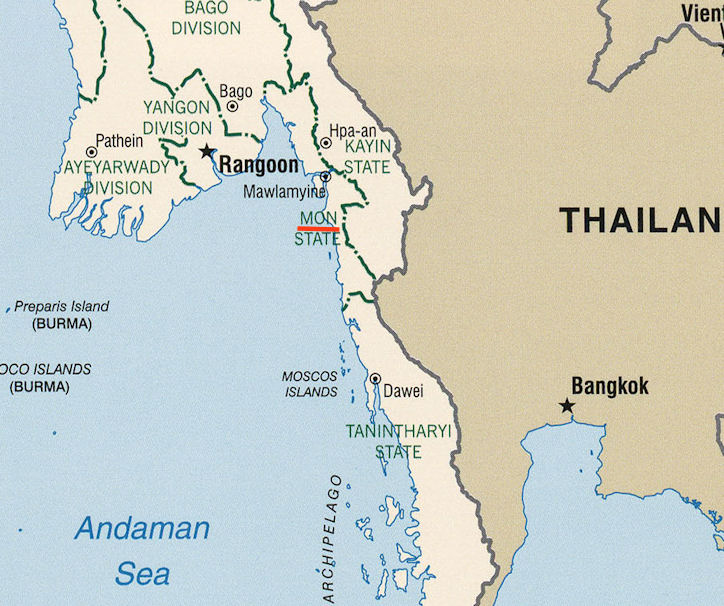
Die Birmanen schlagen einen Aufstand der Mon (မောန် / มอญ) nieder. Viele Mon fliehen nach Siam.
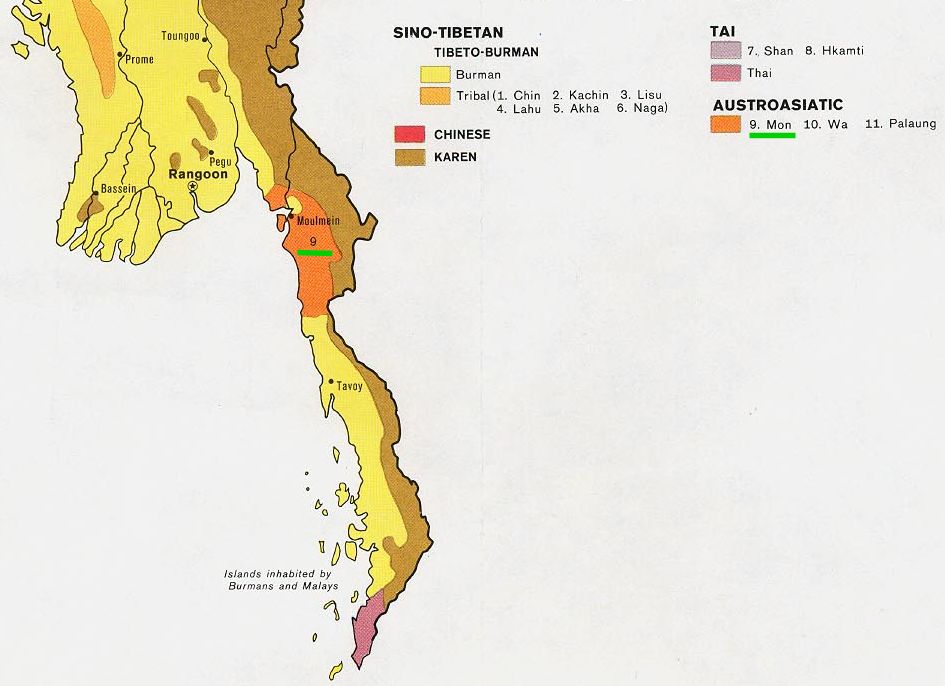
Abb.: Lebensraum der Mon (မောန် / มอญ) in Burma
[Bildquelle: CIA. -- Public domain]
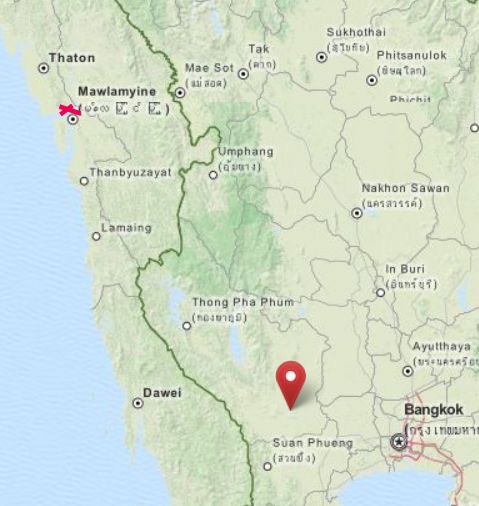
Abb.: Lage von Martaban [heute: Mottama / မိုဟ် တၟံ] und Kanchanaburi [กาญจนบุรี]
[Bildquelle: OpenStreetMap. -- Creative Commons Lizenz (Namensnennung, share alike)]
"In 1814 again there was another rebellion of the Mons in Martaban [heute: Mottama / မိုဟ် တၟံ], when a great number sought refuge in Siam. They were looked upon as desirable immigrants, and on this as on the previous occasion responsible parties were sent out from the capital to meet the fugitives and conduct them to suitable places where land was given and necessaries for their immediate needs amply provided. There is a village and monastery up the Menam [แม่น้ำเจ้าพระยา] in the Pathomthani [Pathum Thani / ปทุมธานี] district which go by the name of the Granary, and it is said that paddy was stored there for the use of the Mons. It is of interest to note that Prince Pra Chom Klao [พระจอมเกล้า, 1804 - 1868], who afterwards became King as the well known Maha Mongkut [มหามงกุฎ], then a mere boy, was appointed by the king to meet the Mons of this last immigration, at Kanchanaburi [กาญจนบุรี], and bring them to Bangkok. The King ordered three royal warboats and lictors to accompany him as a guard of honour." [Quelle: Halliday, Robert <1864 - 1933>: Immigration of the Mons into Siam. -- In: Journal of the Siam Society. -- 10,3 (1913). -- S. 5
1814
USA: Gründung der American Baptist Missionary Union (AMU). Sie entsendet Missionare u.a. nach Burma und Siam.
1814-03/04
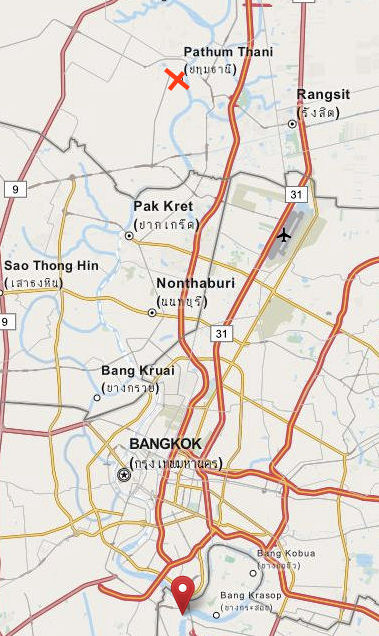
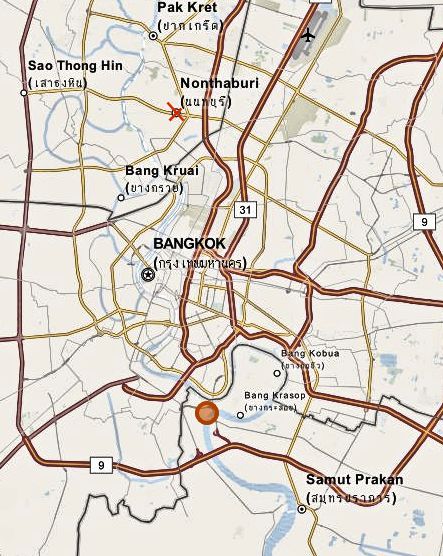
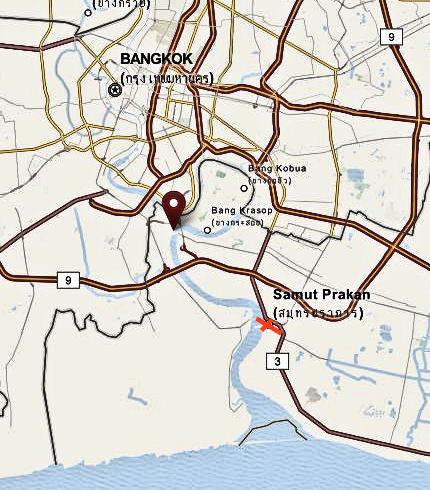
Gründung von Nakhon Khuan Khan (นครเขื่อนขันธ์ = Phra Pradaeng - พระประแดง) und Besiedlung mit 300 Mon-Familien (မောန်) von Pathum Thani (ปทุมธานี). Der Ort soll Bangkok vor Angriffen vom Meer her schützen. Dazu werden hinzu zur bestehenden Festung acht weitere Festungen gebaut. Am Ostufer des Chao Phraya (แม่น้ำเจ้าพระยา) sind jetzt vier Festungen, am Westufer fünf.
Abb.: Lage von Nakhon Khuan Khan (นครเขื่อนขันธ์ = Phra Pradaeng - พระประแดง) und Pathum Thani (ปทุมธานี)
[Bildquelle: OpenStreetMap. -- Creative Commons Lizenz (Namensnennung, share alike)]
1814-04-11 - 1824-09-16
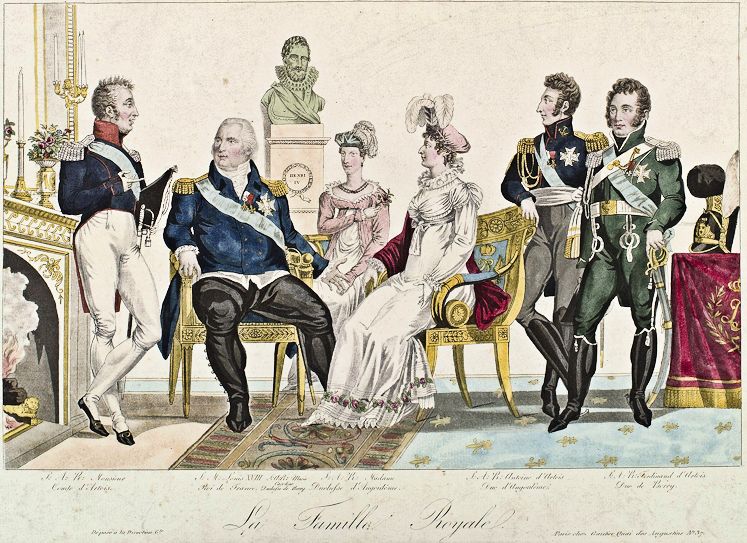
Louis XVIII. (1755 - 1824) ist König von Frankreich.
Abb.: Louis XVIII. im Kreise seiner Familie
[Bildquelle: Wikipedia. -- Public domain]
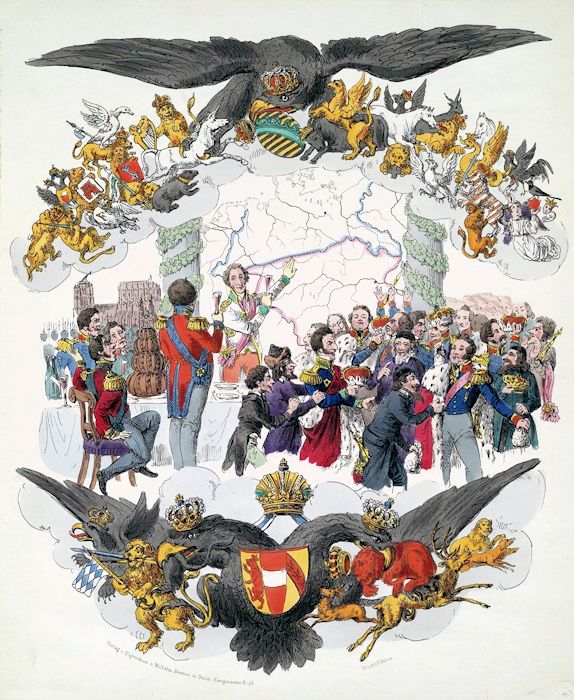
1814-09-18 - 1815-06-09
Wiener Kongress: Neuordnung Europas nach der Niederlage Napoleons.
Abb.: Der Wiener Kongress / von H. Delius
[Bildquelle: peacay. -- http://www.flickr.com/photos/bibliodyssey/3016413346/. -- Zugriff am 2013-05-27. -- Creative Commons Lizenz (Namensnennung)]
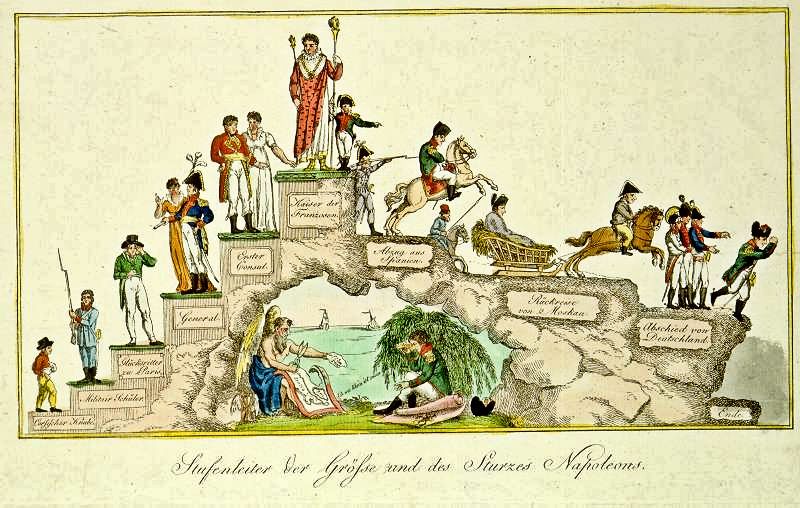
Abb.: Stufenleiter der Größe und des Sturzes Napoleons, 1814
[Bildquelle: Wikimedia. -- Public domain]
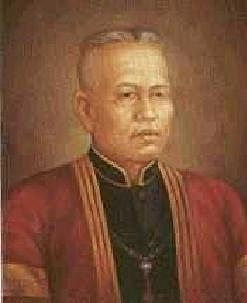
1815 - 1821
Thammalangka - พระเจ้าช้างเผือกธรรมลังกา ist König von Chiangmai.
Abb.: Thammalangka - พระเจ้าช้างเผือกธรรมลังกา
[Bildquelle: th.Wikipedia. -- Public domain]Thammalangka lässt in Chiang Mai einen Stadtmauer und einen Wassergraben bauen sowie innerhalb der Stadt einen Kanal.

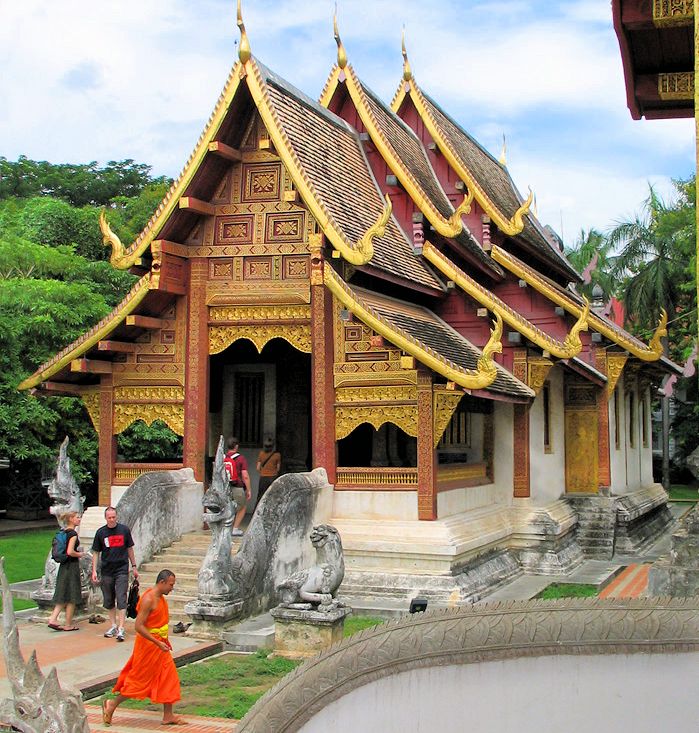
Er lässt Wat Phra Singh (วัดพระสิงห์วรมหาวิหาร) in Chiang Mai restaurieren
Abb.: Wat Phra Singh (วัดพระสิงห์วรมหาวิหาร), Viharn Lai Kham (วิหารลายคำ), 2005
[Bildquelle: Heinrich Damm / Wikimedia. -- GNU FDLicense]Er lässt auch Wat Phra That Si Chom Thong (วัดพระธาตุศรีจอมทองวรวิหาร) in Chiang Mai restaurieren
Abb.: Wat Phra That Si Chom Thong (วัดพระธาตุศรีจอมทองวรวิหาร), 2013
[Bildquelle: Kittipong khunnen / Wikimedia. -- Creative Commons Lizenz (Namensnennung, share alike)]
1815 - 1827
Phrachao Bunma (พระเจ้านครลำพูนบุญมา) (1760/61 - 1827) ist Fürst von Lamphun (ลำพูน)
Abb.: Lage von Lamphun (ลำพูน)
[Bildquelle: OpenStreetMap. -- Creative Commons Lizenz (Namensnennung, share alike)]
1815 - 1817


"The years 1815, 1816, and 1817 were probably long remembered in Siam as the years during which some shocking incidents occurred in the court. First phra’ Inthra Aphai, one of Taksin’s sons, was discovered to have been engaged in a love affair in which three of the king’s women were compromised. According to the law, all four were executed. Then the
Uparāt, the king’s full brother, became ill and died, aged thirty-seven.Not long afterwards the Sangha was shaken by a scandal. The Buddhist monk who had been chosen to become patriarch of the Siamese Buddhist church was accused of homosexual activities. A committee of three princes of kromamū’n rank investigated the matter, found the man guilty, and sent him to gaol. Unfortunately this did not conclude the matter, for kromamū’n Sīsurēn, one of the king’s half- brothers and a friend of the imprisoned man, wrote anonymously a poem on the case in which the king himself was slandered. Another committee of inquiry investigated the poem, and on grounds of style it was decided that prince Sīsurān must have been the author. During interrogation the prince died. However, the case was further investigated by the king’s eldest son, kromamū’n Čhetsadābodin, and eleven courtiers who had been involved in the production and distribution of the poem were condemned to death."
[Quelle: Terwiel, Barend Jan <1941 - >: A history of modern Thailand 1767 - 1942. -- St. Lucia [u. a.] : Univ. of Queensland Press, 1983. -- 379 S. ; 22 cm. -- S. 108.]
1815

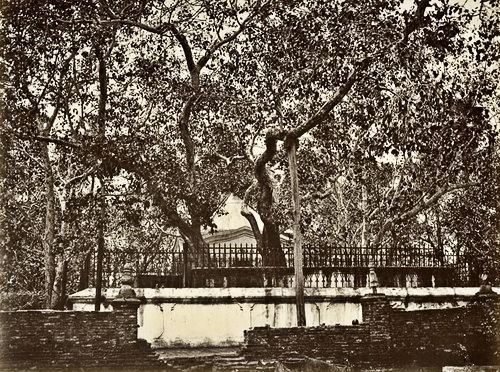
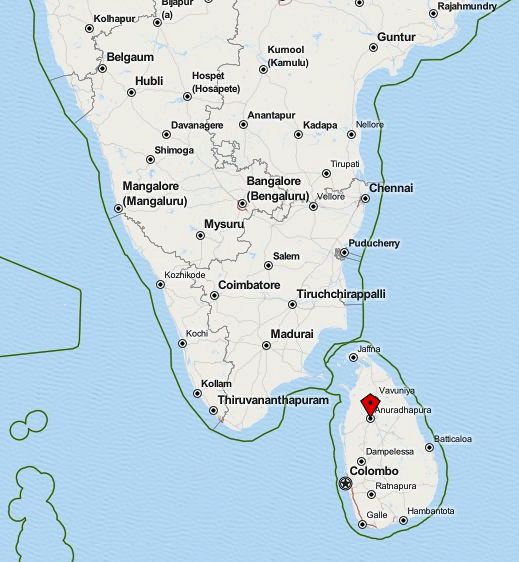
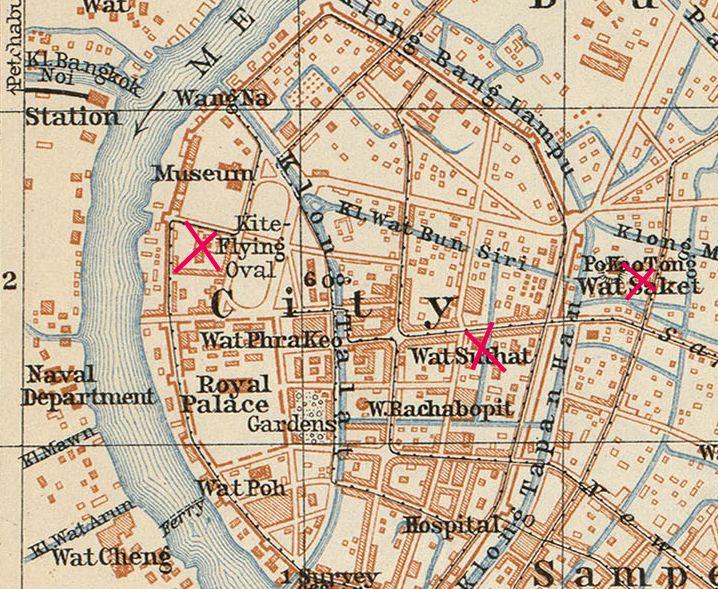
Rama II. sendet eine Delegation mit Geschenken für die Mönche nach Ceylon (Sri Lanka). Die Mönche bringen Schösslinge vom Bodhi-Baum (ජය ශ්රි මහා බොධිය) aus Anuradhapura (අනුරාධපුරය) zurück. Die Schösslinge werden gepflanzt in
- Wat Suthat (วัดสุทัศนเทพวราราม ราชวรมหาวิหาร)
- Wat Saket (วัดสระเกศราชวรมหาวิหาร)
- Wat Mahathat (วัดมหาธาตุ ยุวราชรังสฤษฎิ์ ราชวรมหาวิหาร)
Abb.: Bodhi-Baum (ජය ශ්රි මහා බොධිය), Anuradhapura (අනුරාධපුරය), 1860
Abb.: Lage von Anuradhapura (අනුරාධපුරය)
[Bildquelle: OpenStreetMap. -- Creative Commons Lizenz (Namensnennung, share alike)]
Abb.: Lage von Wat Suthat (วัดสุทัศนเทพวราราม ราชวรมหาวิหาร), Wat Saket (วัดสระเกศราชวรมหาวิหาร), Wat Mahathat (วัดมหาธาตุ ยุวราชรังสฤษฎิ์ ราชวรมหาวิหาร)
[Bildquelle: Baedeker 1914]
1815
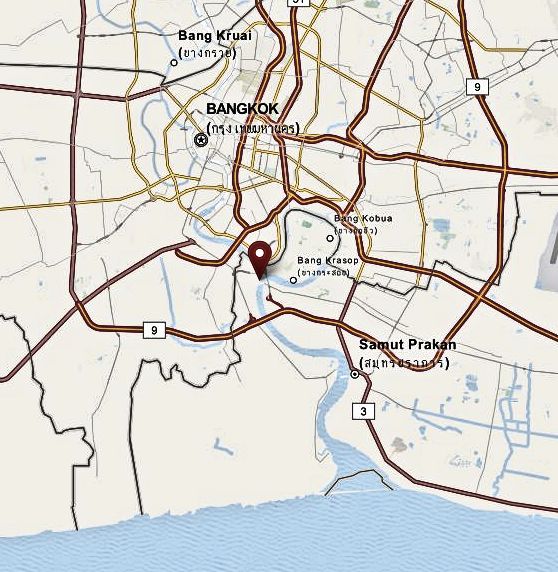
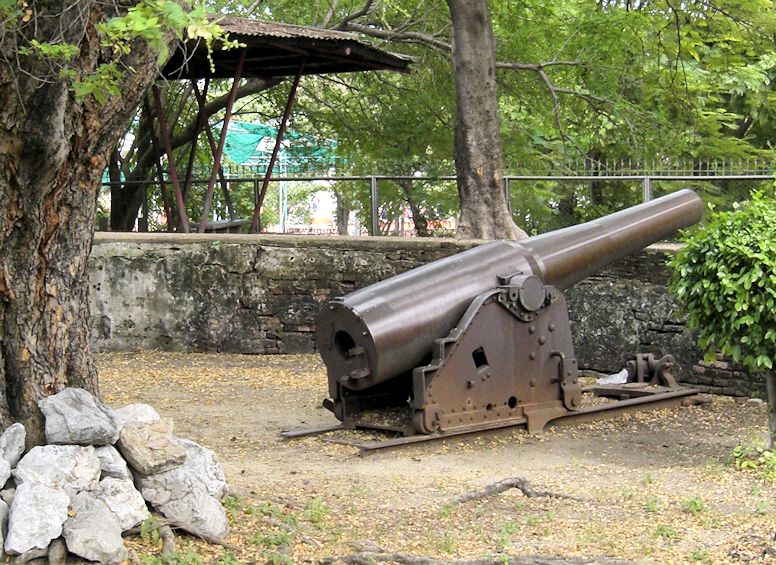
Bau von Fort Pom Phlaeng Faifa (ป้อมแผลงไฟฟ้า) in Phra Pradaeng (พระประแดง)
Abb.: Lage von Phra Pradaeng (พระประแดง)
[Bildquelle: OpenStreetMap. -- Creative Commons Lizenz (Namensnennung, share alike)]
Abb.: Fort Pom Phlaeng Faifa (ป้อมแผลงไฟฟ้า), 2007
[Bildquelle: HAH / Wikipedia. -- Creative Commons Lizenz (Namensnennung)]
ca. 1815
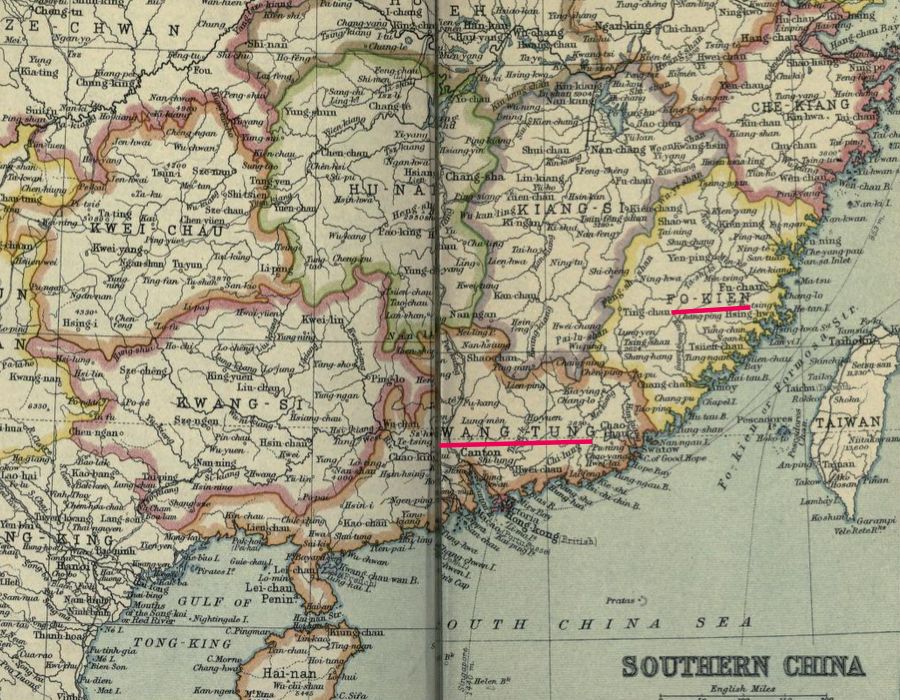
Der chinesische Fernhändler Hsieh Ching Kao (謝清高, 1765 - 1821) aus Kanton/Guangdong [廣東], der von 1795 bis 1815 Handel mit der Gegend um Phuket (ภูเก็ต) betreibt, schreibt:
"the Fukian [Fujian - 福建] and Kwantung [Guangdong - 廣東] people who come here to mine tin and to trade are very numerous." Particularly in Penang, where "the clothing, food and houses are all magnificent ... There are Fukian and Kwantung people who come here to trade. They also leave to travel two to three days northwest by land or for more than a day by sea and arrive at Yang-hsi-lang [Junk Ceylon] [Ujong Salan / Phuket - ภูเก็ต]. If they go a further three to four days by land or about a day by water they arrive at Peng—ya [攀牙] [Phang Nga] [พังงา]." [Zitiert in: Mackay, Colin <1936 - >: A history of Phuket and the surrounding region. -- Bangkok : White Lotus, 2013. -- 438 S. : Ill. ; 25 cm. -- ISBN 978-974-480-195-1. -- S. 270]
Abb.: Lage von Fujian (福建) und Guangdong (廣東)
[Bildquelle: Bartholomew, J. G. <1860 - 1920>: A literary & historical atlas of Asia. -- London, o. J.]
Abb.: Lage von Junk Ceylon (Ujong Salan) /Phuket] (ภูเก็ต), Phang Nga (พังงา) und Penang
[Bildquelle: Scottish Geographical Magazine, 1886. -- Public domain]
1815
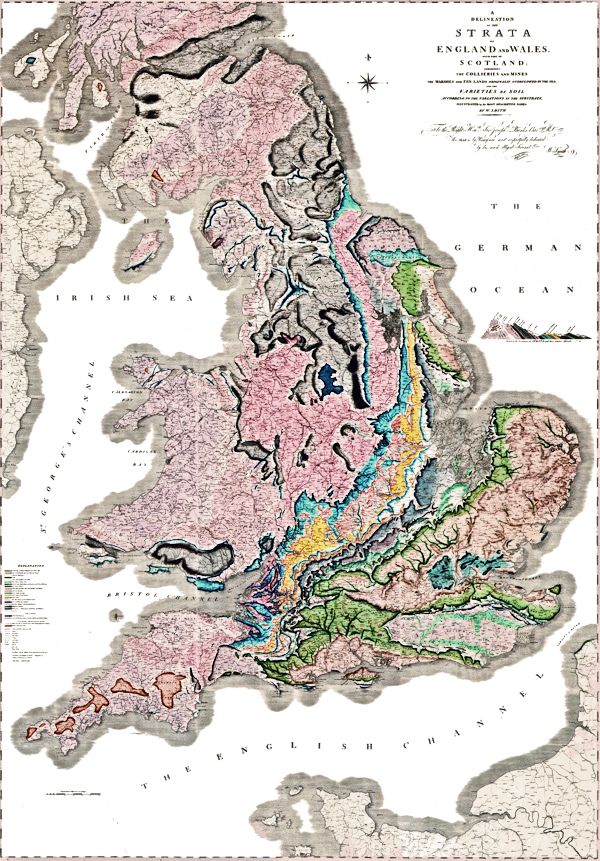
Der britische Geologe William 'Strata' Smith (1769 – 1839) veröffentlicht die geologische Karte "A delineation of the strata of England and Wales with part of Scotland". Sie ist vorbildlich für die Folgezeit.
Abb.: A delineation of the strata of England and Wales with part of Scotland
[Bildquelle: Wikimedia. -- Public domain]
1815-03-18
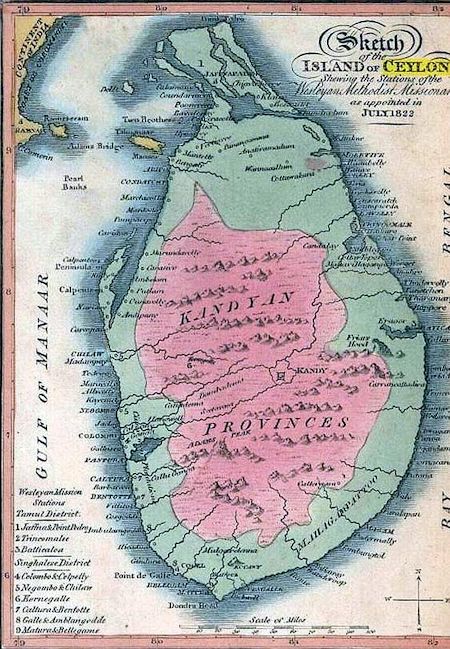
Unterzeichnung der Kandyan Convention zwischen Großbritannien und dem Königreich Kandy (සිංහලේ රාජධානිය) in Ceylon (Sri Lanka). Ende des Königreichs Kandy. Großbritannien hat ganz Ceylon unterjocht.
Abb.: Ehemaliges Königreich Kandy (සිංහලේ රාජධානිය), 1822
1815-04-10
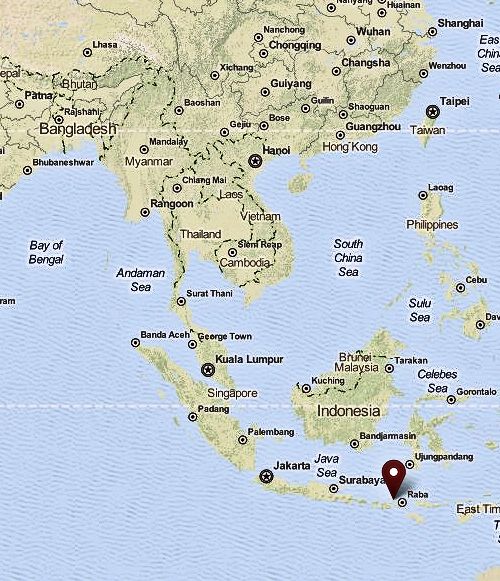
Auf der indonesischen Insel Sumbawa bricht der Stratovulkan Tambora aus. Mindestens 71.000 Tote. Das in der Erdatmosphäre kreisende Auswurfmaterial bewirkt eine globale Klimaänderung, das "Jahr ohne Sommer" 1816, das in Europa zur größten Hungersnot des 19. Jahrhunderts führt.
Abb.: Lage des Tambora
[Bildquelle: OpenStreetMap. -- Creative Commons Lizenz (Namensnennung, share alike)]
1815-06-02
Einweihung des Stadtpfeilers (Lak Mueang - หลักเมือง) von Nakhon Khuan Khan (นครเขื่อนขันธ์ = Phra Pradaeng - พระประแดง)
1815-06-09
Ende des Wiener Kongresses
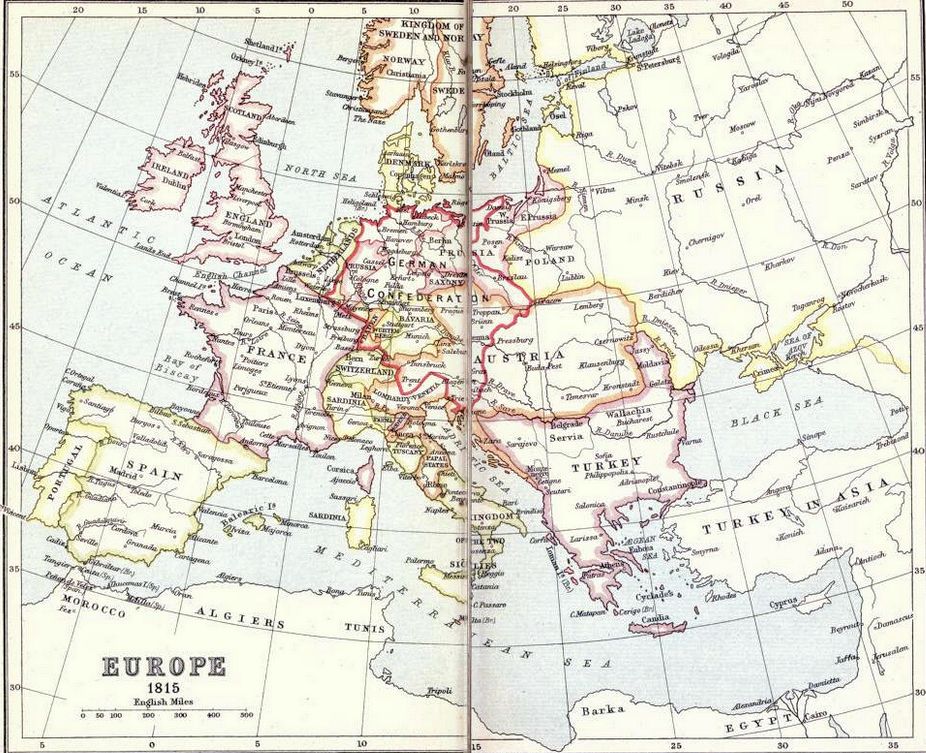
Abb.: Europa 1815 nach dem Wiener Kongress
[Bildquelle: Bartholomew, J. G. <1860 - 1920>: A literary & historical atlas
of Europe. -- London, o. J.]
1815-08-23
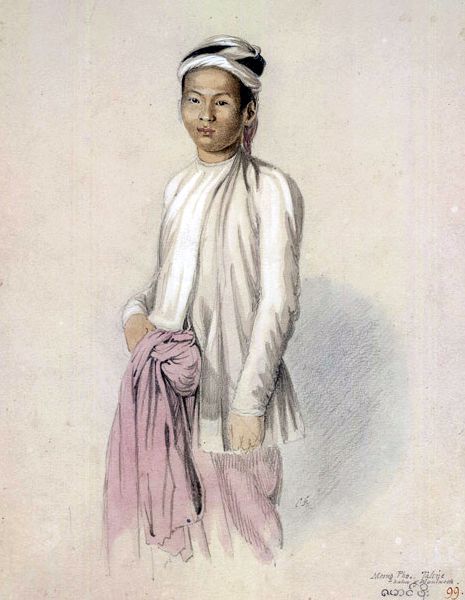
Über 40.000 Mon-Flüchtlinge (မောန်) treffen in Nonthaburi (นนทบุรี) ein und werden an verschiedenen Orten angesiedelt. Die Mons hatten 1814 gegen Burma rebelliert. Die Rebellion wird von Burma brutal niedergeschlagen. 1170 der erwachsenen Mon-Männer werden in Nakhon Khuan Khan (นครเขื่อนขันธ์ = Phra Pradaeng - พระประแดง) angesiedelt. Die Mon-Fürsten erhalten den Rang eines Phraya (พระยา).
Abb.: Lage von Nonthaburi und Nakhon Khuan Khan (นครเขื่อนขันธ์ = Phra Pradaeng - พระประแดง)
[Bildquelle: OpenStreetMap. -- Creative Commons Lizenz (Namensnennung, share alike)]
Abb.: Lebensraum der Mon (မောန်) in Burma
[Bildquelle: CIA. -- Public domain]
Abb.: Mon (မောန်) Mann 1855 / von Colesworthy Grant
[Bildquelle: Wikimedia. -- Public domain]
1815-10-29
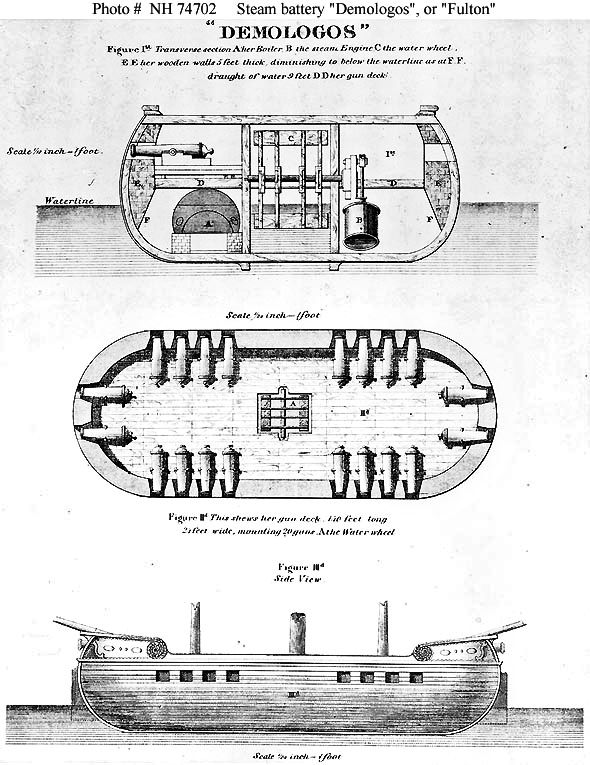
Stapellauf des ersten dampfbetriebenen Kriegsschiffs der Welt, des US-Schiffs Demologos. Es wurde vom US-Ingenieur Robert Fulton (1765 - 1815) entworfen, kommt aber nie als Kriegsschiff zum Einsatz.
Abb.: Planzeichnungen des Kriegsschiffs Demologos
[Bildquelel: Wikipedia. -- Public domain]
1816 - 1923
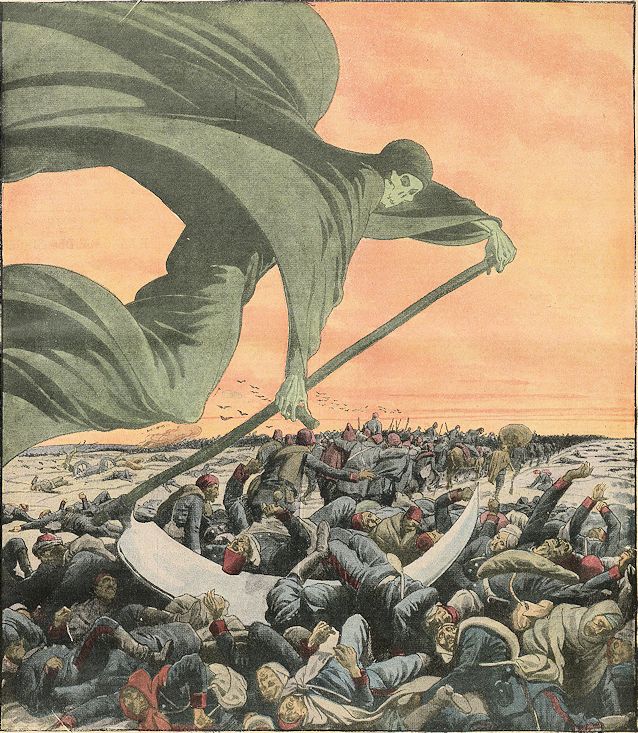
Weltweit: sechs Cholera-Pandemien
Abb.: Die Cholera
[Bildquelle: Le Petit Journal. Supplement illustré <Paris, Frankreich>. -- 1912-12-01. -- Titelblatt]
"From a local disease, cholera became one of the most widespread and deadly diseases of the 19th century, killing tens of millions of people.[50]
- First cholera pandemic 1816–1826. Previously restricted to the Indian subcontinent, the pandemic began in Bengal, then spread across India by 1820. 10,000 British troops and countless Indians died during this pandemic.[51] It extended as far as China, Indonesia (where more than 100,000 people succumbed on the island of Java alone) and the Caspian Sea before receding. Deaths in India between 1817 and 1860 are estimated to have exceeded 15 million persons. Another 23 million died between 1865 and 1917. Russian deaths during a similar period exceeded 2 million.[52]
- Second cholera pandemic 1829–1851. Reached Russia (see Cholera Riots), Hungary (about 100,000 deaths) and Germany in 1831, London in 1832 (more than 55,000 persons died in the United Kingdom),[53] France, Canada (Ontario), and United States (New York) in the same year,[54] and the Pacific coast of North America by 1834. A two-year outbreak began in England and Wales in 1848 and claimed 52,000 lives.[55] It is believed that over 150,000 Americans died of cholera between 1832 and 1849.[56]
- Third pandemic 1852–1860. Mainly affected Russia, with over a million deaths. In 1852, cholera spread east to Indonesia and later invaded China and Japan in 1854. The Philippines were infected in 1858 and Korea in 1859. In 1859, an outbreak in Bengal again led to the transmission of the disease to Iran, Iraq, Arabia and Russia.[57] Throughout Spain, cholera caused more than 236,000 deaths in 1854–55.[58] It claimed 200,000 lives in Mexico.[59]
- Fourth pandemic 1863–1875. Spread mostly in Europe and Africa. At least 30,000 of the 90,000 Mecca pilgrims fell victim to the disease. Cholera claimed 90,000 lives in Russia in 1866.[60]
- In 1866, there was an outbreak in North America. It killed some 50,000 Americans.[56]
- Fifth pandemic 1881–1896. The 1883–1887 epidemic cost 250,000 lives in Europe and at least 50,000 in Americas. Cholera claimed 267,890 lives in Russia (1892);[61] 120,000 in Spain;[62] 90,000 in Japan and 60,000 in Persia.
- In 1892, cholera contaminated the water supply of Hamburg, and caused 8606 deaths.[63]
- Sixth pandemic 1899–1923. Had little effect in Europe because of advances in public health, but Russia was badly affected again (more than 500,000 people dying of cholera during the first quarter of the 20th century).[64] The sixth pandemic killed more than 800,000 in India. The 1902–1904 cholera epidemic claimed over 200,000 lives in the Philippines.[65] 27 epidemics were recorded during pilgrimages to Mecca from the 19th century to 1930, and more than 20,000 pilgrims died of cholera during the 1907–08 hajj"
[Quelle: http://en.wikipedia.org/wiki/Pandemic#Cholera. -- Zugriff am 2013-10-03]
1816 - 1819
Somdet Phra Ariyavongsanana (Mee) - สมเด็จพระอริยวงษาญาณ (มี) (1700 (!?) - 1819) ist Sangharaja (สังฆราช)
1816

Nach Aufständen spaltet Siam das Sultanat Pattani (Kerajaan Patani - كراجأن ڤتتاني) in sieben Provinzen:
Pattani (ปัตตานี)
Nongchik (หนองจิก)
Raman (รามัน)
Rangae (ระแงะ)
Saiburi (สายบุรี)
Yala (ยะลา / Jolor)
Yaring (ยะหริ่ง)
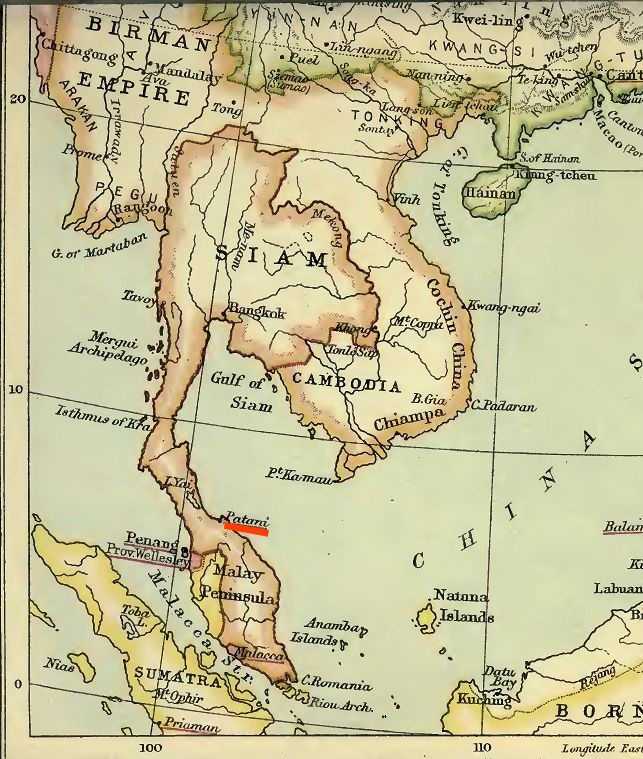
Diese Provinzen bleiben formell unter der Herrschaft des Sultans von Patani. Jede Provinz hat aber einen von Siam eingestzten Raja. Die Rajas sind Adlige aus Kedah (قدح) und Kelantan (كلنتن), die mit der Sultansfamilie von Patani verwandt sind.
Abb.: Lage von Patani (Kerajaan Patani - كراجأن ڤتتاني)
[Bildquelle: Bartholomew, J. G. <1860 - 1920>: A literary & historical atlas of Asia. -- London, o. J.]
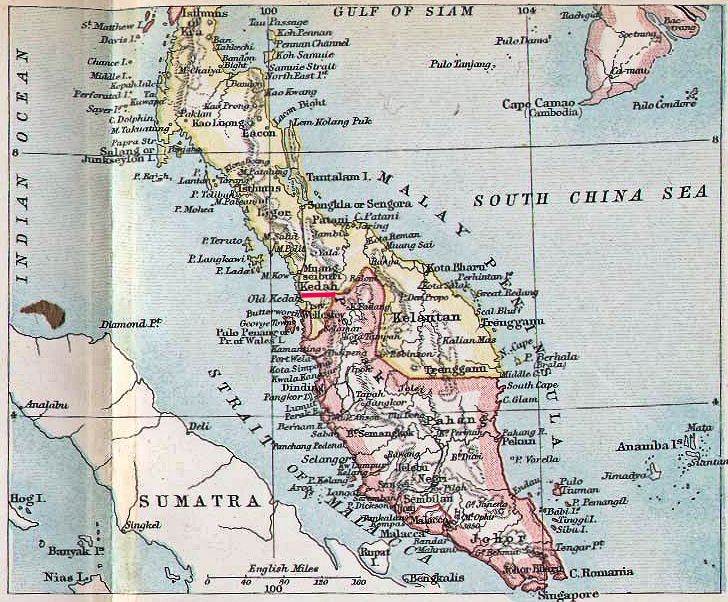
1816 - 1818
Sultanat Kedah (قدح): Bau von Bewässerungskanälen für den Reisanbau.
Abb.: Lage von Kedah (قدح)
[Bildquelle: Constables Hand Atlas of India, 1893. -- Pl. 59]
1816/1817
Großbrand bei Wat Khok (วัดโคก).
Großbrand bei Wat Thong Pu (วัดตองปู).
Feuer im Reislager vor Wat Mahathat in Bangkok (วัดมหาธาตุยุวราชรังสฤษฎิ์ราชวรมหาวิหาร).
1816/1817
Birmanische Gefangene brechen aus und töten und verwunden viele Personen.
1816 - 1843
Es erscheint
The Asiatic journal and monthly register for British and foreign India, China and Australasia. -- London : Allen. -- 1.1816 - 28.1929; N.S. 1.1830 - 40.1843
Abb.: Titelblatt 1834
1816/1817
Katastrophale Hungersnot in vielen Teilen Europas (1816 = Jahr ohne Sommer)
1816
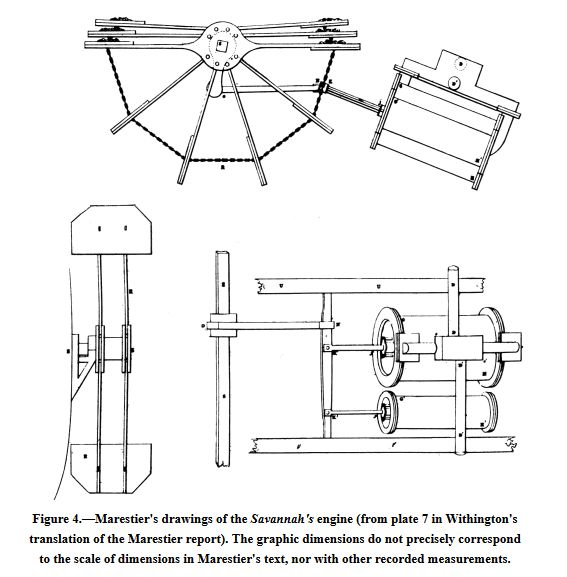
Großbritannien, führend im Dampfschiffbau, beginnt Schiffsmaschinen für Dampfschiffe zu exportieren.
Abb.: Schiffsmaschine von US-SS Savannah, 1818
[Bildquelle: http://www.gutenberg.org/files/25544/25544-h/25544-h.htm. -- Zugriff am 2013-06-25. -- Public domain]
1816
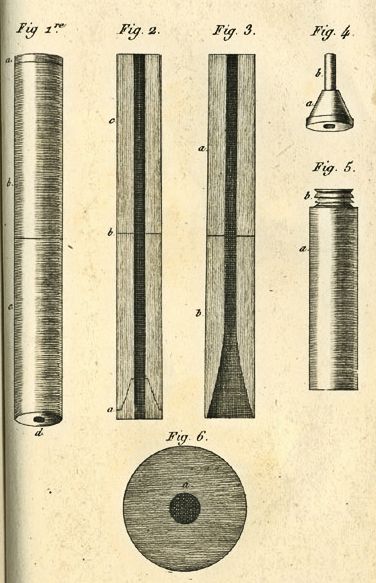
Der bretonische Arzt René-Théophile-Marie-Hyacinthe Laennec (1781 - 1826) erfindet das Stethoskop, mit dem Herz und Lunge abgehört werden können. Bisher musste man das Ohr direkt an den Körper des Abzuhörenden legen.
Abb.: Stethoskope
[Bildquelle: René-Théophile-Hyacinthe Laennec (1781-1826): De l’auscultation médiate..., 1819]
1816

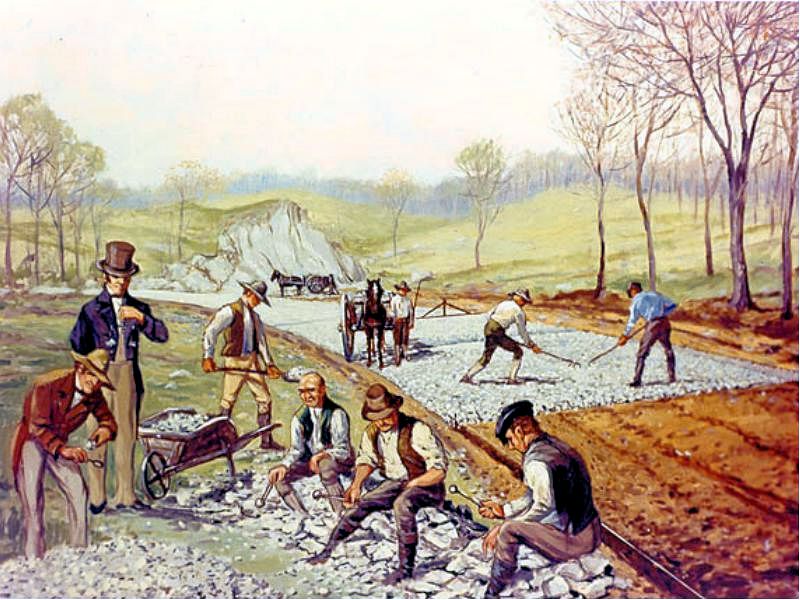
Der Schotte John Loudon McAdam (1756 - 1836) erfindet den nach ihm benannten Straßenaufbau Makadam (Macadam).
Abb.: Bau einer Makadam-Straße 1823 / von Carl Rakeman (1878 - 1965)
[Bildquelle: Federal Highway Administration / Wikimedia. -- Public domain]
"Der Begriff Makadam bezeichnet eine spezielle Bauweise von Straßen, bei der drei Schichten mit jeweils unterschiedlich großen, gebrochenen und gut verdichteten Gesteinskörnungen den Straßenoberbau bilden. Diese Bauweise wurde von dem britischen Ingenieur John Loudon McAdam zu Beginn des 19. Jahrhunderts erfunden, um die Haltbarkeit und Widerstandsfähigkeit der bestehenden Straßen (häufig Packlagen-Bauweise) zu verbessern. Derart befestigte Straßen wurden als makadamisiert bezeichnet. Diese ursprüngliche Bauweise erwies sich mit der zunehmenden Motorisierung insbesondere aufgrund der auftretenden Staubentwicklung als unzureichend. Daher ging man später dazu über, die Gesteinskörnungen mit Teer oder (seltener) mit Bitumen zu binden (teergebundener Makadam). Letztlich konnte auch diese Weiterentwicklung nicht verhindern, dass die Makadam-Bauweise durch andere Bauweisen abgelöst wurde. Gründe dafür waren insbesondere die starke Mechanisierung im Straßenbau (Makadam-Straßen lassen sich nur mit großem Anteil an Handeinbau herstellen) und die geringe Stabilität bzw. Ebenheit bei stärken Verkehrsbelastungen.
Im modernen Sprachgebrauch hat sich die Bedeutung des Begriffs „Makadam“ etwas gewandelt. Meist wird damit landläufig ein nur oberflächlich bituminös gebundener Belag bezeichnet (im Gegensatz zu Asphalt). Zudem werden wassergebundene Decken, wie sie beispielsweise beim Bau von Wirtschaftswegen zur Anwendung kommen, der Makadam-Bauweise zugerechnet."
[Quelle: http://de.wikipedia.org/wiki/Makadam. -- Zugriff am 2013-09-27]
1816-03-04
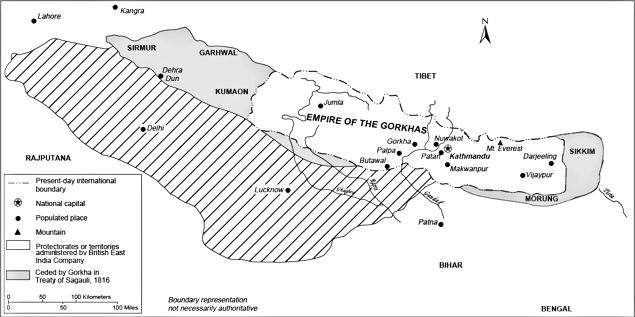
Großbritannien erzwingt militärisch, dass Nepal (Königreich Gorkha - गोर्ख राज्य) einen ständigen britischen Residenten in Kathmandu zulässt sowie britischen Gebietsansprüchen nachgibt (Vertrag von Sagauli).
Abb.: Gebietsabtretungen des Königreichs Gorkha (गोर्ख राज्य) 1816
[Bildquelle: Rebel Redcoat / Wikimedia. -- Public domain]
1816-03-20 -1826-03-10

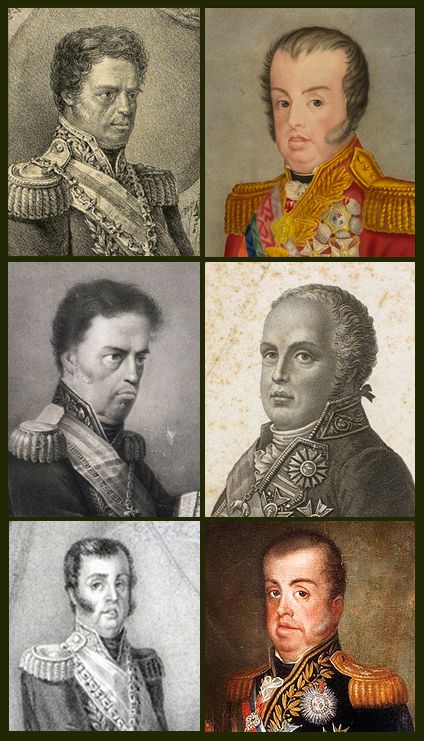
João Maria José Francisco Xavier de Paula Luís António Domingos Rafael de Bragança (1767 - 1826) ist Rei do Reino Unido de Portugal, Brasil e Algarves (König des vereinigten Königreichs von Portugal, Brasilien und den Algarven, ab 1822-09-07: König von Portugal und den Algarven).
Abb.: Zur Auswahl: João Maria José Francisco Xavier de Paula Luís António Domingos Rafael de Bragança
[Bildquelle: Wikipedia. -- Public domain]
1816-10-21

Rev. Sparke Hutchings gründet in Penang die Penang Free School. Es ist die erste Schule in Südostasien mit Englisch als Unterrichtssprache.
Abb.: Lage von Penang
[Bildquelle: Bartholomew, J. G. <1860 - 1920>: A literary & historical atlas of Asia. -- London, o. J.]
Abb.: ®Logo
[Bildquelle: Wikipedia. -- Fair use]
1817–1836
Manthatulat (เจ้ามันธาตุราช) König von Luang Prabang (ພຣະຣາຊອານາຈັກຫລວງພະບາງ)
"Manthatulat oder Manthathurath (voller Thronname Somdet Brhat Chao Maha Sri Vitha Lan Chang Hom Khao Luang Prabang Mangthaduraja; * 1772 in Luang Phrabang; † 7. März 1837 ebenda) war zwischen 1817 und 1837 König von Luang Phrabang. Manthatulat wurde 1772 als Prinz (Sadet Chao Fa Jaya) Mangthana (Mueang Thaen) geboren und war der älteste Sohn von König Anurut. Er wurde bei Hofe ausgebildet, später setzte er seine Studien im Wat Phra Kaeo (Bangkok) und im Wat Mahathat fort. 1791 wurde er zum voraussichtlichen Thronfolger ernannt und erhielt den Titel Raja Varman. Als sein Vater 1817 seinen Thron aufgab, wurde Manthatulat Regent des Reiches, nach dem Tod seines Vaters am 31. Dezember 1819 auch König von Luang Phrabang. Die Krönung fand 1820 in Luang Phrabang statt. Zwischen 1825 und 1826 diente er als buddhistischer Mönch in Bangkok und kehrte anschließend auf den Thron zurück.
Manthatulat war mehrmals verheiratet und hinterließ nach seinem Tod am 7. März 1837 neun Söhne und sechs Töchter."
[Quelle: http://de.wikipedia.org/wiki/Manthatulat. -- Zugriff am 2011-10-15]
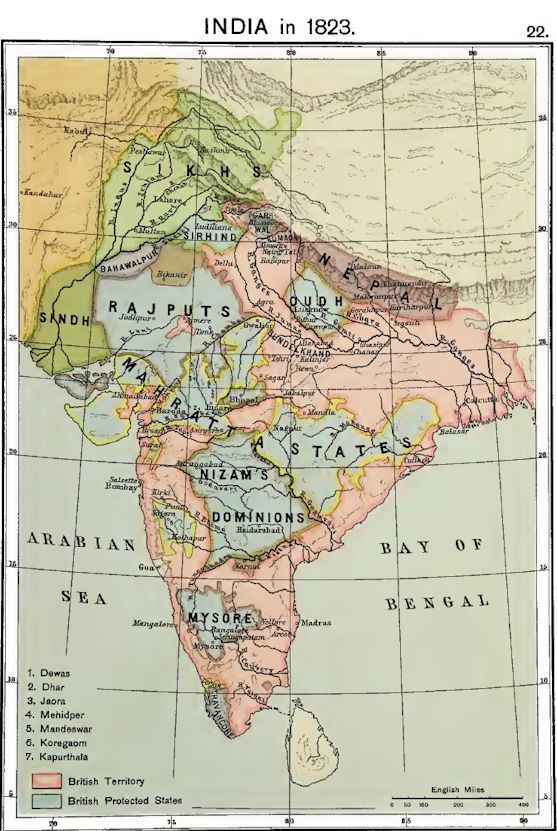
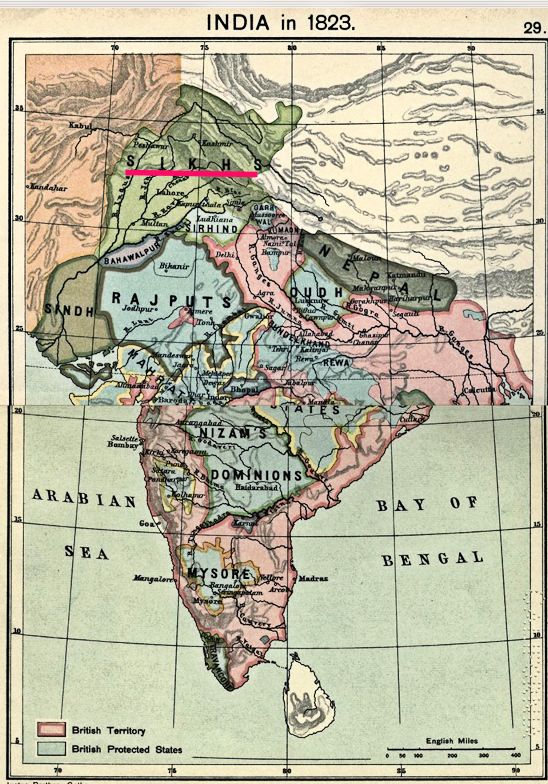
1817 - 1818
Third Anglo Maratha-War zwischen der British East India Company und dem indischen Marathenreich.
Abb.: Indien nach dem Third Anglo-Maratha War, 1823
[Bildquelle: Joppen, Charles <1878 - >: Historical atlas of India for the use of high schools, colleges, and private students. -- London : Longmans, 1907.]
1817/1818
Feuer bei Saphan Han (สะพานหัน)
Abb.: Lage von Saphan Han (สะพานหัน)
[Bildquelle: OpenStreetMap. -- Creative Commons Lizenz (Namensnennung, share alike)]
1817
Nāi Nok verbrennt sich selbst, um ins Nirwana einzugehen. Viele Leute verehren seinen Leichnam.
1817
Invasion Kedah's (قدح) in Perak (ڤيرق). Rama II. belohnt den Sultan von Kedah, Sultan Ahmad Tajuddin Halim Shah II, mit dem Titel Chao Phraya (จ้าพระยา). Der Gouverneur von Ligor (ลิกอร์ = Nakhon Si Thammarat - ครศรีธรรมราช) ist beleidigt, dass der Sultan einen höheren Rang hat als er selbst und verschwört sich mit Vizekönig (raja muda) von Kedah, Tunku Yaakob, gegen den Sultan von Kedah. Sie beschuldigen den Sultan dafür, dass er ein schlechter Herrscher sei, sich nicht nach Bangkok und Ligor begeben hat, um sich bestätigen zu lassen, und dass er mit den Birmanen konspiriert. Dies führt zu den Vorgängen 1821 (s. unten).
Abb.: Lage von Ligor (ลิกอร์ = Nakhon Si Thammarat - ครศรีธรรมราช), Kedah's (قدح) und Perak (ڤيرق)
[Bildquelle: Constables Hand Atlas of India, 1893. -- Pl. 59]
1817-02-25
Beginn der feierlichen siebentägigen Haarschneidezeremonie (Chūlākantamangala - จูฬากันตะมงคล) von Prinz Mongkut (เจ้าฟ้ามงกุฎ สมมติเทวาวงศ์พงษ์อิศรกษัตริย์, 1804 - 1868), dem künftigen Rama IV. Es ist das erste Mal in der Cakri-Dynastie, dass diese Zeremonie mit dieser Feierlichkeit durchgeführt wird. Nach der zeremonie bekommt Mongkut seinen eigenen Palast und ein Harem.
1817-03-04 - 1825-03-04
James Monroe (1758 - 1831) ist Präsident der USA.
Abb.: James Monroe 1819 / von Samuel Morse (1791 - 1872)
[Bildquelle. Wikimedia. -- Public domain]
1817-05
Erstmals wird Visākhapūjā (วันวิสาขบูชา) als Staatsfeiertag gefeiert. An diesem Feiertag werden zugleich Buddha Gotamas Geburt, erlösende Einsicht und endgültiges Erlöschen gefeiert.
1817-06

Perak (ڤيرق) ist gezwungen, Bunga Mas (بوڠا مس / ต้นไม้เงินต้นไม้ทอง) nach Bangkok zu schicken als Zeichen der Gefolgstreue.
1817-07-16
Tod von Somdet Phra Bawornrajchao Maha Senanurak (สมเด็จพระบวรราชเจ้ามหาเสนานุรักษ์; geb. 1773-03-29), Front Palace (Uparaj) (กรมพระราชวังบวรสถานมงคล)
1817-10-31 - 1846-02-21

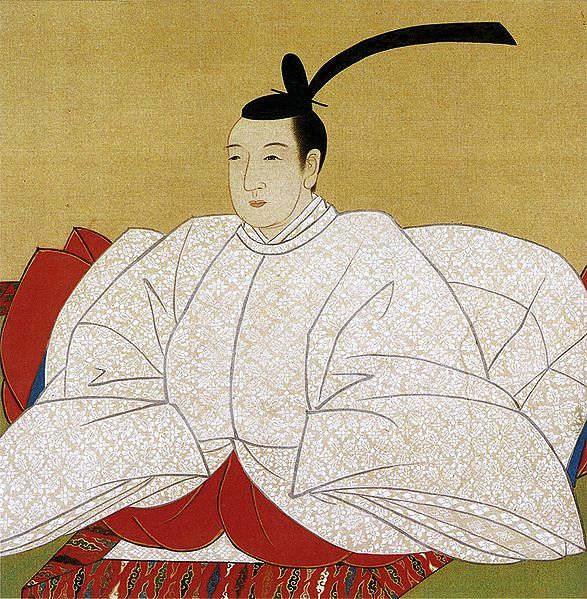
Ninkō (仁孝天皇, 1800 - 1846) ist Tenno (天皇) von Japan. Persönlicher Name: Ayahito (恵仁)
Abb.: Ninkō (仁孝天皇) / von Toyooka Harusuke (豊岡治資)
[Bildquelle: Wikipedia. -- Public domain]
1818

Prinz Mongkut (เจ้าฟ้ามงกุฎ สมมติเทวาวงศ์พงษ์อิศรกษัตริย์, 18104 - 1868) ist sieben Monate lang buddhistischer Novize im Wat Mahathat (วัดมหาธาตุยุวราชรังสฤษฎิ์ราชวรมหาวิหาร).
Abb.: Lage des Wat Mahathat (วัดมหาธาตุยุวราชรังสฤษฎิ์ราชวรมหาวิหาร)
[Bildquelle: OpenStreetMap. -- Creative Commons Lizenz (Namensnennung, share alike)]
1818
Aufgrund von Berichten seiner Tributdelegation über Parkanlagen des Kaisers von China mit Tieren und seltenen Pflanzen lässt Rama II. von Fronarbeitern einen Park mit künstlichen Seen und Inseln sowie Pavillons anlegen.
1818
Schweres Gewitter in Ayutthaya (อยุธยา) beschädigt drei Klöster.
Abb.: Lage von Ayutthaya (อยุธยา)
[Bildquelle: OpenStreetMap. -- Creative Commons Lizenz (Namensnennung, share alike)]
1818
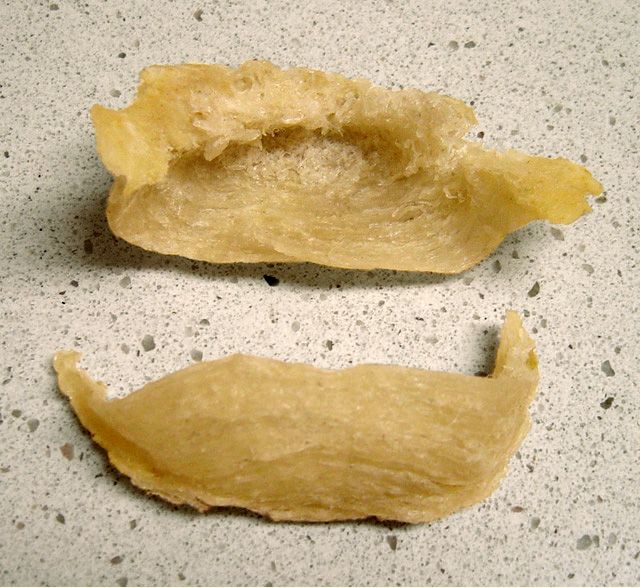
Burma besetzt Phuket (ภูเก็ต) als Vergeltung dafür, dass Malaien von Phuket chinesische und birmanische Boote angegriffen hatten, die essbare Vogelnester (Nester der Salanganen Aerodramus spp.) sammelten.
Abb.: Essbare Vogelnester
[Bildquelle: Rainer Zenz / Wikimedia. -- GNU FDLizenz]
1818
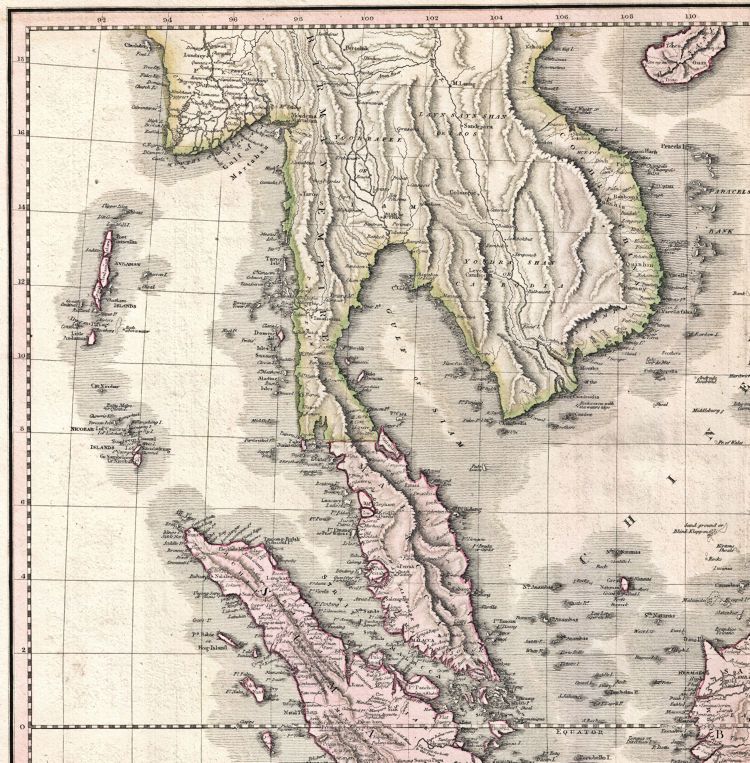
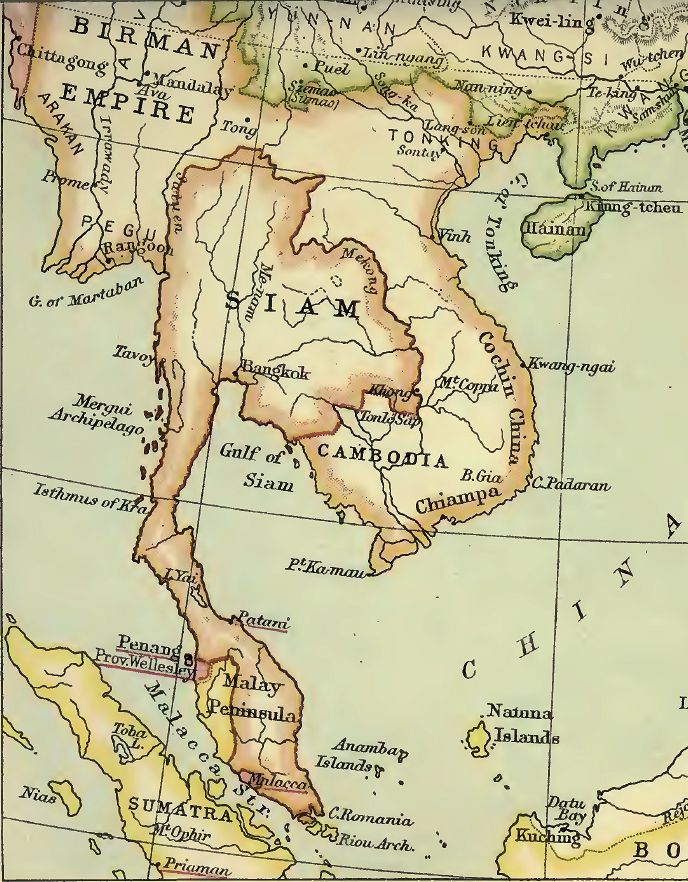
Abb.: Siam (Kartenausschnitt)
[Bildquelle: Pinkerton, J., A Modern Atlas, from the Lates and Best Authorities,
Exhibiting the Various Divisions of the World with its chief Empires, Kingdoms,
and States; in Sixty Maps, carefully reduced from the Larges and Most Authentic
Sources. -- Philadelphia, 1818 / Wikimedia. -- Public domain]
1818

Mit Zustimmmung des Governor General von Bengal der britischen East India Company sendet der britische Governor von Penang eine Freundschaftsadresse nach Siam mit der Bitte, die Handelsbedingungen zu verbessern.
1818
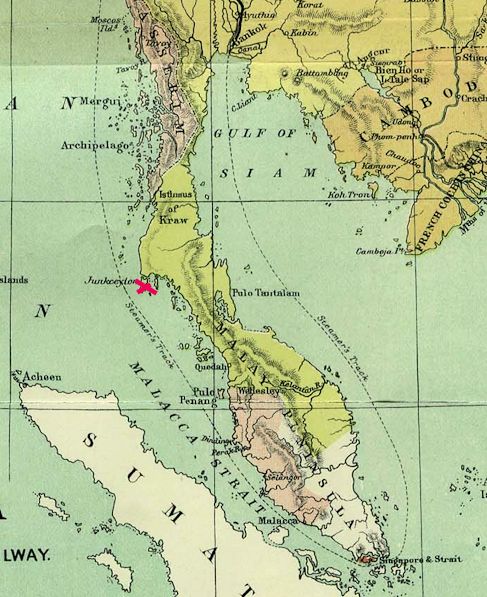
John Crawfurd (1783 – 1868) von der British East India Company kommt an Phuket (ภูเก็ต) vorbei bei einer Fahrt entlang der Tenasserim-Küste nach Penang. Er schreibt darüber:
Abb.: Lage von Junk Ceylon (Ujong Salan) / Phuket] (ภูเก็ต)
[Bildquelle: Scottish Geographical Magazine, 1886. -- Public domain]
"In general the country is a mere wilderness. The best peopled portion of this territory is the island of Salang [Phuket]. The island is under a governor ... subject to his jurisdiction are seven districts on the continent extending all the way to the Burmese frontier. The most considerable place in question is Ponga [พังงา] [Phang Nga - where the Phuket governor was now staying after the Burmese invasions], which contains between three and four thousand inhabitants among whom are said to be from eight hundred to 1,000 Chinese. Tin mines or rather stream works appear to be wrought in the district of Ponga as well as Junkceylon [Phuket]." He had been sailing south down "the mainland coast north of Phuket", which consisted of: "nothing but one universal forest of stately trees. The beach is beautiful white sand ... we afterwards saw one neat village within a mile of the Popra [Pak Pra] [ปากพระ] strait. On the shore we observed a few fishermen drying their nets while their canoes lay on the beach ... we endeavored to make our wish for an intercourse intelligible by signals ... [The men] were most timid seeing our ship ... At length we sent a boat ashore and after considerable hesitation two individuals consented to come on board, but not until one of our men was left behind as a hostage for their safety. This extraordinary timidity arises from the situation in which these poor people are placed. They live on territory disputed between the hostile Bur- mans and Siamese and consequently are in a state of perpetual insecurity and distrust, while they are now rarely visited by European shipping. Our visitors proved to be a Siamese and a Chinese mestizo of Siam ... in complexion and features he was no longer distinguishable as a Chinese and could only be recognized as such by the fashion in which he wore his hair [in a pigtail]. We addressed them in Malay but they understood but a few words and we could carry on no conversation with them ... The coast abounds in fish and for the value of two rupees we obtained a very large supply of an excellent description."
[Zitiert in: Mackay, Colin <1936 - >: A history of Phuket and the surrounding region. -- Bangkok : White Lotus, 2013. -- 438 S. : Ill. ; 25 cm. -- ISBN 978-974-480-195-1. -- S. 255f.]
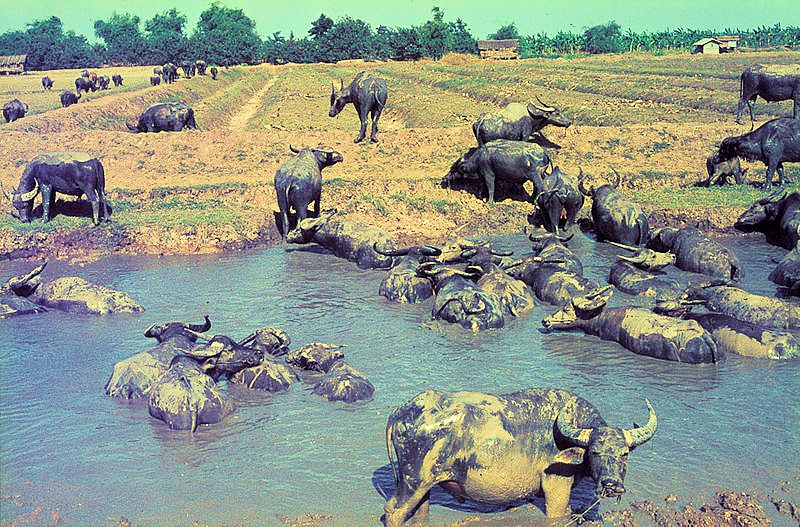
1818/1819
Großes Wasserbüffel-Sterben.
Abb.: Wasserbüffel, Thailand 1965
[Bildquelle: H. Grobe / Wikimedia. -- Creative Commons Lizenz (Namensnennung)]
1818

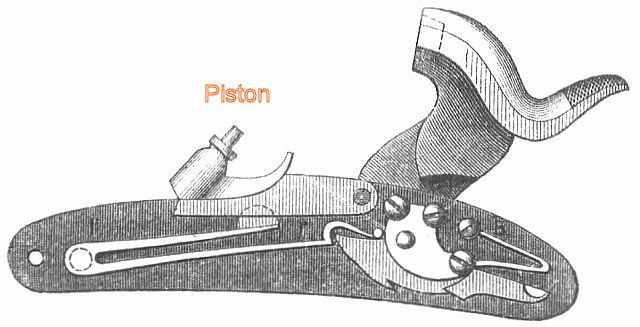
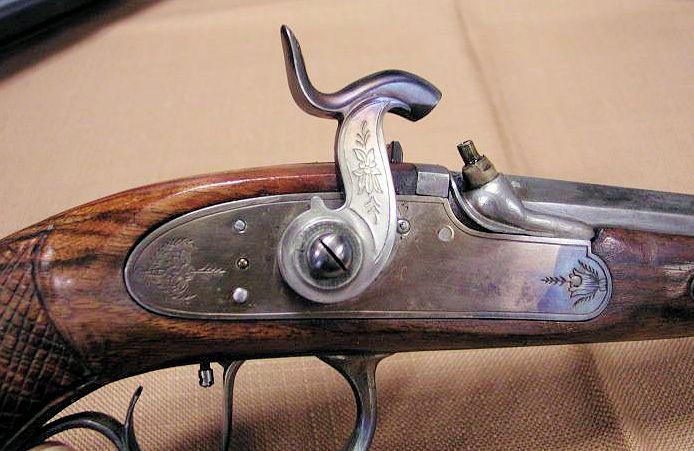
Der Schweizer Büchsenmacher Joseph Egg (1775 - 1835) erfindet das Zündhütchen zum Zünden von Munition. Zum Auslösen benötigt man ein Perkussionsschloss, auf dessen hohlen Stift es gesteckt wird.
Abb.: Perkussionsschloss mit Piston
[Bildquelle: Meyers Großes Konversations-Lexikon, 1905]
Abb.: Perkussionsschloss
[Bildquelle: Wilfried Wittowsky / Wikimedia. -- GNU FDLicense]
1818-06-24
Kapitän Stephen Williams (1781 - 1844) kommt mit einem Schiff nach Siam, um Zucker zu kaufen. Es ist das erste bekannte US-Schiff, das nach Siam kommt.
Williams erhält eine Audienz bei Prinz Chetsadabodin (พระเจ้าลูกยาเธอ กรมหมื่นเจษฎาบดินทร์, 1788 - 1851), dem künftigen Rama III.
Dit Bunnag (ดิศ บุนนาค, 1788–1855) gibt Williams einen Brief (in Portugiesisch) an US-Präsident James Monroe (1758 - 1831) mit, in dem er dazu auffordert, dass künftige Handelsschiffe Feuerwaffen bringen.
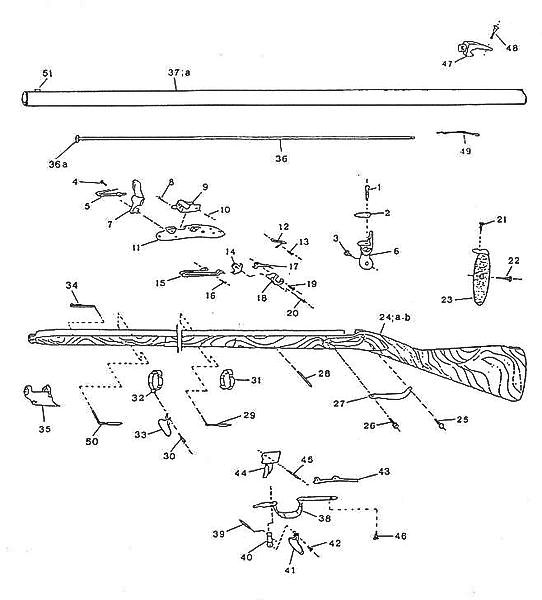
Bis 1821 kommen 12 US-Schiffe nach Siam, sie genießen bevorzugte Behandlung, da sie Feuerwaffen ins Land bringen. 1821 z.B. bringt ein US-Schiff 5.000 Musketen (Vorderlader)
Abb.: Konstruktionsplan einer US Model 1816 Musket, 1816 - 1844
[Bildquelle: Wikimedia. -- Public domain]
1818-09

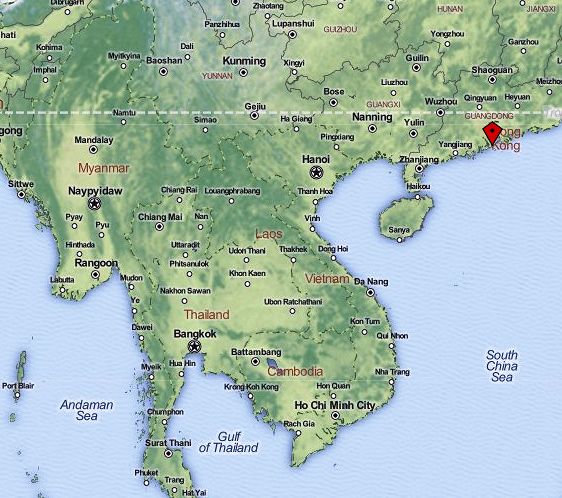
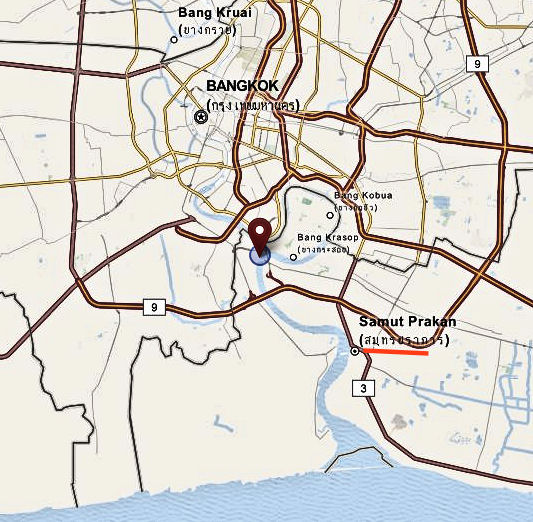
Carlos Manuel Silveira wird vom portugiesischen Gouverneur von Macao, Miguel de Arriaga, nach Siam geschickt. Er wird von Rama II. am 1818-09-24 aber nicht als Gesandter empfangen, sondern als gewöhnlicher Händler. Der König fordert von ihm Gewehre und andere Waffen, die die Portugiesen auch liefern. Trotzdem verweigert Siam einen Handelsvertrag mit Portugal. Silveira wird aber als Konsul Portugals anerkannt.
Abb.: Lage von Macao
[Bildquelle: OpenStreetMap. -- Creative Commons Lizenz (Namensnennung, share alike)]
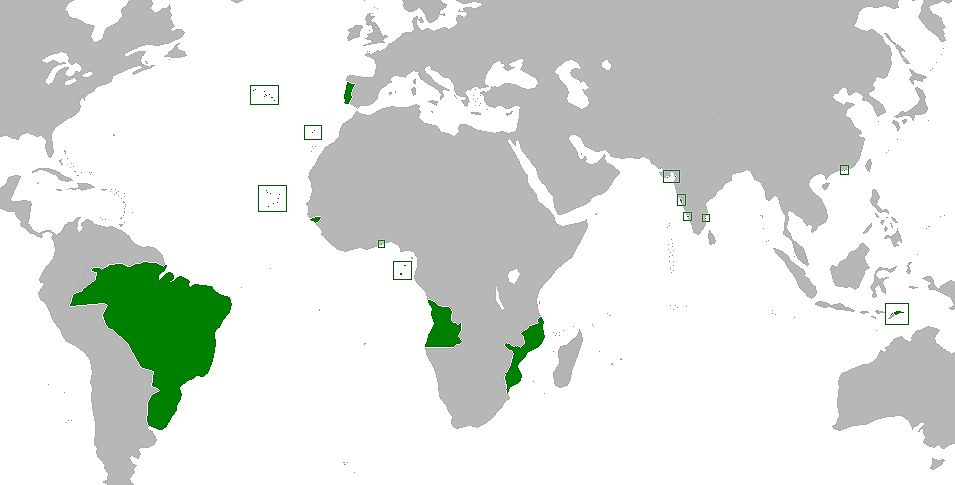
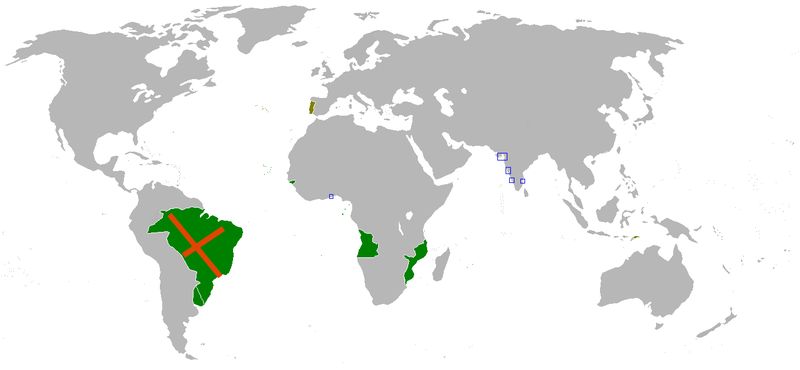
Abb.: Portugiesisches Kolonialreich 1822
[Bildquelle: Wikipedia. -- Public domain]
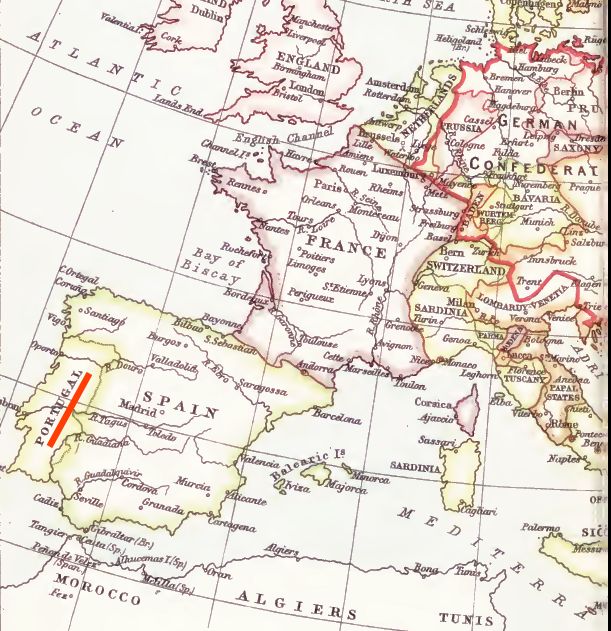
Abb.: Portugal 1815
[Bildquelle: A literary and historical atlas of Europe. -- London, 1910]
"... the Portuguese, the relations between whom and Siam were renewed in 1817, when the Governor of Macao had a letter forwarded to the King in which he requested for the establishment of the former intercourse. The first attempt of the Portuguese was singularly unhappy inasmuch as the person who was to deliver the letter became so excited by the behaviour of the people that he left Siam without waiting for a reply. The letter was, however, afterwards answered and the Consul Silveira [Carlos Manuel Silveira] took charge of the factory. He received on his mission a stipend of 160 Ticals a month from the Siamese Government and was solely employed in building a ship for a merchant in Macao for which the Siamese Government had also promised him money. He got actually for some time 2, 000 Ticals monthly, a sum which was afterwards reduced to 800 Tcs. and finally given up, when Morgan [John Morgan] advanced him to 5, 000 Dollars for this purpose, a transaction which when it became known was not conducive to the good name of the Portuguese. The treaty made by the Portuguese was never ratified although sent to Goa for that purpose, as clauses had been inserted to which the Portuguese Government objected; but it must not be forgotten that according to old rules both Governments accepted silently such clauses as were agreed upon, and it must be therefore surmised that the clauses of the treaty which were agreed upon were considered binding upon both parties. The Consul received from the Government in accordance with old practice a title Hluang Abhai Banit [
หลวง อภัยวาณิช] (the merchant by grace), which recognized him as in charge of Portuguese interests, and gave him to a certain extent charge of the foreign trade."[Quelel: Frankfurter, Oscar <1852 - 1922>: The unofficial mission of John Morgan, merchant, to Siam in 1821. -- In: Journal of the Siam Society. -- 11,1 (1914/15). -- S. 5f.]
1819
Rebellion in Champasak (ຈຳປາສັກ): Ai Sa Kiat Ngong (อ้าย สาเกียดโง้ง) aus Saravane (ສາລະວັນ), ein Phu mi bun (ผู้มีบุญ, verdienstvolle Person), dem magische Kräfte zugeschrieben werden) erklärt sich zum Herrscher. Der Fürst von Champassak flieht. Siam unterdrückt die Rebellion mit Hilfe von Prinz Yoh (โย้). Siam setzt Prinz Yoh als Fürst ein.
1819/21 - 1826
Yoh (โย้) ist Herrscher von Champasak (ຈຳປາສັກ).
"Chao Raja Putra Sadet Chaofa Jaya Yoh (Yuva; * im frühen 19. Jahrhundert in Vientiane; † um 1828) war Kronprinz des Königreichs Vientiane und Maha Uparat (Vizekönig) des Königreichs Champasak. Yoh war der dritte Sohn von König Anuvong (ສົມເດັຈພຣະເຈົ້າອະນຸວົງສ໌, reg. 1805 bis 1828) und wurde von seinem Vater 1804 mit dem Titel Chao Raja Putra bestallt. 1821 ernannte ihn der König von Siam, Rama II., zum Vizekönig von Champasak.
Yoh starb beim Sturz vom Dach einer Pagode, als er nach seiner Flucht aus siamesischer Gefangenschaft vor den Soldaten fliehen wollte."
[Quelle: http://de.wikipedia.org/wiki/Rajabud_Yoh. -- Zugriff am 2011-10-15]
1819
Druck eines protestantischen Katechismus in siamesischer Sprache.
1819 -1821
Die Befestigung des Zugangs nach Bangkok auf dem Chao Phraya (แม่น้ำเจ้าพระยา) wird von Phra Pradaeng (อำเภอ พระประแดง) nach Pak Nam (ปากน้ำ), verlegt. Dort werden sechs neue Forts gebaut.
Abb.: Lage von Phra Pradaeng (อำเภอ พระประแดง) und Pak Nam (ปากน้ำ)
[Bildquelle: OpenStreetMap. -- Creative Commons Lizenz (Namensnennung, share alike)]
1819/20
Große Gefängnisrevolte birmanischer Kriegsgefangener. Die Gefangenen töten einen Wächter und brechen aus. Sie werden eingefangen, vor Gericht gestellt und zusammen mit Phraya Thawai (พระยาทวาย, von Tavoy/Dawei/ထားဝယ်မြို့) hingerichtet.
1819

Die US-Baptistenmissionarin Ann Hasseltine Judson (1789 - 1826) übersetzt in Burma mit Hilfe eines birmanischen Lehrers das Matthäusevangelium ins Thai. Judson war mit Thais in Berührung gekommen, die nach Burma verschleppt worden sind. Judson lernt Thai und versucht die Thais zu bekehren. Sie lässt ihre Übersetzung in Serampore (শ্রীরামপুর, Indien) in Thai-Buchstaben drucken. Dazu werden vom Drucker und Missionar George Henry Hough (1788-1859) - Gründer der American Baptist Mission Press in Burma - extra Thai-Lettern geschaffen. Die Thai-Lettern werden von Rangoon zum Baptist Printing House in Serampore gebracht und von dort später zur London Missionary Society in Singapur.
Abb.: Ann Hasseltine Judson
1819
Handel mit Britisch-Penang: Export und Import im Wert von 207.750 Straits-$ (Umrechnung, Straits-$ gibt es erst ab 1898).
- Import aus Penang: Opium, Baumwolle
- Export nach Penang: Zucker
Abb.: Lage von Penang
[Bildquelle: Bartholomew, J. G. <1860 - 1920>: A literary & historical atlas of Asia. -- London, o. J.]
1819
Mit Zustimmmung des Governor General von Bengal der britischen East India Company sendet der britische Governor von Penang eine Freundschaftsadresse nach Siam mit der Bitte, die Handelsbedingungen zu verbessern.
1819-02-06

Thomas Stamford Raffles (1781 - 1826) unterzeichnet im Namen der British East India Company einen Vertrag mit Hussein Mua'zzam Shah ibni Mahmud Shah Alam (1776 - 1835) von Johor [جوهر] über die Entwicklung von Süd-Singapur als britischer Handelsstützpunkt. Die eigentliche Gründung von Singapur geschieht unter der Leitung von Major William Farquhar (1774 - 1839). Farquhar lässt von 1819 - 1823 477 Wasserfarb-Malereien von Pflanzen und Tieren anfertigen. Maler ist ein ungenannter Chinese.
Aus den Instruktionen Raffles an Farquhar:
Abb.: Lage von Terengganu [ترڠڬانو]
[Bildquelle: Swettenham, a.a.O., Beilage]
“With regard however to those States which have not yet fallen under their [that was the Dutch] authority, it is justifiable and necessary that you exert your influence to preserve their existing state of independence. If this independence can be maintained without the presence of an English authority, it would be preferable, as we arc not desirous of extending our stations; but as from the usual march of the Dutch policy, the occupation of Tringanu [Terengganu - ترڠڬانو], and the extension of their views to Siam, may be reasonably apprehended, a very limited Establishment in that quarter may become ultimately necessary. ” [Zitiert in: Swettenham, Frank Athelstane <1850 - 1946>: British Malaya; an account of the origin and progress of British influence in Malaya. -- London : Lane, 1907. -- 354 S. : Ill. -- S. 325]
Abb.: Lage von Johor [جوهر], Singapur und Terengganu [ترڠڬانو], Ende 19. Jhdt.
[Bildquelle: Bartholomew, J. G. <1860 - 1920>: A literary & historical atlas of Asia. -- London, o. J.]
Abb.: Farquhar Collection: Durian (Durio zibethina L.)
[Bildquelle: Wikimedia. -- Public domain]
Abb.: Farquhar Collection: Kingfisher unter Barringtonia racemosa (L.) Spreng.
[Bildquelle: Wikimedia. -- Public domain]Raffles entwirft das typische chinesische shop-house (店屋 / ห้องแถว), das von Singapur aus in ganz Südostasien zum Standard wird.
Abb.: Shop-house (店屋), Singapur, 2007
[Bildquelle: Terence Ong / Wikimedia. -- GNU FDLicense]
Abb.: Shop-house (ห้องแถว), Korat (โคราช), 2010
[Bildquelle: Khaosaming / Wikimedia. -- GNU FDLicense]
1819-05-24
Der US-Dampfsegler SS Savannah läuft zur ersten Atlantiküberquerung aus und erreicht am 20. Juni Liverpool. Damit beginnt das Zeitalter der Hochseedampfschifffahrt.
Abb.: SS Savannah
[Bildquelle: Wikimedia. -- Public domain]
1819-06-05 - 1837-04-15
Bagyidaw (ဘကြီးတော်, 1784 - 1846) ist König von Burma.
182x
William Armstrong Clubley ( - 1826), British East India Company [EIC], über Phuket (ภูเก็ต):
"Shortly after the occupation of Penang there was a considerable trade in Tin and other articles and vessels were constantly passing to and from Junk Ceylon [Phuket - ภูเก็ต]. [But today] .. .The island [Phuket] is still in possession of a power which does not appear disposed to draw forth its resources and the dread of an attack from the Burmans prevents the inhabitants of the adjoining Coast from settling upon the island ... if the valuable island of Junk Ceylon could be added, either by conquest or fair negotiation, to the possessions of the Honourable Company [EIC], their revenues would be materially increased. ... That Junk Ceylon possesses every advantage that can be desired for a British settlement has been fully established by the concurring testimony of all persons who have visited the place or considered the subject." [Zitiert in: Mackay, Colin <1936 - >: A history of Phuket and the surrounding region. -- Bangkok : White Lotus, 2013. -- 438 S. : Ill. ; 25 cm. -- ISBN 978-974-480-195-1. -- S. 253f.]
1820 - 1822
Somdet Phra Ariyavongsanana (Suk Ñānasaṃvara) สมเด็จพระอริยวงษญาณ สมเด็จพระสังฆราช (สุก ญาณสังวร) (1733 - 1822) ist Sangharaja (สังฆราช)
1820 -1840
Erste Einwanderung von Hmong (= Maeo, - ແມ້ວ / ມົ້ງ - แม้ว / ม้ง) in Laos.
Abb.: Hmong, Oudomxay (ອຸດົມໄຊ), Laos
[Bildquelle: Luisah / Wikimedia. -- Public domain]
ca. 1820
Thomas Stamford Raffles (1781 – 1826) über die Behinderungen des Handels mit Siam:
"On arrival in a Siamese port the most valuable part of the cargo is immediately presented to the king [or king’s agent] who takes as much as he pleases; the remaining part is chiefly consumed in presents to the courtiers and other Mandarins, while the refuse of the cargo is then permitted to be exposed to sale. The part consumed in presents to the Mandarins is entire loss; for that which the king takes he returns a present which is seldom adequate to the value of the goods he has received; but by dint of begging and repeated solicitation this is sometimes increased a little. [Zitiert in: Mackay, Colin <1936 - >: A history of Phuket and the surrounding region. -- Bangkok : White Lotus, 2013. -- 438 S. : Ill. ; 25 cm. -- ISBN 978-974-480-195-1. -- S. 279]
1820
John Crawfurd (1783-1868) von der British East India Company über Phuket (ภูเก็ต):
"The richest mines [von Zinn] exist on the island of Junkceylon [Phuket - ภูเก็ต]." [Zitiert in: Mackay, Colin <1936 - >: A history of Phuket and the surrounding region. -- Bangkok : White Lotus, 2013. -- 438 S. : Ill. ; 25 cm. -- ISBN 978-974-480-195-1. -- S. 253]
1820
Die französischen Chemiker Pierre Joseph Pelletier (1788–1842) und Joseph Bienaimé Caventou (1795-1877) extrahieren aus Chinarinde Chinin. Es ist das wichtigste Anti-Malaria-Mittel.
Abb.: Von Pierre Joseph Pelletier und Joseph Bienaimé Caventou isoliertes Chinin
[Bildquelle: Wellcome Images. -- Creative Commons Lizenz (Namensnennung, keine kommerzielle Nutzung, keine Bearbeitung)]
1820
Der französische Genral Allard sowie mehrere Offiziere Napoleons helfen in Indien eine Sikh-Armee gegen die britische East India Company aufzustellen.
Abb.: Lage der Sikh-Staaten 1823
[Bildquelle: Joppen: Historical atlas of India. -- 1914. -- Karte 29]
1820
Zum Beispiel: Ostindienfahrer "Repulse" in den East India Docks, London, 1820
[Bildquelle: Wikipedia. -- Public domain]
1820-01-29 - 1830-06-26
George IV. (1762 - 1830) ist König von Großbritannien.
Abb.: George IV., 1822
[Bildquelle: Thomas Lawrence (1769 - 1830) / Wikipedia. -- Public domain]
1820-02-14 - 1841-01-20
Minh Mạng (明命, 1791–1841) ist Kaiser von Vietnam.
Abb.: Vietnam 1800[Bildquelle: Bartholomew, J. G. <1860 - 1920>: A literary & historical atlas of Asia. -- London, o. J.]
Abb.: Kaiser Minh Mạng (明命)
[Bildquelle: Wikiepdia. -- Public domain]
"Kaiser Minh Mạng (Hán tự: 明命; * 25. Mai 1791 in Huế; † 20. Januar 1841 ebenda) war der zweite Kaiser der vietnamesischen Nguyễn-Dynastie (阮朝), er bekleidete dieses Amt vom 14. Februar 1820 bis zu seinem Tode. Sein eigentlicher Name war Nguyễn Phúc Đảm (阮福膽), als Ärabezeichnung wählte er Minh Mạng. Biografie
Minh Mạng war ein jüngerer Sohn des Kaisers Gia Long (嘉隆), dessen ältester Sohn, Kronprinz Canh, während des Nguyễn-Krieges um den Thron starb. Minh Mạng war für seinen Widerstand gegen das Engagement der Franzosen in Vietnam und für seine rigide konfuzianische Orthodoxie bekannt.
Wie alle Nguyễn-Kaiser musste er mit einigen Bauernrevolten zurechtkommen, aber er schaffte es, diese zu unterdrücken. Wie auch immer, die ernsthafteste Bedrohung kam von einem der treuesten Statthalter seines Vaters und einem Nationalhelden in Vietnam, Le Van Duyet (黎文悅). Duyet gewann den Krieg für die Nguyễn-Streitkräfte bei Qui Nhơn und wurde von Gia Long als Regent im Süden eingesetzt mit der Freiheit, zu regieren und mit ausländischen Mächten zu verhandeln. Duyet hatte sich der Inthronisierung von Minh Mạng entgegengestellt, der gegen Einflüsse von Ausländern und Christentum gewaltsam wurde, weil dies ein Verrat an denselben Leuten wäre, die Gia Long zum Thron verholfen hätten.
Le Van Duyet jedoch starb, bevor Minh Mạng gegen ihn handeln konnte, aber in einem erniedrigenden Racheakt hatte 1832 Minh Mạng Duyets Grab geschändet und seine Überreste öffentlich entehrt. Diese Tat, vor allem in der konfuzianischen Gesellschaft erniedrigend, brachte Duyets Sohn, Le Van Khoi (黎文傀), dazu, eine Rebellion gegen Minh Mạng anzuführen. Für die Nguyễn-Dynastie war es eine ausweglose Situation, als auch Thailand die Möglichkeit ergriff, den südlichen Teil Vietnams zu überfallen. Die Nguyễn-Streitkräfte waren nur spärlich fähig, die Attacke zurückzuweisen und die Rebellen zu unterdrücken, nach denen gewaltsame Vergeltungsmaßnahmen auftraten.
Obwohl diejenigen, die Kaiser Minh Mạng trafen, immer zustimmten, er würde persönlich ein weiser und vornehmer Mann sein, hatte seine harsche Politik gefährliche Auswirkungen auf sein Land. Sein strikter Glaube an die konfuzianische Gesellschaft bedeutete, dass keinerlei Innovation jeglicher Art während seiner Regentschaft erlaubt war, und wenn Rebellionen ausbrachen, war es seine erste Reaktion, die christlichen Missionare und ihre vietnamesischen Bekehrten dafür verantwortlich zu machen. Er machte Gesetze, die die Verbreitung neuer Religionen verboten und hunderte Christen in den Tod führten. Das gab Frankreich die Entschuldigung, in Vietnam einzufallen, und 1858 besetzten französische Truppen kurze Zeit Tourane (heute: Đà Nẵng) mit der Forderung nach Beendigung der Verfolgungen. Das war der Beginn der französischen Kampagne der folgenden Jahre, Vietnam zu beobachten und für fast 100 Jahre zu kolonisieren.
Am Ende starb Minh Mạng und überließ den Thron seinem Sohn, Kaiser Thiệu Trị (紹治), der genauso ein rigider Konfuzianist und Ausländerfeind wie sein Vater war. Dennoch etablierte Minh Mạng während seiner Regentschaft eine effizientere Regierung, beendete eine Thai-Invasion und baute viele Nationalmonumente in der kaiserlichen Stadt Huế. Seine Hinterlassenschaft ist einerseits ein Erfolg für ihn, doch brachte seine Politik Vietnam auch viele Schwierigkeiten, nachdem er starb."
[Quelle: http://de.wikipedia.org/wiki/Minh_M%E1%BA%A1ng. -- Zugriff am 2011-11-26]
1820-03
Choleraepidemie in Siam. Die Epidemie kommt von Indien über Penang nach Sai Buri (สายบุรี) und Songkhla (สงขลา) nach Samut Prakan (สมุทรปราการ) und Ende Mai nach Bangkok. In Bangkok sterben ca. 30.000 Personen an Cholera. Man kommt nicht mehr nach, die Leichen zu verbrennen. Darum liegen an den Verbrennungsplätzen und in Klöstern massenhaft Leichen umher, in den Kanälen und Flüssen schwimmen Leichen. Rama II. befiehlt, dass alle Untertanen nur noch buddhistische Texte singen und Mönchen Speisen geben. Rama II. lässt alle gefangenen Tiere und Menschen frei, mit Ausnahme birmanischer Gefangener. Eine Staatszeremonie mit Gewehrschüssen soll die bösen Geister vertreiben. Von Siam wandert die Epidemie nach Vietnam.
Abb.: Lage von Penang, Sai Buri (สายบุรี) und Songkhla (สงขลา)
[Bildquelle: OpenStreetMap. -- Creative Commons Lizenz (Namensnennung, share alike)]
Abb.: Ausbreitung der Cholera (schematisch)
[Bildquelle: OpenStreetMap. -- Creative Commons Lizenz (Namensnennung, share alike)]
Abb.: Leichenstätte, Wat Saket (วัดสระเกศราชวรมหาวิหาร), Bangkok: Reste einer Cholera-Epidemie
[Bildquelle: Child, Jacob T.: The pearl of Asia. Reminiscences of the court of a supreme monarch : or, Five years in Siam. Chicago : Donohue, Henneberry & co., 1892.]
1820-09-25
Der französische Physiker André-Marie Ampère (1775 - 1836) erkennt den Zusammenhang zwischen Elektrizität und Magnetismus und begründet damit die Elektrodynamik.
1820-10-03 - 1850-02-25

Daoguang (道光, 1782 - 1859) ist Kaiser von China.
Abb.: Kaiser Daoguang (道光)
[Bildquelle: Wikiepdia. -- Public domain]
"Daoguang (chines. 道光, * 16. September 1782; † 25. Februar 1850) war ab dem 3. Oktober 1820 Kaiser von China. Er gilt als fähiger, engagierter und von den besten Absichten geleiteter Herrscher. In seiner Amtszeit baute England im Zusammenwirken mit der korrupten chinesischen Beamtenschaft den Opiumexport in das Reich der Mitte noch weiter aus. Dies stellte nicht nur eine erhebliche Gefährdung der Volksgesundheit dar, sondern ließ auch die traditionell für China günstige bilaterale Handelsbilanz kippen: Allein 1831–1833 hatte China für die Droge die gleiche Summe (10 Millionen Silberunzen) auszugeben, die es im gesamten Jahrzehnt davor im Handel mit der Britischen Ostindienkompanie eingenommen hatte.
Nicht zuletzt wegen eines schweren Falles von Opiumsucht in der eigenen Familie entschloss sich Daoguang zum Eingreifen und ließ 1839 durch den kaiserlichen Sonderkommissar Lin Zexu (林則徐) in Kanton 22.291 Kisten Opium im Meer versenken und die Abgesandten der Britischen Ostindienkompanie ausweisen. Dies war der Anlass für den Ersten Opiumkrieg, der Chinas Abstieg von der Hegemonialmacht Asiens zu einem halbkolonialen Entwicklungsland einläuten sollte.
Daneben war die Regierungsperiode Daoguangs von Unruhen und Aufständen in verschiedenen Reichsteilen geprägt. So kam es etwa seit 1825 in Ostturkestan zum Konflikt mit der muslimischen Bevölkerung, die dem vom Qing-Hof geforderten Bekenntnis zum konfuzianischen Staatskult nicht nachkommen wollte. Daneben brachen unter anderem in den Provinzen Hunan (湖南), Guizhou (貴州) und Yunnan (雲南) Unruhen bei Minderheitsvölkern aus. Vor allem aber zeichneten sich in der Provinz Guangxi (廣西) die ersten Vorzeichen des von dem Bauernsohn Hong Xiuquan ( 洪秀全) geführten Taiping-Aufstands (太平天国) ab, der unter Daoguangs Nachfolger Xianfeng (咸豐) die Qing-Dynastie ( 清朝) in ihren Grundfesten erschüttern sollte.
Literatur
- Wolfram Eberhard: Geschichte Chinas: von den Anfängen bis zur Gegenwart. Kröner, Stuttgart 1971.
- John King Fairbank: Geschichte des modernen China: 1800–1985. 2. Auflage. dtv, München 1989, ISBN 3-423-04497-7.
- Jacques Gernet: Die chinesische Welt. Suhrkamp, Frankfurt am Main 1988, ISBN 3-518-38005-2.
- Gisela Gottschalk: Chinas große Kaiser. Pawlak, Herrsching 1985, ISBN 3-88199-229-4.
- Jonathan D. Spence: Chinas Weg in die Moderne. Hanser, München 1995, ISBN 3-446-16284-4."
[Quelle: http://de.wikipedia.org/wiki/Daoguang. -- Zugriff am 2011-11-26]
1820-11-09 / 20

Notenaustausch zwischen Siam und Portugal über die Wiederaufnahme diplomatischer Beziehungen. Rama II. schenkt Portugal Land für Konsulat und Handelsvertretung.
Die Schenkunsgurkunde:
"Eu Chao Phya Surivon Montri Ministro de S. Magestade o Rey de Siam faço saber a V. Exa. O Illmo. Exmo. Sr. D. Diogo de Souza, Vice Rey e Capitão General de Mar e Terra dos Estados da India que recebemos as cartas e offertas enviadas por V. Exa. pelo Consul General e eu o fiz introduzir á Audiencia de S. Magestade o Soberano, o mais amado de seus povos, e juntamente o Commandante do Brigue com os seus officiaes e Havendo S. Magestade tomado Conhecimento do conteúdo das cartas de V. Exa. de ordem do seu 2o Rey para que tomado em consideração as prepoziçoes de V. Exa. e as do Ministro de Macau para renovar a antiga amizade deste Reyno com o de Portugal e estabelecer huma Feitoria com a residencia de hum Consul neste Reyno para o que se darão as promptas providencias para se por em execução o se entregou ao Consul General Carlos Manoel da Silveira, hum chão que lhe pareceu proprio e conveniente com 72 braças de Siam ao longo do Rio, 50 de fundo com dois gudes para fazer navios com privilegio que todos os portugueses poderão vir aqui negociar como antigamete por quanto S. Magestade, Inclinado á Nação Portuguesa que a nenhuma outra. O Consul General, o Commandante do Brigue e seus officiaes receberão quatro meses de comodorias a 16O ticaes por mês e o mesmo Consul General S. Magestade foi servido honrar-lhe com o Titulo de Luong Aphai Phanit e o singio com as insignias daquela graduaçao. As offertas de V. Exa. para S. Magestade forão recebidas todas e entregues aos seus officiaes respectivos. S. Magestade ordenou ao seu Ministro para enviar a S. Exa. pelo Comandante do Brigue Sr. João Baptista cem picos de assucar, 3 ditos de Marfim, 15 ditos de calem; 2O ditos de pimenta, 3 ditos de tinta amarella e es era que V. Exa. aceita cm consideração á Sua particular estima. As ideias de V. exa. unidas as do Ministro de Macau O Illmo. Miguel de Arriaga Brun da Silveira afim de instaurar a antiga amisade deste Reyno com o do Portugal o faz dignamente merecedor de ser 1° representante de S. Magestade O Rey de Portugal na India. E se esta amidade for com efeito estabelecida firmemente como deseja S. Magestade e os Portugueses aqui venham comerciar francamente será hum motivo de eternizar para sempre o nome de V. exa. entre todas as Naçoens do mundo inteiro até que exista o Ceo e a Terra. S. Magestade recomenda-me avisar a V. Exa. para que se sirva informar a todos os mercadores que aqui venhão que tragao espingardas bastantes e boas porque S. Magestade muito necessita delias. Deos Guarde a V. Exa. por muitos annos. Bangkok aos 5 da Lua do 12 mes do annos Marong de 1182 que corresponde à Era Christã 9 de Novembro de 1820. " [Zitiert in: Mendonça e Cunha, Hélder de <1921 - 1992>: The 1820 land concession to the Portugese. -- In: Journal of the Siam Society. -- 59,2 (1971). -- S. 147f.]
1821 - 1845
Sunthorn Phu (สุนทรภู่, 1786–1855) schreibt das Epos Phra Aphai Mani (พระอภัยมณี) in 30.000 Versen.
Abb.: Phra Aphai Mani (พระอภัยมณี) als Cartoon
[Fair use]
Abb.: Phra Aphai Mani (พระอภัยมณี) als Puppenspiel
[Fair use]
1821/22
Starke Teuerung des Reises: 1 Wagenladung kostet 28 Baht, polierter Reis kostet 7/8 Baht pro Eimer.
1821/1822
Unüblich viele Wasserschlangen im Fluss beißen tödlich Menschen.
1821

Niederschlagung einer Rebellion des Sultans von Kedah (قدح) (heute zu Malaysia gehörend). Unterwerfung des Sultanats Perak (ڤيرق) (heute zu Malaysia gehörend). Viele Malaien werden nach Siam als Sklaven gebracht. Großbritannien leistet dem Sultan keinen Beistand. Viele Malaien fliehen vor den Siamesen in die britische Provinz Wellesley, der Sultan flieht nach Penang. Siam fordert vom Gouverneur Penangs die Auslieferung des Sultans. Die Auslieferung wird verweigert, weswegen der Sultan der britishen East India Company Company gegenüber viel bescheidener auftritt.
Siam nennt Kedah in Saiburi (ไทรบุรี) um (wie später wieder im Zweiten Weltkrieg) und stellt es bis 1839 unter die direkte Verwaltung Siams.
Burma plant einen gemeinsamen Angriff auf Siam durch Burma, Kedah (قدح), Selangor (سلاڠور) und andere malaiische Staaten. Als Gegenleistung soll Kedah ein Vasall Burmas werden.
Abb.: Lage von Kedah (قدح) und Perak (ڤيرق)
[Bildquelle: Constables Hand Atlas of India, 1893. -- Pl. 59]
"During the greater part of the eighteenth century there was little regular foreign intercourse with Siam. Occasionally a ship with a more than ordinarily venturesome commander would drop anchor in the river with a view to trade, but, as a rule, the experiences of the visitors were such as not to encourage a repetition of the cruise. It was found that the king's monopoly of trade, so far from having relaxed with the lapse of years, had grown in stringency. All imported goods had to be submitted for sale to royal agents, and they only purchased them at their own price. Commercial transactions outside these narrow limits were treated as a form of treason, to be punished with the last severity of Oriental despotism. In these circumstances the incentive to closer communication between the Western nations and Siam was slight, and there was the less temptation to embark on any adventure in that direction because the development of the trade with India and China at this period was making great headway.
But the East India Company never entirely lost sight of the promise which Siam offered of trade under settled conditions of government. The course of events in that country was carefully noted, and from time to time, in the light of information forwarded by agents, reports were drafted by experienced officials bearing upon the prospects of commerce.
The advance of the Siamese into the Malay Peninsula, in the manner described in the previous chapter, gave an added interest to the country and brought to a prominence the question of the desirability of the formulation of a regular policy in dealing with it. Nothing, however, was done of a practical kind, partly because the Indian authorities had their hands full of the task of resisting French encroachments, and partly because the dangers to British influence of Siamese aggression in Malaya were only dimly perceived at Calcutta.
One of the first to realise the significance of the Siamese action against the Malay States was Francis Light, the founder of Pinang [Penang - Pulau Pinang - بينانج]. There is little doubt that in acquiring that island this gifted administrator had in his mind the barrier that a British occupation of territory hereabouts would interpose to the march of the restless nation in the north. While he gave the Sultan of Kedah what can only be regarded as a pledge of British support in the event of a Siamese attack, he repeatedly urged upon the Calcutta Government the desirability of actively intervening to save the State from Siamese occupation. "If they destroy the country of Kedah," he wrote, "they deprive us of our great supplies of provisions, and the English will suffer disgrace in tamely suffering the King of Kedah to be cut off. We shall then be obliged to go to war in self-defence against the Siamese and Malays. Should your lordships resolve upon protecting Kedah, two companies of sepoys with four six-pounder field pieces and a supply of small arms and ammunition will effectually defend this country against the Siamese, who, though they are a very destructive enemy, are by no means formidable in battle."
The Indian Government took a different view of their obligations to the Sultan of Kedah to that held by Light, and persistently refused to take any action to preserve the independence of the State. For a good many years the Calcutta authorities had no particular reason to regret their decision, but there came a day when the disadvantages of non-intervention were brought very directly home to them.
In 1821 the Siamese made a sudden and unexpected descent upon Kedah. Landing on the river bank, they attacked and defeated the Sultan's forces, and then proceeded to ruthlessly waste the country, in accordance with the principles of Siamese warfare. The Sultan of Kedah, the son of the chief who ceded Pinang to Light, fled with difficulty to Province Wellesley, and thence proceeded to Pinang, where he placed himself under British protection. A Siamese fleet was despatched to Pinang to demand the surrender of the fugitive, but it was quickly sent about its business by the British authorities, who despatched against it the gunboat Nautilus, with orders to fire upon the Siamese prahus if they did not quit the harbour. For some time the deposed Sultan was a source of contention between the Siamese and the British, and it was not until he had been shipped off to Malacca that the controversy dropped.
Meanwhile the Siamese, continuing their march southwards, penetrated to Perak, which State they subdued. They then prepared to attack Selangore, but met with such a hot reception that they deemed it advisable to beat a retreat, and they did not stay their march until they arrived at the State of Ligore, from whence the expedition had started.
These events, so disturbing in their influence on the British settlements in the Straits, and so detrimental to trade, brought home to the Indian Government the imperative necessity of establishing diplomatic relations with Siam."
[Quelle: Arnold Wright in: Twentieth century impressions of Siam : its history, people, commerce, industries, and resources / ed. in chief: Arnold Wright. -- London [etc.] : Lloyds, 1908. -- S. 52f.]
Ein britischer Beamter in Penang berichtet über das brutale Vorgehen der Siamesen:
"There has been a continuous scene of the most brutal rapine, carnage, oppression and devastation that can be imagined ... Their religion is violated ... Wives and daughters were forcibly dragged from their husbands and fathers and ravished by the Siamese soldiery ... aged parents and helpless babies were butchered ruthlessly ... and the most wanton murders, perpetrated by means most cruel and painful to the wretched victims are of daily occurrence ... the Siamese butchered them in great numbers, putting them to death by means most cruel and revolting to human nature ... it is impossible to calculate the number of Malays who perished by the swords of the Siamese." [Zitiert in: Mackay, Colin <1936 - >: A history of Phuket and the surrounding region. -- Bangkok : White Lotus, 2013. -- 438 S. : Ill. ; 25 cm. -- ISBN 978-974-480-195-1. -- S. 249]
Der Kapitän eines britischen Kriegsschiffs, das kurz nach dem Vorgehen der Siamesen vor Kedah (قدح) liegt, berichtet, was ihm seine Mannschaft aus Kedah berichtet:
"Many of their cruelties do not bear repetition, but there are two refined modes of torture I will venture to describe ... One was cooking a human being alive. A hollow tree ... scooped out by manual labour, was left with merely its bare stem standing. Into it the prisoner was put naked, his hands tied behind his back and a large piece of pork fat lashed on his head. The tree was then coated with mud to prevent its ignition or so it might merely smoulder and then a slow steady fire was maintained around it. The unfortunate victim’s sufferings being by these means terribly prolonged, his shrieks and exclamations [were] responded to by the exultant shouts of his executioners ... Another Siamese torture was choosing a spot in the mud where the sprout of a young plant, a species of Nipa palm, was found shooting upwards which it does at a rate of several inches in twenty four hours; they would construct a platform around it and lash their miserable victim in a sitting posture over the young tree so that its lance like point should enter his body and bring on death - a slow mode of impaling ... The climax to this tale of horrors, was the gambling which took place upon the capture of unfortunate Malay women who happened to be ‘enceinte’ [pregnant], the stakes depending upon whether the infant was a boy or a girl, the diabolical game concluding with the death of the mother to decide who were the winners [after cutting the child from her belly] ... such were the cruelties perpetrated ... such have been the miseries which throughout Birmah, Siam and Malaya that first one master and then another practice upon their unhappy subjects." [Zitiert in: Mackay, Colin <1936 - >: A history of Phuket and the surrounding region. -- Bangkok : White Lotus, 2013. -- 438 S. : Ill. ; 25 cm. -- ISBN 978-974-480-195-1. -- S. 249f.]
John Anderson (1795–1845), britischer Beamter in Penang, schreibt:
Abb.: Lage von Ligor (ลิกอร์ = Nakhon Si Thammarat - นครศรีธรรมราช)
[Bildquelle: OpenStreetMap. -- Creative Commons Lizenz (Namensnennung, share alike)]
"The rajah of Ligore [ลิกอร์] (Viceroy Noi of Nakorn [Nakhon Si Thammarat - นครศรีธรรมราช]) next invaded the Langkawi [لڠكاوي] islands, which, independent of possessing between 3 and 4,000 souls, had received a large accession of emigrants from Queddah [Kedah - قدح]. Here too, commenced a terrible scene of death and desolation, almost exceeding credibility. All the men were murdered and the women and female children were carried off, while the children were either put to death or left alone to perish. That fine island is now nearly depopulated." [Zitiert in: Mackay, Colin <1936 - >: A history of Phuket and the surrounding region. -- Bangkok : White Lotus, 2013. -- 438 S. : Ill. ; 25 cm. -- ISBN 978-974-480-195-1. -- S. 250]
1821 - 1839
Kedah (قدح) steht unter direkter Herrschaft des siamesischen Gouverneurs von Ligor (ลิกอร์ = Nakhon Si Thammarat - ครศรีธรรมราช). Es gibt immer wieder starken Widerstand gegen Siam in Kedah.
1821/1822
Die Armee in Kanchanaburi (กาญจนบุรี) wird dazu eingesetzt, Holz zu schlagen und dieses sowie große Felsbrocken nach Bangkok zu transportieren, um in Bangkok auf dem Grund des Königspalastes einen Berg zu bauen.
Abb.: Lage von Kanchanaburi (กาญจนบุรี)
[Bildquelle: OpenStreetMap. -- Creative Commons Lizenz (Namensnennung, share alike)]
1821/1822
Bewohner von Phetchaburi (เพชรบุรี) beschweren sich in Bangkok über die schlechte Behandlung durch die dort stationierten Truppen: die Armeekommandierenden behandeln deie Einwohner wie Sklaven, beschlagnahmen rücksichtslos denen Boote und Besitz. Die Regierung in Bangkok weist die Armee an, Rücksicht auf die Bevölkerung zu nehmen: sie dürfen höchstens dei Hälfte des Reisvorrats gegen Bezahlung requirieren, für einen Baht müsse die Armee sieben Kübel Zucker statt der sechs marktüblichen bekommen. Die Regierung betont, dass in Ratchaburi (ราชบุรี) und Kanchanaburi (กาญจนบุรี) das Verhältnis zwischen Armee und Bevölkerung problemlos sei; es gäbe keinen Grund, dass in Phetchaburi kein so gutes Verhältnis herrsche.
Abb.: Lage von Phetchaburi (เพชรบุรี), Ratchaburi (ราชบุรี) und Kanchanaburi (กาญจนบุรี)
[Bildquelle: CIA. -- Public domain]
1821
Einweihung der katholischen Assumptio-Kirche (heute: Kathedrale: อาสนวิหารอัสสัมชัญ) in Bangkok.
Abb.: Assumptio-Kathedrale, vor 1909
[Bildquelle: Twentieth century impressions of Siam : its history, people, commerce, industries, and resources / ed. in chief: Arnold Wright. -- London [etc.] : Lloyds, 1908. -- S. 215]
Abb.: Lage der Assumptio-Kirche
[Bildquelle: OpenStreetMap. -- Creative Commons Lizenz (Namensnennung, share alike)]
"The Assumption Cathedral (Thai: อาสนวิหารอัสสัมชัญ) is the principal Roman Catholic church of Thailand, located at 23 Oriental Avenue, New Road, in the Bang Rak district of Bangkok. It is the main church of the Archdiocese of Bangkok. It was visited by Pope John Paul II during his trip to Thailand in 1984. History
Assumption Cathedral is located within 100 meters of the Oriental Hotel [1] and the French Embassy, and the original building was the result of the request from a French missionary, Father Pascal in 1809 and the work of a French architect which saw the cathedral completed in 1821 during the reign of King Rama II.[2] The architect designed the original Assumption Cathedral with material imported from France and Italy. The cathedral was named Assumption to honor the passage of the Virgin Mary to heaven after her death, and she is commemorated at the church during The Feast of the Assumption, on St. Mary's Day on 15 August.[2]
Throughout the latter half of the 19th century, the church and surrounding area played an important role for Christian missionaries arriving in Bangkok, particularly after 1860. The cathedral is part of a series of buildings which consist of the Assumption Convent, Catholic Mission of Bangkok, Assumption Printing Press and rectory which were inhabited by the missionaries during their time in the city.
However around 1909 or 1910 the church underwent significant reconstruction and was rebuilt in the romanesque style between 1910 and 1918.[2] The church has a relatively tall rectangular structure with a red brick exterior which stands out against its surrounding white buildings. The tall square towers flank the main entrance. Inside is a high ceiling adorned with many ornate decorations. Construction costs were largely covered by a local catholic businessman, Mr Low Khiok Chiang (also known as Jacobe) who owned the nearby Kiam Hoa Heng & Company, a Chinese Teochew family business.
In 1942, during World War II, nearby buildings were destroyed by bombing which resulted in serious damage to the church.[2] It underwent extensive restoration shortly afterwards, and was partly refurbished in the 1980s and 1990s. Stained glass windows are now used in the cathedral today.
Pope John Paul II visited the church in May 1984, given that the church is the center of the Roman Catholic diocese there.[2] The church is open seven days a week. Services for mass on Sundays are held at 6am, 7:30am, 8:30am, 10am and 5pm.[1]
Notes
- "Assumption Cathedral, Bangkok". Thailand Travel Services. Retrieved October 11, 2008.
- "Assumption Cathedral Bangkok: The French legacy on the Chao Phraya". Tour Bangkok Legacies. Retrieved October 11, 2008."
[Quelle: http://en.wikipedia.org/wiki/Assumption_Cathedral,_Bangkok. -- ZUgriff am 2011-10-18]
1821ff.
Exilanten aus Kedah (قدح) greifen immer wieder siamesische Garnisonen an.
Abb.: Lage von Kedah (قدح)
[Bildquelle: Scottish Geographical Magazine. -- 1886. -- Public domai9n]
1821
Der englische Naturforscher Michael Faraday (1791 - 1867) entdeckt die elektromagnetische Rotation, das Grundprinzip des Elektromotors.
Abb.: Versuchsanordnung Faradays zum Nachweis der elektromagnetischen Rotation, 1844
[Bildquelle: Michael Faraday: Experimental Researches in Electricity. -- Bd. 2. -- 1844]
1821
Goeckingk, Leopold Friedrich Günther von <1748 - 1828>: Gedichte. Neue, verbesserte und vermehrte Ausgabe. -- Frankfurt a. M. : Hermannsche Buchhandlung, 1821.
"Zuschrift an den König von Siam
Kommt diese Dedication,Durch Schiffer Peter Nils von Emden,
Nach Wunsch, vor Eurer Hoheit Thron,
Und laßt Ihr dann sie übersetzen:
So seyd kein Kind, und denkt nicht gleich,
Daß Deutschland, weil ein Deutscher Euch
Besingt, gar sehr Euch müsse schätzen.
Zerbrecht Euch, Sir', auch nicht das Haupt
Darüber, wie Ihr zu der Ehre
Gekommen seyd? Wenn Ihr's erlaubt,
(Ihr habt ja nichts zu thun!) erklären
Wir Euch das Ding ganz kürzlich so:
Die Dichtkunst drischt bei uns nur Stroh,
Die Kunst zu schmeicheln aber, Aehren.
Nun ist bei uns so der Gebrauch,
Von Aehren, nicht von Stroh, zu leben.
Drum lernen wir Poeten auch
Die Kunst, sie andern auszudreschen;
Das heißt: den Durst nach Schmeichelein
Löscht der Poet; den Durst nach Wein
Muß ihm dafür der Andre löschen.
Glaubt, Sire, wollt' ich manchen Herrn
In unserm Welttheil', so besingen,
Als ich wohl könnt': er setzte gern
Bei einer Arbeitfreien Stelle,
Auf seine Kosten, mich in Ruh',
Denn jeder hat ein Haus dazu;
Man nennt es: Eine Zitadelle.
Und doch besang ich niemals sie.
Warum? das kann Euch nichts verschlagen.
Doch wär't Ihr dümmer als ein Vieh,
Geruhtet Ihr daraus zu schließen:
Ich legt' Euch diese Zuschrift, voll
Von Eurem Ruhm', als einen Zoll,
Der dem Verdienst' gebührt, zu Füßen.
Ihr seyd vielleicht ein schlechter Held?
Das thut nichts! dafür seyd Ihr König!
Wenn mir es sonst einmal gefällt,
Euch Preußens Friedrich vorzuziehen:
Wer darf in Siam sagen: »Ha!
Wie lügt der Schurke!« Niemand ja
Läßt gern sich schinden oder brühen!
Ich aber, Sire! bin kein Thor,
Auf gutes Glück zu creditiren.
Nein! Zug um Zug! Ihr müßt zuvor
Mir diese Zuschrift baar vergüten,
Sonst wird sich ihr Verfasser schier
Vor Eurem Lobe, so wie Ihr
Vor einer Mützen-Schlange1 hüten.
Es thut vielleicht Euch wenig leid,
Ob Siam Euch nicht liebt? nur fürchtet?
Doch wenn Ihr nicht ein Faulthier seyd,
Muß für den Ruhm bei Nationen,
Wo jeder Bettler, ungescheut,
Euch preiset und vermaledeit,
Doch wohl ein Wunsch noch in Euch wohnen?
Soll ich den Wunsch erfüllen? Top!
Schickt mir nur einen Elephanten!
Für Euer Gold kann ich, Gottlob!
Weil ich's entbehren lernte, danken;
Allein ein Thier zum Reiten, kann
Mir Dienste thun; ich kranker Mann
Fang' etwas früh schon an zu wanken.
Der Herr Professor Pauli2 hat
Zwar ausgelobt, doch Euer Leben
Schreibt Schirach gern an seiner Statt,
Wenn ich das Reitthier ihm vermache;
Denn seyd Ihr gleich uns hier zu Land
Auch nach dem Namen unbekannt,
So thut das eben nichts zur Sache.
Fußnoten
1 Oder Brillenschlange. Sie ist die gefährlichste von allen indianischen Schlangen, und in Siam zugleich die häufigste. Ihr Biß ist tödlich, wenn man nicht auf der Stelle ein Mittel dagegen gebraucht. S. L' Histoire du Royaume de Siam, par M. Turpin. T.I. p. 343.
2 Verfasser des Lebens großer Helden."
1821-05-15
Der britische Kaufmann John Morgan kommt im Auftrag des britischen Governor von Penang, Phillips, nach Bangkok, angeblich als privater Händler, in Wirklichkeit als britischer Geheimagent, der Informationen sammeln und Beziehungen aufbauen soll. Er überbringt die Mitteilung, dass die Briten Singapur [1819] gegründet haben und an guten Handelsbeziehungen mit Siam interessiert sind. Die verdeckte Mission ist letztlich erfolglos.
"In the meanwhile also the newly established Colony of Singapore had thought it expedient to enter into direct commercial relations with Siam and to acquire an unbiased knowledge of things there. So they tried the experiment of entrusting with this mission a merchant who, they thought, would combine it with his commercial venture untrammelled by political etiquette. The person so selected was one Mr. Morgan, of Singapore, who was recommended for that position by one Mr. Palmer, of Calcutta, who was financially interested in the venture. Mr. Morgan received very full instructions and was to deliver a letter addressed to the King of Siam by the resident councillor of Singapore, Colonel Farquhar [William Farquhar, 1774 - 1839], and he was guaranteed against all possible losses in his venture. In his instructions it was made quite clear that he.
was only to speak in his own name and not commit the Government by any act. Mr. Morgan purchased and loaded a small boat “ Non me recordo ” of 70 tons burden, in Singapore, and left for Siam on the 25th of April 1821, arriving there on May 15th. On his arrival he had an interview with the Minister for Foreign Affairs, who in the evening conducted him to an audience with Krom Mün Chesda [กรมหมื่นเจษฎาบดินทร์, 1787 - 1851], the later King Phra Nang Klao [Rama III / นั่งเกล้า].At that time Siam was making preparations for a war with Burmah and it is known that during a number of years Siamese troops had been sent to the frontiers “ to catch Burmese. ” In fact it was only at the death of the King Phra Buddha Lot La [Rama II. / พระบาทสมเด็จพระพุทธเลิศหล้านภาลัย, 1768 - 1824] that the troops were recalled. Siam thought it expedient, whenever opportunity offered, to ascertain what position the British Government would assume and whether it would remain neutral, and they were consequently glad of the mission.
Morgan, to whom these questions were put, answered them diplomatically without committing himself, under the plea that he was a merchant and did not know anything about the matter, and to the question whether Great Britain would assist Burmah in case of war and to the subsequent remark that it would be better for Great Britain not to do so also kept diplomatic silence.
Evidently, however, Krom Mün Chesda was satisfied with the answer received, and on the 5th of June early in the morning a boat was sent by the Foreign Minister for Mr. Morgan to conduct him to an audience with the King. The presents which were sent by Colonel Farquhar were displayed before the throne as well as those which Morgan himself had brought, and a letter addressed to the King was read aloud. Morgan conformed to the usual ceremonies and the King addressed to him the customary enquiry about the health of the resident and also enquired about the abandonment of Malacca, about the newly established settlement of Singapore, and why he had not brought muskets which he knew were wanted.
After these questions permission was granted to Morgan to carry on trade without let or hindrance, which he did, believing that after the permission made to him his venture would prove very successful. He was, however, disappointed and he ascribed his non-success partly to the interference of the Chulias [Tamilen] and native Portuguese, in whose hands the trade was and who necessarily looked upon him as an interloper, and it may be here mentioned, that Crawfurd [John Crawfurd, 1783-1868], Burney [Henry Burney, 1792-1845] and Malloch [D. E. Malloch] held the same opinion about them.
On the other hand it must not be forgotten that Morgan imported opium, which was absolutely forbidden to be imported, and clandestinely disposed of it, a fact which was certainly known to the authorities. The only excuse that Morgan could make was that in this trade a beautiful profit was made, and that all high officials and Chinese were interested in it. He admits on the other hand, as a further excuse, that the only persons using opium were the Chinese.
Morgan in all his trading transactions did not forget the semi-official mission with which he was entrusted, and he came to the conclusion “that any treaty that could be made could not protect merchants from the frauds practised on them without some person being on the spot to represent them.” In a subsequent audience Morgan had with Krom Mün Chesda, the question of British trade was raised and he was asked whether the British wanted a factory in Siam. In accordance with his instructions he replied he would report about it. It is curious to notice that in the instructions Crawfurd received and in the letter which he was to deliver to the King, it was especially mentioned that the Government did not desire to establish a factory or a Consulate in Bangkok, and Burney we know likewise repudiated the idea and even went so far as to say that the establishment of a Consulate or factory in Siam would lead to complications. Be that as it may, certainly the establishment of a factory would not have been viewed with favourable eyes by the Portuguese, the relations between whom and Siam were renewed in 1817, when the Governor of Macao had a letter forwarded to the King in which he requested for the establishment of the former intercourse.
[...]
Morgan concluded his affairs and presented a bill of his losses amounting to $5, 200. 08 to the Penang Government, and after some correspondence and reports to Calcutta a sum of $3, 612.30 was paid to his firm and $1, 200 for personal expenses. When Morgen left, he received as presents from the King for the Singapore Government 9 pieces of ivory and 53 piculs of sugar. The reports made by Morgan were handed over to Crawfurd, but the Government did not alter the instructions regarding the establishment of a factory. It is very likely that the meaning Morgan attached to the word “factory” implied something very different from what the Government understood by it. When Morgan arrived in Siam this was a country in which the Government as such engaged in trade. Crawfurd’s mission afterwards can in no way be considered a success, as the time chosen for it was not very opportune and no definite treaty could be signed. When Burney arrived in 1825 the King Phra Nang Klao had ascended the throne and had declared in a proclamation that the Government as such would no longer trade, and had abolished many monopolies. From being purely commercial, the interests of Siam had then become also political."
[Quelle: Frankfurter, Oscar <1852 - 1922>: The unofficial mission of John Morgan, merchant, to Siam in 1821. -- In: Journal of the Siam Society. -- 11,1 (1914/15). S. 3ff.]
1821-05-05
Napoléon Bonaparte (geb. 1769) stirbt in der Verbannung auf St. Helena (im Südatlantik)
Abb.: William Pitt (Großbritannien) und Napoleon (Frankreich) fressen die Welt / von James Gillray (1756 - 1815), 1805
[Bildquelle: Wikimedia. -- Public domain]
1821-07-19
Königskrönung von George the Fourth (1762 - 1830), by the Grace of God, of the United Kingdom of Great Britain and Ireland King, Defender of the Faith.
Abb.: George IV: Noch als Prinz-Regent, 1816
[Bildquelle: George Cruikshank (1792 – 1878). -- Public domain]
Abb.: George the Fourth, by the Grace of God, of the United Kingdom of Great Britain and Ireland King, Defender of the Faith mit seiner Gattin Her Majesty the Queen, Caroline Amalie Elisabeth von Braunschweig-Wolfenbüttel (1768 - 1821)
[Bildquelle: George Cruikshank (1792 – 1878). -- Public domain]
1821-08
Bisher konnten 12 US-Schiffe ihre Ladung in Siam verkaufen. Als Rückfracht nehmen sie Zucker mit. Ein Captain Han schenkt dem König 500 Gewehre, dafür erhält er den Titel ขุนภักดีราช (Khun Phadiraja" = Sir Dem König-ergeben") und Zollbefreiung auf einen Teil seiner Waren.
1821-09 - 1821-10

IM London Magazine erscheint anonym
[De Quincey, Thomas Penson <1785 - 1859>:] Confessions of an English Opium-Eater
1822 erscheint diese Autobiographie in Buchform.
Abb.: Titelblatt der zweiten Auflage 1823
1821-11
König Bagyidaw (ဘကြီးတော်, 1784 - 1846) von Burma verlegt die Hauptstadt von Amarapura (အမရပူရ) wieder zurück nach Ava (Inwa, အင်းဝ).
Abb.: Lage von Ava (Inwa, အင်းဝ) und Amarapura (အမရပူရ)
[Bildquelle: Bartholomew, J. G. <1860 - 1920>: A literary & historical atlas of Asia. -- London, o. J.]
1821-11-28
"While the restoration of the dethroned Sultan [von Kedah - قدح] was one of the motives which led the [East India] Company to enter into political relations with Siam, this was far from being the most important cause. The reasons for the step were primarily economic. In the first place, the Penang Council was afraid that the Siamese conquest of Kedah would interfere with the food supply of Penang. The attempt to make the island self-supporting had failed, and it was dependent for the greater part of its food upon Kedah. The Council was always very sensitive to any change which seemed to threaten this source of supply, and it was greatly perturbed by the possibility that Siam might place obstacles in the way of obtaining food. The Malay government had been " at times froward and troublesome" but it was always " kindly disposed " and " easily dealt with." The Council seems greatly to have overrated the power of the Siamese, and it anticipated much trouble from them because, through their "insolence and haughtiness," they " could only he held in check by the strong arm of power."" [Quelle: Mills, L. A. (Lennox Algernon) <1896 - 1968>: British Malaya, 1824-1867 : with appendix by C. O. Blagden. -- Singapore : Methodist Publ., 1925. -- 338 S. ; 25 cm. -- S. 130]
1822 - 1842
สมเด็จพระอริยวงษญาณ สมเด็จพระสังฆราช (ด่อน) Somdet Phra Ariyavongsanana (Don) ist Sangharaja (สังฆราช)
1822/1823
Der Preis für 1 Wagenladung Reis steigt von 28 Baht im Vorjahr auf 44 Baht.
1822/1823
Pacht für Einnahme der Alkoholsteuer in Bangkok: 72.000 Baht.
1822/1823
Viele Menschen werden von tollwütigen Hunden gebissen und sterben.
Abb.: Hund mit aggressiver Tollwut im Spätstadium
[Bildquelle: Wellcome Images. -- Creative Commons Lizenz (Namensnennung, keine kommerzielle Nutzung)]
Abb.: Tollwut-Krampf / von Jane Jackson
[Bildquelle: Wellcome Images. -- Creative Commons Lizenz (Namensnennung, keine kommerzielle Nutzung)]
1822
Die Verteidigung von Samut Prakan (สมุทรปราการ) und Khuan Khan (= Phra Pradaeng - พระประแดง)
Abb.: Lage von Samut Prakan (สมุทรปราการ) und Khuan Khan (= Phra Pradaeng - พระประแดง)
[Bildquelle: OpenStreetMap. -- Creative Commons Lizenz (Namensnennung, share alike)]
1822

Selangor (سلاڠور) vertreibt Siam und Kedah (قدح) aus den von diesen besetzten Gebieten Perak's (ڨيرق). Perak anerkennt die Oberherrschaft Selangors an.
Abb:: Lage von Selangor (سلاڠور), Perak (ڨيرق) und Kedah (قدح)
[Bildquelle: Constables Hand Atlas of India, 1893. -- Pl. 59]
1822-01
Der Indo-Brite George Gibson wird mit einem Gefolge von 45 Personen zum König von Burma nach Ava (အင်းဝမြို့) geschickt. Als Vorwand dient, dass er die Möglichkeit des Kaufs von Schwalbennestern erkundet, in Wirklichkeit soll er ausspionieren, ob Vietnam zusammen mit Burma gegen Siam vorgehen würde. Er verlässt Ava am 1822-07-21 und erreicht Saigon (西貢 / Sài Gòn) am 1823-06-08.
Abb.: Lage von Ava (အင်းဝမြို့) und Saigon (西貢 /Sài Gòn)
[Bildquelle: Bartholomew, J. G. <1860 - 1920>: A literary & historical atlas of Asia. -- London, o. J.]
1822-03-26
John Crawfurd (1783 – 1868) landet in Siam in diplomatischer Mission der britischen East India Company.
Abb.: John Crawfurd (1783 – 1868)
[Bildquelle: Wikipedia. -- Public domain]
"John Crawfurd (13 August 1783 – 11 May 1868), Scottish physician, and colonial administrator and author, was born in the island of Islay, Scotland. He followed his father's footsteps in the study of medicine and completed his medical course at Edinburgh in 1803, at the age of 20. He joined the East India Company, as a Company surgeon and was posted to India's Northwestern Provinces (now Uttar Pradesh) from 1803–1808. Following that he was sent to Penang, where he first acquainted himself with Southeast Asia, and applied himself to the study of Malay language and culture. It was also in Penang where he met Stamford Raffles for the first time. In 1811, Crawfurd accompanied him on Lord Minto's military expedition of Java from the Dutch in 1811. When Raffles was appointed the Lieutenant-Governor by Lord Minto during the 45-day Java Expedition, Crawfurd was appointed the post of Resident at the Court of Yogyakarta( modern-day Jarkata) in November 1811. As Resident, he pursued in the study of the Javanese language, cultivated personal relationships with several Javanese aristocrats and literati, and was sent on diplomatic missions to Bali and the Celebes (now Sulawesi). This scholastic pursuits, and his knowledge of the local culture proved to be invaluable to Raffles' government in Java.
However, tensions arise between Crawfurd and Raffles when he was asked to assist Raffles in introducing land reform in the Cheribon residency. Crawfurd, with his experience of India, was always a keen supporter of the Village System of revenue collection, and he vigorously opposed Raffles' attempts to introduce the individual (Ryotwari) settlement into Java.[1]
Java was returned to the Dutch in 1816, and Crawfurd returned to England that year, turning to writing books. In 1820 he published his three-volume History of the Indian Archipelago. That following year in 1821, Crawfurd's expertise was recognised by Governor-General Lord Hastings, who sent him on a mission as an envoy to the courts of Siam (modern Thailand) and Cochin-China (modern Vietnam.) In between those two missions, Crawfurd was appointed British Resident of Singapore in March 1823. The mission to the court of King Rama II was virtually the first official visit to one of the most powerful nations in the region since the Siam–England war of 1687 with the previous Siamese Ayutthaya kingdom. Hastings was especially interested in learning more about Siamese policy with regard to the northern Malay states. The missions were of limited obvious success, though the one to Siam did pave the way for closer relations with Britain, leading King Rama II to ally his kingdom with the British in the First Anglo-Burmese War (1824–1826). This in turn helped Captain Henry Burney conclude the Treaty of Amity and Commerce (Siam–UK) in June 1826 in the reign of King Rama III.[2]
He was again sent on another envoy mission to Burma (Myanmar) in 1827, by Hastings' successor, Lord Amherst. It was to be his last political service for the Company – a difficult but nonetheless a historically significant one. These envoy experiences from envoy missions gave him material to write and publish his Journals in 1828 and 1829. This documentation proved to be useful guides to future missions, and resource materials for scholars – being reprinted nearly 140 years later by Oxford University Press.
Crawfurd was a polygenist, he studied the geography of where different races were located, he believed that different races had been created separately by God in specific regional zones for climatic circumstance.[3]
In his retirement years after the Burmese mission, he spent the remaining years of his long life devoted to writing books and papers on Eastern subjects. Though he made several unsuccessful attempts to enter the British Parliament in the 1830s, he was elected President of the Ethnological Society in 1861, and in 1868 as the first President of the Straits Settlements Association, which was formed to protect the Colony's interests. That was his last office before his death in South Kensington, London on 11 May 1868 at the age of 85.
Books written by CrawfurdNotes
- History of the Indian Archipelago (1820)
- Journal of an Embassy to the Court of Ava in 1827 (1829)
- Journal of an Embassy to the Courts of Siam and Cochin-China, exhibiting a view of the actual State of these Kingdoms (1830)
- Inquiry into the System of Taxation in India, Letters on the Interior of India, an attack on the newspaper stamp-tax and the duty on paper entitled Taxes on Knowledge (1836)
- Grammar and Dictionary of the Malay Language (1852)
- Descriptive Dictionary of the Indian Islands and Adjacent Countries (1856)
References
- Bastin, John. "Malayan Portraits: John Crawfurd", in Malaya, vol.3 (December 1954), pp.697–698.
- Steam, Duncan (14 – 20 May 2004). "Dr. John Crawfurd and the Mission to Thailand, 1822" (Column). A Slice of Thai History. Pattaya Mail. Retrieved 11 August 2011. "This in turn helped Captain Henry Burney conclude a treaty of commerce with Thailand in June 1826."
- David N. Livingstone, Adam's ancestors: race, religion, and the politics of human origins, 2008, p. 112
- Chew, Ernest C. T. (2002) 'Dr John Crawfurd (1783–1868): The Scotsman Who Made Singapore British', Raffles Town Club, vol. 8 (July–Sept). Singapore : Raffles Town Club.
[Quelle: http://en.wikipedia.org/wiki/John_Crawfurd. -- Zugriff am 2011-10-19]
"These events [Die Unterjochung Kedahs und Peraks], so disturbing in their influence on the British settlements in the Straits, and so detrimental to trade, brought home to the Indian Government the imperative necessity of establishing diplomatic relations with Siam. An attempt had been made some years before to open up negotiations, but the Company's envoy, Colonel Symes, had been treated with marked discourtesy, and nothing had come of his mission. This experience was not encouraging, and only the pressure of the newly created situation in the Straits, coupled with the fear of the extension of Dutch influence, led to a resumption of the efforts to negotiate.
The choice of a representative fell upon Mr. J. Crawfurd, one of the most experienced of the Company's officials in the Straits. Mr. Crawfurd was a ripe Malay scholar and a man of no mean literary ability. He served under Sir Stamford Raffles at a subsequent period at Singapore, and when the great administrator left he assumed charge of the new settlement. His personal qualities peculiarly recommended him for a mission such as that to Siam. He was gifted in a marked degree with tact, and his manner was conciliatory and sympathetic, though he could on occasion be firm enough. Above all, he thoroughly understood Orientals. The potentate to whom the mission was accredited was a ruler with a somewhat striking personality. He signalised his accession by making a clean sweep of all whom he considered to be inimical to him. Within thirty-six hours after his father's death no fewer than 117 personages of distinction had been executed. It is only just, however, to his memory to say that after this sanguinary act the king ruled with moderation and judgment. One of his acts entitles him to be regarded in the light of a reformer. Taking note of the immense number of talopins, or priests, who lived in idleness throughout the country, he issued an order that they should serve for a period as soldiers. The edict created an immense sensation, and led to the formation of a conspiracy against the king amongst the priests. The movement coming to light, the royal despot caused seven hundred priests to be arrested, but he dealt with them in mild fashion. The greater number were liberated almost immediately. In the few cases in which punishment was meted out the prisoners were merely stripped of their yellow robes and condemned to cut grass for the sacred white elephants. The king's rule was capricious, but not cruel when judged by Oriental standards. But nothing hardly could surpass in ruthlessness the spirit which dominated the external policy of Siam at this period. Our territory in Province Wellesley, opposite to Pinang, was crowded with thousands of refugees, who fled thither to escape the awful horrors of a Siamese invasion. The section of the population which did not thus escape was either butchered in cold blood or sold into slavery.
The reception of the mission presaged ill for the success of the negotiations. On arrival at Paknam on March 26, 1822, "we could not," says Mr. Finlayson, the surgeon and naturalist of the mission, "fail to remark that the different personages who had as yet visited us were either of very low rank, or of none at all." One of the king's boats was sent down on March 27th to convey Mr. Crawfurd to Bangkok. The next day the John Adam, the ship which had brought the mission to Siam, was allowed to travel up the river. On the 29th the governor-general's letter was delivered to a person appointed by the Phra Klang to receive it. On the 30th a habitation was provided for the British envoy, a miserable place, an outhouse with four small, ill-ventilated rooms approached through a trapdoor from below, and on three sides almost entirely excluded from fresh air. A Malay of low rank was for some time the only channel of intercourse. He came and demanded the presents for the king. In the urgency to obtain and the frequency of the demands of the court for the gifts there was "a degree of meanness and avidity at once disgusting and disgraceful. For several successive days there was no end to their importunities." The treatment of the mission did not improve with the lapse of time. Mr. Crawfurd and his colleagues were kept under a rigid surveillance—were, in fact, practically prisoners until the ceremony of introduction was over. This was postponed from time to time in circumstances which seemed to indicate a desire to humiliate the mission. At length, after more than a week's delay, the reception took place. Mr. Finlayson thus describes it :—
"In the evening a message was brought by the Malay to say that the minister would be glad to see Mr. Crawfurd. Accompanied by Captain Dangerfield, he accordingly paid him a visit. He received them in a large and lofty hall, open on one side, spread with carpets, and hung with glass lights and Chinese lanterns. They took their seats on carpets spread for the purpose and were entertained with tea, fruit, and Chinese preserves. It would appear that the conversation was of a general nature and rather formal. They were well pleased with the attention of the chief and spoke favourably of their reception. He offered to make what alterations were deemed necessary to fit the house for our convenience —an offer which he subsequently bore little in remembrance. The servility which the attendants of this man observed towards him appears to have been quite disgusting and altogether degrading to humanity. During the whole of the visit they lay prostrate on the earth before him, and at a distance. When addressed they did not dare to cast their eyes towards him, but, raising the head a little, and touching the forehead with both hands united in the manner by which we should express the most earnest supplication, their looks still directed to the ground, they whispered an answer in the most humiliating tone. The manner in which he was approached by the servants of his household was even still more revolting to nature. When freshments were ordered they crawled forward on all-fours, supported on the elbows and toes, the body being dragged on the ground. In this manner they pushed the dishes before them from time to time, in the best manner that their constrained and beast-like attitude would admit, until they had put them into their place, when they retreated backwards in the same grovelling manner, but not turning round. How abominable, how revolting this assumption of despotic power ! . . . Yet this haughty chief was himself but a minister of the fifth order in importance, doomed to take his turn of beast-like grovelling, as was subsequently exhibited in visiting Chromachit, son to the king. Every man here is doomed to crawl on the earth before his superiors."
Mr. Crawfurd himself in his narrative mentions a curious circumstance connected with this complimentary feast at Paknam. While they were enjoying the good things which were provided for them their attention was attracted by a curtain suspended across one end of the apartment. Their curiosity being aroused they sought information, and were told that the hanging concealed the body of the late chief of Paknam, who had died five months previously and whose remains were awaiting an auspicious day for burial. The next day more particular inquiries were made of the host relative to this gruesome experience, and some of the members of the mission were shown the corpse, which was "wrapped up in a great many folds of cloth like an Egyptian mummy, apparently quite dry, and covered with such a profusion of aromatics that there was nothing offensive about it."
A few days after the interview with the governor of Paknam Mr. Crawfurd was received by Prince Kromchiat, the eldest son of the king. Accompanied by Lieut. Rutherford, Mr. Crawfurd proceeded at eight o'clock in the evening to the prince's palace. The visitors were ushered into a large hall "decorated with European lustres of cut glass, with European and Chinese mirrors, and with a profusion of Chinese lanterns." They discovered the prince, "a heavy and corpulent figure about thirty-eight years of age but having the appearance of fifty," sitting on a mat in the upper part of the chamber. The courtiers kept at a great distance, crouching to the very ground with their hands clasped before them." Mr. Crawfurd and his companion seated themselves on a carpet which was pointed out to them between the prince and his courtiers. It had been provided that the interpreters should be admitted, but when these individuals appeared they were jostled by the attendants and forced to withdraw. A somewhat long conversation was nevertheless carried on between the prince and the envoy. After some inquiries had been made relative to the Viceroy, the prince said, "I have heard of his reputation for justice and wisdom from the merchants of all nations who have of late years resorted to this country." Later, in reference to another matter, the prince observed, "When I speak of Europeans in general I do not mean the English, for their superiority over all other people, in this respect, is well known." The audience lasted two hours, and on arriving home after it the visitors found eight large tubs of sweetmeats which had been sent as a present to them by the prince.
Ultimately the 8th of April was appointed by the king for an audience. The question of the nature of the obeisance to be made to his Majesty was settled with less difficulty than had been anticipated. "It was finally determined that upon appearing in the presence we should make a bow in the European fashion, seat ourselves in the place usually assigned to foreign missions, make an obeisance to his Majesty when seated, by raising two joined hands to the forehead, but above all things take care not to exhibit our feet or any portion of the lower part of the body to the sacred view of his Siamese Majesty."
When the eventful day arrived the mission proceeded to the palace, passing through long lines of troops and officials to a great hall much frequented by pigeons, swallows, and sparrows. They were kept waiting for some twenty minutes, and were then summoned to the royal presence. Escorted by a number of officers with white wands, they arrived at the inner gate of the principal palace. Here they had to divest themselves of their shoes. This done, they entered the gateway, their appearance being a signal for a deafening discord from a large band placed hereabouts. Facing them in the hall of audience the visitors saw a large Chinese mirror, intended apparently as a screen to conceal the interior of the court. Advancing to this they were received with a great flourish of wind instruments and a discordant yell, which they subsequently discovered hailed the advent of the king. Mr. Crawfurd and the other members of the mission stepped forward, took off their hats, and bowed in the European manner. Meanwhile, the courtiers prostrated themselves in Siamese fashion, and in a twinkling the floor was so thickly covered with the forms of mandarins and attendants that it was difficult to move without stepping on some one. The view which was presented at the moment was more singular than impressive. The hall of audience was a well-proportioned and spacious apartment about thirty feet high. The walls and ceilings were painted a bright vermilion ; the cornices of the walls were gilded and the ceiling was thickly spangled with stars in very rich gilding. A number of English lustres of good quality were suspended from the ceiling, but the effect they produced was marred by the presence on the pillars supporting the roof of some miserable oil lamps. The throne was situated at the upper end of the hall. It was richly gilded all over, was about fifteen feet high, "and in shape and look very like a handsome pulpit." In front of the throne, and rising from the floor in sizes decreasing as they ascended, were numbers of gilded umbrellas. The king as he appeared seated on the throne struck the mission as looking more like a statue in a niche than a sentient being. He was short and rather fat, and wore a loose gown of gold tissue with very wide sleeves. His head was devoid of a crown or any other covering, but near him was a sceptre or baton of gold. On the left of the throne were exhibited the presents, which the envoy firmly believed were represented as tribute from the English Government. There was a few minutes of profound silence, broken at length by the king addressing Mr. Crawfurd. He put a few insignificant questions, and concluded with these words : "I am glad to see here an envoy from the Governor-General of India. Whatever you have to say communicate to my chief minister. What we want from you is a good supply of firearms—firearms and good gunpowder." As soon as the last words were uttered a loud stroke was heard, as if given by a wand against a piece of wainscoting. It was a signal apparently for the closing of the ceremony, for immediately curtains were lowered and completely concealed the king and his throne from view. A great flourish of wind instruments heralded the disappearance of Majesty, and the courtiers, to further emphasise the action, stretched their faces along the ground six several times.
The members of the mission, in accordance with their preconceived arrangement, contented themselves with bowing. While the audience was in progress a heavy shower of rain fell, and the king graciously sent to each of the strangers a small common umbrella as a protection from the elements. But as a counterpoise to this thoughtfulness they were prohibited from putting on their boots, so that they had to march through the miry courtyards in their stockinged feet. An inspection of the royal elephants, including the famous sacred white animals, brought the palace experiences to a close.
In the afternoon of the same day that the members of the mission were received by the king, they were waited on at their residence by the chief minister. "This visit," says Mr. Crawfurd in his account of the mission, "afforded an opportunity of observing one of the most singular and whimsical prejudices of the Siamese. This people have an extreme horror of permitting anything to pass over the head, or having the head touched, or, in short, bringing themselves into any situation in which their persons are liable to be brought into a situation of physical inferiority to that of others, such as going under a bridge, or entering the lower apartment of a house when the upper one is inhabited. For this sufficient reason, their houses are all of one storey. The dwelling which we occupied, however, had been intended for a warehouse, and consisted, as already mentioned, of two storeys, while there was no access to the upper apartments except by an awkward stair and trap-door from the corresponding lower ones. This occasioned a serious dilemma to the minister. A man of his rank and condition, it was gravely insisted upon, could not subject himself to have strangers walk over his head without suffering seriously in public estimation.
"To get over this weighty objection, a ladder was at last erected against the side of the house, by which his Excellency, although neither a light nor active figure suited for such enterprises, safely effected his ascent about three o'clock in the afternoon. The native Christians of Portuguese descent had prepared an abundant entertainment, after the European manner, which was now served up. The minister sat at table, but without eating. His son and nephew, the youths whom I have before mentioned, also sat down, and partook heartily of the good things which were placed before them. No Oriental antipathies were discoverable in the selection of the viands. Pork, beef, venison, and poultry were served up in profusion, and there was certainly nothing to indicate that we were in a country where the destruction of animal life is viewed with horror and punished as a crime. The fact is, that it is practice the Siamese eat whatever animal food is presented to them without scruple, and discreetly put no questions, being quite satisfied, as they openly avow, if the blood be not upon their heads."
Before taking leave of the visitors the minister intimated to Mr. Crawfurd that in accordance with Siamese custom the expenses of the mission would from that day be disbursed by the Government. The envoy sought to explain that the members of the mission were all servants of the Government of India, and as they received adequate remuneration stood in no need of the assistance offered. But the minister resolutely declined to entertain the idea that any one but his Majesty of Siam could legitimately maintain the embassy on Siamese soil, and placed on the table a small sum in silver which was not adequate to keep even the servants of the mission for forty-eight hours.
After this visit the visitors saw little of the minister until one day, more than a fortnight after the reception by the king, he appeared in a state of great excitement. It was surmised from his condition that he must have some matter of great political importance to impart, but when he had recovered his breath sufficiently to speak, it was found that his visit merely referred to some glass lamps which had been offered to the king by a person on board the John Adam and afterwards clandestinely sold by him to some private individual. His Majesty had set his heart on these lamps and was greatly angered at the notion that any one else should have dared to purchase them. Impelled to vigorous action by his threats of dire punishment for all if the error was not rectified, the officials had scattered in all directions in search of the missing lamps. Mr. Crawfurd told the minister that he could not help him, and added that with his countrymen it was the usual custom for an article to go to the person who was prepared to pay the best price for it. Two days after this the members of the mission were aroused from their slumbers by the cries of a wretched individual who was being castigated in the street below. On inquiry the next day they ascertained that the victim was their Portuguese interpreter, who was thus punished because he had omitted to report the sale of the lamps. The chastisement failed to secure a disclosure of the objects of the royal search, because the poor man really knew nothing as to their whereabouts. The king, however, was not to be diverted from his purpose by ordinary difficulties. The lamps he knew were in the capital somewhere, and he meant to have them. Dire were the threats held over the heads of his ministers in the event of their failure to accomplish his wishes. At length, after Bangkok had been kept for two days in a state of turmoil, the precious lamps were discovered in the house of an old Siamese woman, who with fear and trembling handed the articles over to the royal officials with a protest that all along she had intended them as a present to his Majesty.
Before the echoes of this absorbing hunt had completely died away, the members of the mission were aroused one night by the arrival of a special messenger from the king. The man brought with him a great doll or puppet and conveyed an earnest wish of his Majesty that the visitors would give instructions for the dressing of the figure so as to represent Napoleon Buonaparte. Amongst the servants of the mission was a dirzee, or Indian tailor, and the man was promptly set to work to provide the desired counterfeit. In the end, with the assistance of four court tailors and two shoemakers, the dirzee turned out a very fair presentment of the Man of Destiny, greatly to the gratification of the Lord of White Elephants.
Meanwhile, the serious affairs of the mission were at a practical standstill. When the king discovered, as he speedily did, that the East India Company were not prepared to embroil themselves with the King of Burma by supplying him with arms and ammunition, he became indifferent to the mission. Outwardly the visitors were treated with courtesy, but the surveillance maintained over them was never relaxed.
"Every day," says Mr. Crawfurd, "brought to light some new occurrence calculated to display the ceaseless jealousy and suspicious character of the Siamese Government. A Government so arbitrary and unjust can place no reasonable reliance upon its own subjects, and seems to be in perpetual dread that they are to be incited to insurrection or rebellion by the example of strangers. This is unquestionably the true explanation of the hectic alarm and distrust which it entertains of all foreigners. One of the interpreters of the mission reported today the circumstances of a conversation which he held the day before with one of the brothers of the Prah-klang, who was much in the minister's confidence. This person said, 'that the English were a dangerous people to have any connection with, for that they were not only the ablest but the most ambitious of the European nations who frequented the East.' The interpreter answered, that it was impossible the English could have any ambitious views on Siam ; 'for what,' he said, 'could they, who have so much already, and are accustomed to convenient countries, do with such a one as yours, in which there are neither roads nor bridges, and where you are ankle-deep in mire at every step ?' The reply, according to the interpreter's report, was, 'Do not speak so ; these people are clever and active, and the country would not be long in their possession before they made it such that you might sleep in the streets and rice-fields.' It may be necessary to mention that the person who made this communication was by birth a Siamese, and by disposition very talkative and communicative."
In the conferences which took place between the British envoy and the chief minister, the main difficulty—an insuperable one as it proved—was the royal right of pre-emption. The minister resolutely declined to entertain any scheme by which this would be abrogated or even weakened. It had, he said, been a royal prerogative from time immemorial, and could not be surrendered or diminished. The position thus taken up was fatal to the success of the mission. What the East India Company sought was trade, and trade in the then circumstances was hopeless.
How the peculiar Siamese commercial methods worked is explained by Mr. Crawfurd in his Journal, in these words : "When a ship arrives the officers of Government, under pretext of serving the king, select a large share of the most vendible part of the goods and put their own price upon them. No private merchant, under penalty of heavy fine or severe corporal punishment, is allowed to make an offer for the goods until the officers of the court are all satisfied. A large portion, and often the whole, of the export cargo is supplied to the foreign merchant on the same principle. The officers of Government purchase the native commodities at the lowest market rate and sell them to the exporter at their own arbitrary valuation. The resident Chinese alone, from their numbers and influence, have got over this difficulty, and of course are carrying on a very large and remunerative commerce. This pernicious and ruinous practice of preemption is the only real obstacle to European trade in Siam, for the duties on merchandise or on tonnage are not excessive, and the country is fertile, abounding in productions suited for foreign trade beyond any other with which I am acquainted."
After remaining four months at Bangkok, the mission quitted Siam. They left behind them, anchored in the Menam, a British ship which had come for purposes of trade. The captain, thinking to propitiate the king, had brought as a present for his Majesty a white horse. The animal, which appears to have been something of a screw, did not meet with the royal approbation, and was returned to the captain without thanks. The old tar, not caring to have his decks encumbered with a useless animal, had the beast destroyed and caused the carcase to be thrown into the river. The offence of killing a horse, and especially a white horse, was a heinous one, and the fact was soon brought home to the unfortunate captain. A body of mandarins and soldiers boarded his ship, seized him, and subjected him to a severe bambooing, with other ill-treatment. Such an episode in modern times would have been productive of very unpleasant consequences for the Siamese Government ; but the doctrine of Civis Romanus sum was then only struggling for recognition as a principle of British policy, and the outrage remained unavenged, just as the graver massacre of Mergui, of the previous century, was left without punishment."
[Quelle: Arnold Wright in: Twentieth century impressions of Siam : its history, people, commerce, industries, and resources / ed. in chief: Arnold Wright. -- London [etc.] : Lloyds, 1908. -- S. 53 - 57]
Crawford über die Brücken in Bangkok: sie bestehen aus einer einzigen Planke.
Crawford über den Seehandel Siams:
"I obtained the following details, respecting the trade of Siam, during my stay at Bangkok, or afterwards at Singapore, from the communications of Siamese and Chinese traders. The inland and coasting trade is very considerable: the principal part of this domestic traffic is carried on on the Menam [แม่น้ำเจ้าพระยา] and its branches, and the produce is carried in flat boats, or on large rafts of bamboo. The upper part of the Menam where it begins to be navigable, is practicable in the months of August and September. Boats which quit Lao in these months, do not arrive at Bangkok until November and December, when the river is crowded with them. Grain, salt, cotton, sapan- wood [Caesalpinia sappan L.], oil, and timber, are brought to the capital by this mode of conveyance. Elephants generally constitute the land carriage, and are especially much employed in carrying goods in the mountainous and uncultivated parts of the country. The distant inland traffic of the Siamese is with Lao, Kamboja, the Chinese province of Yunnan [云南], and with the Malayan peninsula. From Lao there are imported stick-lac, benjamin [benzoin], some raw silk, ivory and bees-wax, with horns and hides; and the exportation to that country consists of salt, salt-fish, and Chinese, Indian, and European manufactures. Between the river Menam, and the great river of Kamboja, there is water-carriage all the way by the river Ban-pa-kung [บ้านป่ากุง], which in the season of the rains has generally a depth of five cubits, and in the dry season from a cubit to a cubit and a half, being therefore navigable during the former for boats of considerable burthen, and at all times for small boats. The importations from Kamboja into Siam consist of gamboge [Gummigutta], cardamums, stick- lac, varnish, raw hides, horns, and ivory. The inland intercourse between Siam and China is conducted through Lao and Yunnan. These countries are divided from each other by a strong natural barrier of mountains and forests, over which goods are transported with difficulty by small horses. The imports from China in this quarter, I am told, consist of coarse Chinese woollens, some English broad-cloths, pins, needles, and other descriptions of hardware, with some gold, copper, and lead.
Abb.: Süd-Siam
[Bildquelle: Bartholomew, J. G. <1860 - 1920>: A literary & historical atlas of Asia. -- London, o. J.]The traffic between the countries lying on the shores of the straits of Malacca and bay of Bengal, with the Siamese capital, is conducted by three different routes over the mountains of the peninsula. The first of these lies between Queda and Singora [Songkhla - สงขลา] ; the second, the most frequented, between Tratig and Ligor [Nakhon Si Thammarat - นครศรีธรรมราช] ; and the third, between Phunphin [พุนพิน], opposite to Junk-Ceylon [Phuket - ภูเก็ต] and Chaiya [ไชยา]. The land part of the journey is from five to seven days on elephants, the only description of carriage made use of. When the goods reach the shore of the gulf of Siam, they are shipped in boats for the capital. By these routes are brought to Bangkok tin and ivory from Junk-Ceylon [Phuket - ภูเก็ต], esculent swallows’ nests, opium, Indian and British cotton goods, with some miscellaneous British manufactures. In 1821, there were exported from Prince of Wales’s Island [Penang] to Siam opium and European and Indian piece goods to the value of 122,200 Spanish dollars, of which by far the largest part went by the channels now alluded to.
Abb.: Süd-China
[Bildquelle: Bartholomew, J. G. <1860 - 1920>: A literary & historical atlas of Asia. -- London, o. J.]Of the foreign trade of Siam, the most important branch is that with China. This is wholly carried on in vessels of Chinese form, navigated by Chinese, but the greater portion of them built in Siam. As far as Siam is concerned, the whole of the Chinese trade centres in Bangkok, with the exception of a few junks which trade to Singora [Songkhla - สงขลา] and Ligor [Nakhon Si Thammarat - นครศรีธรรมราช]. The ports of China which carry on trade with Siam, are Canton [廣州], Kiangmui, and Changlim, in the province of Quanton [廣州]; Amoy [Xiamen - 門市], or Emwi, in Fokien [Fujian - 福建省] ; Limpo, or Nimpo, in Chekiang [Zhejiang - 浙江] ; with Sianghai [Shanghai - 上海], and Sao-cheu [Suzhou - 苏州;], in Kiang-nan [Jiangsu - 江蘇] ; besides several ports of the great island of Hainan [海南]. These junks are expected in Siam in the following order. Those of the island of Hainan [海南] usually arrive in January, and those from the provinces of Canton [廣州], Fokien [Fujian - 福建省], and Che-kiang [Zhejiang - 浙江], in the latter end of February and down to the beginning of April. They all sail from the Menam [แม่น้ำเจ้าพระยา] in the months of June and July, when the south-west monsoon is at its strength, and of course there is but one voyage performed yearly. I am told, however, that the junks occasionally make short voyages on the coast of China in the intermediate time between their arrival there, and their proceeding on a new voyage to Siam. The imports from China are very numerous, consisting of what are called in commercial language "assorted cargoes". The following is a list of the principal commodities: coarse earthenware and porcelain, spelter [Zinklegierung], quicksilver, tea, lack-soy (vermicelli), dried fruits, raw silk, crapes, satins and other silk fabrics, nankeens [Nanking-Kattungewebe], shoes, fans, umbrellas, writing-paper, sacrificial paper, incense rods, and many other minor articles. Not the least valuable part of the importations are passengers.
The exports from Siam are also very various, but the following list comprehends the most considerable: black pepper, sugar, tin, cardamums, eagle-wood, sapan-wood, red mangrove bark, rose wood for furniture and cabinet work, cotton, ivory, stick-lac, rice, areca-nuts, salt-fish, the hides and skins of oxen, buffaloes, elephants, rhinoceros, deer, tigers, leopards, otters, civet cats, the pangolin [Schuppentier] ; of snakes, and rays, with the belly-shell of a species of land tortoise; the horns of the buffalo, ox, deer, and rhinoceros; the bones of the ox, buffalo, elephant, rhinoceros, and tiger; dried deers’ sinews, the feathers of the pelican, of several species of stork, of the peacock and kingfisher, &c. and finally esculent swallows' nests.
The commercial intercourse between Siam and China has existed since the earliest acquaintance of Europeans with these countries, but it has become considerable only since the accession of the Prince who ascended or usurped the throne of Siam, on the expulsion of the Burmans in the year 1769, and who was himself of the half Chinese blood, as already stated. La Loubere, who visited Siam one hundred and thirty-five years before our own mission to it, estimated the whole Chinese in the country at only between three and four thousand, and from other authorities the Chinese trade does not appear to have exceeded a few junks annually. All foreign intercourse in Siam is viewed as coming under the head of commerce, and this applies even to that with China, although the King of Siam professes himself to be a vassal of that empire. This vassalage, however, is purely nominal, but under pretext of it the Siamese Court is enabled every year to send two large junks of fifteen thousand piculs [擔], or between nine hundred and one thousand tons each, to Canton, which, at the expense of a few trifling presents, are exempted from the payment of all duties. Ambassadors proceed on these annually to Canton [廣州], and there pay their respects to the Viceroy of that province, and every third year repair to Pekin [Beijing - 北京], after being rendered worthy of that honour by being invested with a Chinese title of nobility, and assuming the Chinese costume. When the embassy is to the Viceroy of Canton, the presents consist of the staple products of Siam,—such as tin, pepper, and sugar; but when to the Emperor, there is added to them a tree of gold and of silver, resembling the similar tributes paid to the King of Siam himself by his Malayan vassals.
No adequate data exist for offering a correct account of the extent of the trade between Siam and China; but a probable estimate of it may be formed.
The Siamese junks trading to the province of Canton are as follow :—three large junks, of from 10,000 to 15,000 piculs each, trade to the port of Canton; fifty, from 2000 to 5000, to the same place; and two of 7000 to Changlim. The Siamese junks trading to the province of Fokien [Fujian - 福建省], amount to two of 6000 piculs each; those proceeding to the port of Nimpo amount to eight, measuring from 5000 to 8000 piculs each. The junks proceeding to the province of Kiang-nan [Jiangsu - 江蘇], amount to one junk of 5000 piculs, for the port of Sao-cheu; and fifteen junks, from 5000 to 8000, for that of Siang-hai [Shanghai - 上海]. A fair average of this branch of the Chinese trade of Siam, will not give less for the whole than 393,000 piculs, or 24,562 tons.
Besides this trade, conducted in what may be called Siamese bottoms, an inferior, but still a considerable one is carried on in similar vessels belonging to China. From the port of Kiang-mui in the province of Canton, there come five junks, measuring from 3000 to 5000 piculs; from Changlim, one junk of 5000 piculs; and from Amoy [Xiamen - 門市], two junks of 3000 each. With the ports of Canton, Nimpo, and Siang-hai [Shanghai - 上海], there is no trade to Siam under the Chinese flag. All the junks carrying on the trade between the island of Hainan [海南], which is a dependency of the province of Quantong, belong to China. They are small vessels measuring from 2000 to 3500 piculs, and seldom less than fifty come yearly. Taking the average of this branch of the trade, the whole will probably not be overrated at 168,500 piculs or 10,531 tons. The numerical account of the whole trade between Siam and, China will, according to this statement, be about 140 junks, and the tonnage employed will not be less than 561,500 piculs, or 35,093 tons.
No accurate details can be furnished respecting the value of the trade which Siam carries on with China; but some interesting particulars may be stated, which will assist us in forming a general notion of it. The junks belonging to Siam are all built at Bangkok, and at that place commonly from six to eight of the largest description are launched annually. They are built under the direction of a Chinese head-carpenter, the ordinary workmen being usually Siamese. The frame-work is commonly of the wood called by the Malays marbao (metrosideros amboinensis), and the deck and planks of teak the tectona grandis). The cost of one of the larger description ready for sea, is estimated at twenty-five ticals per ton, or about 3l. 2s. 6d. Assuming this rate for the whole, the value of the Siamese shipping trading to China will be 614,050 ticals, or 76,756l.
The shipping belonging to China carrying on the Siamese trade, are built at the respective ports of that country from which they sail, and cost differently at each. They are built of inferior woods to the Siamese junks,—I think, generally of fir,—their rudder, anchor, and masts being commonly of suitable wood procured in Kamboja, Siam, or the Malayan islands. At Amoy [Xiamen - 廈門] in Fokien [Fujian - 福建省], the cost of ship-building is at the rate of above forty-two Spanish dollars per ton ; but at Changlim in Canton, only thirty-two Spanish dollars. These Chinese junks undergo a thorough repair every four years, and such repairs are indefinitely carried on until the junk be finally lost by shipwreck, for it appears not to be the practice in any case to condemn a vessel and break her up.
The great majority of the mariners navigating these junks of both classes are Chinese; for Siamese are found only on board those which trade to the port of Canton,—this nation being, it appears, like Europeans, strictly excluded from all other parts of China. A Chinese junk is manned with an extraordinary proportion of hands, if compared to European vessels—a circumstance which chiefly arises from the awkwardness of the rudder, the cable and anchor, and the weight and clumsiness of the enormous square-sails which are made use of. A junk of 8000 piculs, or about five hundred tons, requires a crew of ninety men, and the proportion of hands is still greater for vessels of smaller size. The officers and crew, in the larger junks at least, are commonly paid in the following manner. The commander, or Chinchu gets no fixed salary, but receives a hundred piculs of tonnage in both the outward and homeward voyage, has the cabin accommodation for passengers at his disposal, worth from 150 to 200 dollars, and gets a commission commonly of ten per cent, on the net profits of the voyage. The pilot receives 200 dollars for the voyage, with 50 piculs of tonnage; the accountant, 100 dollars and 50 piculs; the captains of the steerage, 15 piculs of freight; and the captains of the anchor and the hold, 9 piculs each. Each seaman receives 7 piculs of freight, and no wages. These proportions apply to a junk of 6000 piculs, but vary a little as the vessel is larger or smaller.
The rates of freight which are charged will show the profits which are expected from these adventures. From Bangkok to Changlim in the province of Canton, the freight paid for tin is two and a half-dollars per picul; for esculent swallows' nests, ten dollars per picul; and for such commodities as trepang or bêche-de-mer, three dollars. All gruff commodities, such as dye-woods, barks, &c., are constantly taken on speculation by the owners of the junk. The return freights are,—for earthenware, tea, and other bulky articles, one Spanish dollar per picul; and for such fine articles as wrought and unwrought silks, five Spanish dollars. The freights to and from Amoy are a good deal higher.
Passengers form the most valuable importation from China into Siam. The rate of passage-money between Bangkok and Amoy is eight Spanish dollars, and between Bangkok and Changlim six Spanish dollars,—ready money in both cases. The commander furnishes provisions. A single junk has been known to bring 1200 passengers to Bangkok; and I am told that the annual immigrations into that place may be moderately estimated at seven thousand. The staple articles of import are coarse chinaware, coarse teas, and raw and wrought silks; but the imports do not equal the exports without including a quantity of Chinese silver in ingots. The staple articles of exportation are black pepper, sugar, stick-lac, sapan-wood, cardamums, cotton wool, eagle-wood, rice, hides, and wood for furniture. I give the quantities of some of these as they were stated to me, without however venturing to vouch for their accuracy. The produce of Siam in pepper is 60,000 piculs, and nearly the whole of this goes to China. The production of sugar equals that of pepper, of which about one half is said to be sent thither. The export of stick-lac is given at 16,000 piculs, and the sapan-wood at 30,000; the ivory at 1000 piculs ; and the fine cardamums at 500.
The Phraklang [พระคลัง] informed me that the most profitable part of the trade was that carried on with the ports of Siang-hai [Shanghai], Nimpo, and Sao-cheu; and the least so that with the ports of Canton and Amoy, but especially the latter. It is indeed a fact generally understood, that at the two ports in question the duties are heavier, and the conduct of the public officers more vexatious, than in any other part of China.
Abb.: Golf von Siam
[Bildquelle: Bartholomew, J. G. <1860 - 1920>: A literary & historical atlas of Asia. -- London, o. J.]The remaining branches of the external trade of Siam are all conducted nearly in the same manner and with the same class of vessels, and may be comprehended under one head. These branches consist of the coasting trade, which Bangkok, the capital, carries on with the Siamese ports on the eastern and western side of the Gulf —the trade with Kamboja and Cochin China, and the trade with the different countries of the Malayan Archipelago. Bangkok carries on a coasting trade with the ports of Champon [Chumphon - ชุมพร], Chaiya [ไชยา], Bandon [บ้านดอน], Ligor [Nakhon Si Thammarat - นครศรีธรรมราช], Singora [Songkhla - สงขลา], and Talung [Phatthalung - พัทลุง], on the western coast of the Gulf, and with Ban-pa-soi, Ban-pa-kung, Bang-prah, Ban-pomung, Rayong [ระยอง], Passeh, Chantabun [Chanthaburi - จันทบุรี], Tung-yai, and Ko-kong [កោះកុង] on the eastern coast. The great object of this trade is to collect produce for the Chinese market,— such as pepper, cardamums, gamboge, ivory, eagle- wood, dye-woods, and barks. A considerable number of the junks employed in this traffic belong to the King, and are engaged in carrying from Chantabun and Tung-yai the royal tributes in pepper and other commodities. It may here be remarked, that the intercourse between Bangkok and the eastern coast of the Gulf, which is sheltered by a long chain of islands, may be carried on without interruption nearly throughout the year, the monsoons opposing no serious obstacle.
Abb.: Kambodscha und Cochin-China
[Bildquelle: Bartholomew, J. G. <1860 - 1920>: A literary & historical atlas of Asia. -- London, o. J.]The Siamese trade with Kamboja is conducted with the ports of Pongsom, Kang-kao, Tek-sia, and Kamao; here the exports from Siam consist of Chinese, European, and Indian manufactures» with iron; and the imports of gamboge, cardamums, ivory, hides, and horns, with dried deers’ flesh, and salt-fish, chiefly for the Chinese market.
The Siamese trade with Cochin China is carried on with the ports of Sai-gun [Saigon] or Long-nai, Sincheu or Fai-fo, and the capital Hué [Huế], but by far to the greatest extent with the first-named place. The number of junks conducting this trade is from forty to fifty, all small. The exports from Siam consist of unwrought iron, iron pans, tobacco, opium, and some European Chinese goods. They take back mats for bags and sails, wrought and unwrought silks, &c.
Abb.: Malaiischer Archipel
[Bildquelle: Bartholomew, J. G. <1860 - 1920>: A literary & historical atlas of Asia. -- London, o. J.]The trade with the different countries of the Malayan Archipelago has within the last few years been greatly extended, and become indeed of very considerable consequence. It is conducted with the following ports:—Patani [ڤتاني], Kalantan [كلنتن], Tringano [Terengganu] [ترڠڬانو], Pahang [ڤهڠ], Rhio, Singapore, Malacca [ملاك], Penang [بينانج], Batavia [heute: Jakarta], Samarang [Semarang], Cheribon [Cirebon], Palembang, and Pontianak. In this intercourse the staple exports of Siam are sugar, salt, oil, and rice; to which may be added the minor articles of stick-lac, iron pans, coarse earthenware, hogs, lard, &c. The returns are British and Indian piece goods, opium, with a little glass-ware, and some British woollens from the European settlements, with commodities suited for the Chinese market, —such as pepper, tin, dragons' blood, rattans, bêche-de-mer, esculent swallows’ nests, and Malayan camphor from the native ports. In 1824, the Siamese junks which visited the ports in the straits of Malacca, and all of which finally cleared from Singapore, amounted to forty-four. This is undoubtedly at present the most extensive branch of the foreign trade of Siam, after that with China.
The junks carrying on the different branches of the trade just described, are all built and owned in Siam, and are formed and equipped in a manner considerably different from the junks intended for the Chinese trade, and such as to make them more manageable, and more cheaply navigated. Their ordinary size runs from 1000 to 3000 piculs, although there be a few which are as large as between 6000 and 7000. The proportion of the crew to the tonnage is smaller than in the junks of Chinese construction, and may be estimated at about sixteen hands to the hundred tons. In the coasting-trade, these crews are partly Chinese and partly Siamese; but in the more distant and difficult navigation, almost exclusively Chinese.
The whole number of junks carrying on the branches of trade now referred to, were estimated to me at about two hundred; which, from what I had an opportunity of observing personally, I am not inclined to consider as an exaggerated statement, since nearly a fourth part of the amount is made up by the trade of the Straits of Malacca alone. Taking the average of each junk at 2250 piculs, the whole of this trade will amount to 450,000 piculs, or 28,125 tons.
After the data now given, a conjecture may be hazarded respecting the number of mariners engaged in the whole external trade of Siam. The Chinese trade of Siam conducted in Siamese bottoms has been estimated at 24,562 tons, which, at the moderate estimate of twenty hands to every hundred tons, will give 4912 manners. The coasting-trade with that of Kamboja, Cochin China, and the Malayan countries, at sixteen men to each hundred tons, will give 4500; so that the whole mariners belonging to Siam will in this manner amount to 9412. If to these be added the mariners' navigating vessels belonging to China, of which the tonnage was estimated at 10,581, and whose numbers will amount to 2106 hands, the whole mariners carrying on the external trade of Siam will amount to 11,518. This statement, as far as it can be relied upon, is calculated to convey a respectable impression of the foreign trade of Bangkok; which indeed, I have every reason to believe, far exceeds that of any other Asiatic port not settled by Europeans, with the single exception of the port of Canton in China."
[Quelle: Crawfurd, John <1783-1868>: Journal of an embassy from the Governor-General of India to the courts of Siam and Cochin-China; exhibiting a view of the actual state of those kingdoms. -- London : Colburn. -- Vol. II. -- S. 152 - 167]
Crawfurd über die Chinesen Siams:
"The Chinese resort to Siam unaccompanied by their families. They soon intermarry with the Siamese, there being no scruples against this on either side. They even adopt the Buddhist religion." [Zitiert in: Mackay, Colin <1936 - >: A history of Phuket and the surrounding region. -- Bangkok : White Lotus, 2013. -- 438 S. : Ill. ; 25 cm. -- ISBN 978-974-480-195-1. -- S. 301]
Crawfurd über die Regierung Siams und seine Verhandlungen:
"The character of the government of Siam was discovered to be unusually sordid, insincere and rapacious ... one of the finest and most favoured countries in the world is oppressed by one of the most mischievous forms of government. To their character of venality and corruption we found superadded a remarkable degree of national vanity, yet with an extraordinary jealousy and distrust of all strangers and especially of Europeans ... Intercourse was courted, but merely as affording an object of extortion to those in power, for whether with regard to foreigners or to their own people, a more reckless undisguised disregard for equity and the public interests cannot well be conceived. With a government thus at once vain, jealous, insincere and corrupt ... it was no easy matter to conduct negotiation at all." [Zitiert in: Mackay, Colin <1936 - >: A history of Phuket and the surrounding region. -- Bangkok : White Lotus, 2013. -- 438 S. : Ill. ; 25 cm. -- ISBN 978-974-480-195-1. -- S. 255]
Crawfurds Empfehlung der militärischen Unterjochung Siams:
"Should the arrogance of the Siamese embarrass us in the manner I have pointed out as probable, it appears to me that it will unquestionable be the best policy to meet the difficulty at once. The military preparations for this purpose may be made on the most moderate and economical scale. A simultaneous attack by a few companies of sepoys from Penang and the blockade of the Menam [แม่น้ำเจ้าพระยา] by 2 or 3 cruizers of the smallest class, it appears to me, will be adequate to every object.... The blockade of the Menam will be the easiest, safest and most effectual measure that can well be contemplated. The squadron will be secure in the fine harbour of the Sichang [Ko Sichang - เกาะสีชัง] group of Islands of which a survey is in the possession of Government, and nearly from this station it will have in its power to intercept, not only the whole foreign trade of the kingdom, which centres in the Menam and can pass by no other route, but the valuable tributes and forced deliveries which are conveyed to the capital from every part of the Gulf." [The Crawfurd Papers. -- Zitiert in: Terwiel, Barend Jan <1941 - >: Through travellers' eyes : an approach to early nineteenth century Thai history. -- Bangkok : Duang Kamol, 1989. -- S. 21.]
Abb.: Lage von Ko Sichang (เกาะสีชัง)
[Bildquelle: OpenStreetMap. -- Creative Commons Lizenz (Namensnennung, share alike)]
Abb.: Sepoy's, 182x
[Bildquelle: Wikipedia. -- Public domain]
Abb.: Crawfurds Karte von Zentral-Siam
[Bildquelle: Terwiel, Barend Jan <1941 - >: Through travellers' eyes : an approach to early nineteenth century Thai history. -- Bangkok : Duang Kamol, 1989. -- S. 75.]
1822-03
Zum Beispiel: Handel mit China
"When Crawfurd arrived in Bangkok in early 1822 the annual fleet from China had already arrived. This fleet comprised approximately 140 boats. Products carried from China to Bangkok included massive amounts of crockery, such as cups, dishes and bowls,36 tea, brassware, copperware, silk, sugar candy, playing cards, dice, paper, and dried vegetables. Apart from these goods, the vessels would often carry large numbers of people. Crawfurd mentions in his Journal of an Embassy to the Courts of Siam and Cochin China how one junk had been known to bring twelve hundred passengers to Bangkok, and he was told that the annual immigration of Chinese to Bangkok was a least seven thousand. For the return journey, the fleet would carry rice, black pepper, sugar, cotton, tin, cardamom, hides, feathers, ivory, various woods for furniture making, sapan wood, mangrove bark, stic-lac, esculent swallows’nests, and beche-de-mer. The goods exported to China were much more valuable than those brought from China to Bangkok, and the Chinese had to make up the difference in money. Boat-building also continued steadily, and every year between six or eight junks of the largest size were manufactured in Bangkok."
[Quelle: Terwiel, Barend Jan <1941 - >: A history of modern Thailand 1767 - 1942. -- St. Lucia [u. a.] : Univ. of Queensland Press, 1983. -- 379 S. ; 22 cm. -- S. 114.]
1822-03
Zum Beispiel: Küstenhandel mit Südostasien
Abb.: Der Golf von Siam
[Bildquelle: Bartholomew, J. G. <1860 - 1920>: A literary & historical atlas of Asia. -- London, o. J.]
"Apart from the annual Chinese fleet, there was an extensive coastal trade with ports controlled by Cambodia, with the region later known as Cochin-China, especially with the harbour of Saigon, and with places far to the south, including Patani, Kelantan, Trengganu, Pahang, Singapore, Malacca, Penang, Batavia, Semarang, Cheribon, Palembang, and Pontianak. This trade around the Gulf of Siam and further south into the Indonesian archipelago was conducted with vessels smaller than those used in the trade to China. From the Siamese point of view, most of the coastal trade and that into the archipelago was a corollary of the trade with China: some of the goods obtained from the annual fleet were exported to these smaller ports, and goods China wanted were brought back to Bangkok. Through this secondary trade network Siam also became linked up with other markets and obtained goods from India and Europe. A large number of the coastal trade junks belonged to the king. Crawfurd reports that the Siamese trade with many parts of the Malayan archipelago had greatly increased, Siam exporting mainly rice, sugar, salt, and oil, and importing products for the Chinese market as well as European goods. Singapore was rapidly gaining importance for this trade, not only because of its strategic position, but also because just then the relations between the Siamese and the Dutch were not very cordial." [Quelle: Terwiel, Barend Jan <1941 - >: A history of modern Thailand 1767 - 1942. -- St. Lucia [u. a.] : Univ. of Queensland Press, 1983. -- 379 S. ; 22 cm. -- S. 114f..]
1822-03
Zum Beispiel: Chinesen müssen keine Fronarbeit leisten sondern eine Kopfsteuer von 1 Baht (บาท) + 1½ Fuang (เฟื้อง, 1 Fuang = ⅛ Baht) zahlen. 1822 zahlen 31.500 Chinesen eine solche Kopfsteuer.
1821/1822
Staatliche Einnahmen aus der Alkoholsteuer in Städten:
Abb.: Einnahmen aus der Alkoholsteuer in Städten 1821/22
[Datenquelle: George Finlayson 1826, zitiert in: Terwiel, Barend Jan <1941 - >: A history of modern Thailand 1767 - 1942. -- St. Lucia [u. a.] : Univ. of Queensland Press, 1983. -- 379 S. ; 22 cm. -- S. 119.]
1822-04
Großbritannien: Stapellauf des ersten völlig aus Eisen gebauten Dampfschiffs, des Flussdampfers Aaron Manby. Das Schiff ist 30 m lang und hat 30 PS.
Abb.: Aaron Manby, ca. 1825
[Bildquelle: Wikipedia. -- Public domain]
1822-04-27

Königliche Pflügezeremonie:
"This was a day of some celebrity in the Siamese calendar, being that on which the kings of Siam, in former times, were wont to hold the plough, like the Emperors of China wither as a religious ceremony, or as an example of agricultural industry to their subjects. This rite has long fallen into disuse, and given place to one which, to say the least of it, is of less dignity…. A Siamese … who had often witnessed it, gave me the following description:—A person is chosen for this occasion to represent the King. This monarch of a day is known by the name of Piya-Pun-li-teb, or King of the Husbandmen. He stands in the midst of a rice-field, on one foot only, it being incumbent on him to continue in this uneasy attitude during the time that a common peasant takes in ploughing once around him in a circle. Dropping the other foot, until the circle is completed, is looked upon as a most unlucky omen; and the penalty to the " King of the Husbandmen" is said to be not only the loss of his ephemeral dignity, but also of his permanent rank, what ever that may be, with what is more serious—the confiscation of his property. The nominal authority of this person lasts from morning to night. During the whole of this day the shops are shut; nothing is allowed to be bought or sold; and whatever is disposed of, in contravention of the interdict, is forfeited, and becomes the perquisite of the King of the Husbandmen following the ploughing. Specimens of all the principal fruits of the earth are collected together in a field, and an ox is turned loose amongst them, and the particular product which he selects to feed upon, is, on the authority of this experiment, to be considered as the scarcest fruit of the ensuing season, and therefore entitled to the especial care of the husbandman." [Quelle: John Crawfurd <1783 - 1868>: Journal of an Embassy from the Governor-general of India to the Courts of Siam and Cochin China. -- Vol. 1. -- 2. ed. - 1830. -- S. 207–209]
1822-05-03
Lyon (Frankreich): Pauline Marie Jaricot (1799 - 1862) gründet L’Oeuvre de la Propagation de la Foi. Diese unterstützt u.a. auch die französischen Missionare in Siam.
Abb.: Pauline Marie Jaricot
[Bildquelel: Wikimedia. -- Public domain]
1822-06-10
Der Superintendent of Customs Siams an John Crawfurd (1783 – 1868), Gesandten der British East India Company:
Abb.: Lage von Paknam [ปากน้ำ; heute: Samut Prakan - สมุทรปรากา]
[Bildquelle: Baedeker, 1914]
" If English merchant-ships come to the port of the capital, upon their arrival at the mouth of the river they shall be searched by the Governor of Paknam [ปากน้ำ; heute: Samut Prakan - สมุทรปรากา], and their small arms and cannons landed, according to former custom, and then the ships conducted to the capital. As soon as they are anchored, the Superintendent of Customs shall afford all assistance in buying and selling with the merchants of Siam, and the duties and charges shall not be more than heretofore, nor afterwards be raised." [Zitiert in: Manich Jumsai [มานิจ ชุมสาย] <1908 - 2009>: Popular history of Thailand. -- Bangkok : Chalermnit, 1972. -- S. 456f.]
1822-07-22
Erstes Tierschutzgesetz Großbritanniens: Act to prevent cruelty to animals. Das Gesetz geht zurück auf die unermüdliche Initiative von Colonel Richard Martin ("Humanity Dick", 1754 – 1834),
Abb.: "Painting by P. Mathews in or just after August 1838 of the Trial of Bill Burns, the first prosecution under the 1822 Martin's Act for cruelty to animals, after Burns was found beating his donkey. The prosecution was brought by Richard Martin, MP for Galway, also known as Humanity Dick, and the case became memorable because he brought the donkey into court"
[Bildquelle: Wikipedia. -- Public domain]
Abb.: In Thailand sind auch 2012 (illegale) Tierquälereien an der Tagesordnung: Misshandelter Schimpanse, Samutprakan Crocodile Farm and Zoo (ฟาร์มจระเข้และสวนสัตว์สมุทรปราการ), 2012
[Bildquelle: Robert Schrader. -- http://www.flickr.com/photos/29009208@N06/8134911957. -- Zugriff am 2013-10-02. -- Creative Commons Lizenz (Namensnennung, keine kommerzielle Nutzung, keine Bearbeitung)]
1822-09-07
 *
*
Brasilien wird unabhängig von Portugal. Ende der Großmachtstellung Portugals.
Abb.: Portugal ist nach dem Wegfall Brasiliens keine Weltmacht mehr: das Portugiesische Kolonialreich vor und nach 1822
[Bildquelle: Wikipedia. -- Public domain]
1823 - 1825
Khamfan - เจ้าหลวงเศรษฐีคำฝั้น ist König von Chiang Mai
Abb.: Khamfan - เจ้าหลวงเศรษฐีคำฝั้น
[BIldquelle: th.Wikipedia. -- Public domain]Während seiner Herrschaft gibt es Machtstreitigkeiten mit Phraya Ratchawong Suwannakhamun. Deswegen herrscht Chaos in Chiang Mai.
1823/1824
Zwei weiße Elefanten sterben. Dies gilt als böses Omen.
1823
Ab jetzt werden Raddampfer in den asiatischen Kolonien europäischer Mächte eingesetzt.
Abb.: Raddampfer in Niederländisch-Indonesien, 1907
[Bildquelle: Tropenmuseum of the Royal Tropical Institute (KIT) / Wikimedia. -- Creative Commons Lizenz (Namensnennung, share alike)]
1823
Erstmals wird eine Fresnel Linse in einem Leuchtturm verwendet, im Leuchtturm von Cordouan (Frankreich). Fresnel-Linsen sind weniger dick und schwer als normale Linsen.
Abb.: Wirkungsweise einer Fresnel-Linse im Leuchtfeuer
[Bildquelle: Wikimedia. -- Public domain]
1823
Russland: die Brüder Dubinin (Дубинин) destilieren in einer einfachen Anlage erstmals Erdöl.
1823-06-07
Brief von Thomas Stamford Bingley Raffles (1781 - 1826), dem Gründer von Singapur, an John Crawford (1783 - 1868), britischer Resident in Singapur:
Abb.: Lage von Kědah [قدح], [Terengganu - ترڠڬانو] und Penang [بينانج]
[Bildquelle: Swettenham, a.a.O., Beilage]
“Having given you these instructions as far as regards your situation as Resident of Singapore, I am desirous also of calling your attention, on some points, to the line of policy which it appears to me advisable for you to pursue more generally in your political capacity in the Archipelago. On this subject one of the most material points is our political relations with Siam and the Malayan States alleged to be tributary to it. On this point it is incumbent upon me to state with candour that the policy hitherto pursued by us has in my opinion been founded on erroneous principles. The dependence of the tributary States in this case is founded on no national relation which connects them with the Siamese nation. These people are of opposite manners, language, religion, and general interests, and the superiority maintained by the one over the other is so remote from protection on the one side or attachment on the other, that it is but a simple exercise of capricious tyranny by the stronger party, submitted to by the weaker from the law of necessity. We have ourselves for nearly forty years been eye-witnesses of the pernicious influence exercised by the Siamese over the Malayan States. During the revolution of the Siamese Government these profit by its weakness, and from cultivating an intimacy with strangers, especially with ours over other European nations, they are always in a fair train of prosperity; with the settlement of the Siamese Government, on the contrary, it invariably regains the exercise of its tyranny, and the Malayan States are threatened, intimidated, and plundered. The recent invasion of Kědah [قدح] is a striking example in point, and from the information conveyed to me it would appear that that commercial seat, governed by a prince of most respectable character, long personally attached to our nation, has only been saved from a similar fate by a most unlooked-for event. By the independent Malayan States, who may be supposed the best judges of this matter, it is important to observe that the connexion of the tributary Malays with Siam is looked upon as a matter of simple compulsion, Fully aware of our power, and in general deeply impressed with respect for our national character, still it cannot be denied that we suffer, at the present moment, in their good opinion by withholding from them that protection from the oppression of the Siamese which it would be so easy for us to give; and the case is stronger with regard to Kědah [قدح] than the rest, for here a general impression is abroad amongst them, that we refuse an assistance that we are by treaty virtually bound to give, since we entered into a treaty with that State, as an independent power, without regarding the supremacy of Siam or ever alluding to its connection for five-and-twenty years after our first establishment at Pinang [Penang / بينانج]. The prosperity of the Settlement under your direction is so much connected with that of the Malayan nation in its neighbourhood, and this again depends so much upon their liberty and security from foreign oppression, that I must seriously recommend to your attention the contemplation of the probable event of their deliverance from the yoke of Siam, and your making the Supreme Government immediately informed of every event which may promise to lead to that desirable result. ” [Zitiert in: Swettenham, Frank Athelstane <1850 - 1946>: British Malaya; an account of the origin and progress of British influence in Malaya. -- London : Lane, 1907. -- 354 S. : Ill. -- S. 317f.]
Brief von Thomas Stamford Bingley Raffles (1781 - 1826), dem Gründer von Singapur, an die Britische Regierung:
“ The information which must be before the Supreme Government from Prince of Wales Island, as well as in the reports of the late Mission to Siam, renders it unnecessary that I should enter at any length on the actual condition of the Malay States in the Peninsula; but I have thought it advisable to direct Mr. Crawford’s attention to the subject, with the view of his keeping the Governor-General in Council regularly advised of the progress or otherwise of the Siamese influence among them. “The conduct and character of the Court of Siam offer no opening for friendly negotiations on the footing on which European States would treat with each other, and require that in our future communications we should rather dictate what we consider to be just and right, than sue for their granting it as an indulgence. I am satisfied that if, instead of deferring to them so much as we have done in the case of Kědah [قدح], we had maintained a higher tone and declared the country to be under our protection, they would have hesitated to invade that unfortunate territory. Having, however, been allowed to indulge their rapacity in this instance with impunity, they are encouraged to similar acts towards the other States of the Peninsula, and if not timely checked may be expected in a similar manner to destroy the truly respectable State of Tringanu [Terengganu - ترڠڬانو], on the eastern side of the Peninsula.
“ The blockade of the Menam River [Chao Phraya - แม่น้ำเจ้าพระยา], which could at any time be effected with the cruisers from Singapore, would always bring the Siamese Court to terms as far as concerns the Malay States, and from the arrogant and offensive tone recently assumed by the Siamese, some measure of the kind will, I fear, ere long become indispensable, unless the possible apprehension of our adopting such a measure may bring them to terms of more accommodation than they have yet shown. "
[Zitiert in; Swettenham, Frank Athelstane <1850 - 1946>: British Malaya; an account of the origin and progress of British influence in Malaya. -- London : Lane, 1907. -- 354 S. : Ill. -- S. 318f.]
1823-08-01 - 1828-03-13
The Lord Amherst (1773 - 1857) ist Governor-General of the Presidency of Fort William (Kolkata, Bengal, Indien)
1824
Wenige Tage vor der schweren Erkrankung seines Vaters, Rama II, wird Prinz Mongkutsommutiwong Phong-isuankrasat Khattiyaratchakuman (1804 - 1868, เจ้าฟ้ามงกุฎ สมมติเทวาวงศ์พงษ์อิศรกษัตริย์), der spätere Rama IV. Mönch im Wat Samorai (วัดสมอราย, heute: Wat Ratchathiwat - วัดราชาธิวาสวิหารราชวรวิหาร). Er erhält den Mönchsnamen Vajirañāṇo Bhikkhu (วชิรญาณภิกขุ).
Zu diesem Zeitpunkt ist Mongkut bereits Vater von zwei Kindern.
Abb.: Lage von Wat Samorai (วัดสมอราย, heute: Wat Ratchathiwat - วัดราชาธิวาสวิหารราชวรวิหาร)
[Bildquelle: OpenStreetMap. -- Creative Commons Lizenz (Namensnennung, share alike)]Um mit dem zölibatären Leben zurechtzukommen, scheint Vajirañāṇo Bhikkhu (วชิรญาณภิกขุ) wiederholt den Orden verlassen zu haben, um nach der sexuellen Erleichterung sich wieder neu ordinieren zu lassen (Ki Thanit: Prawat khana song thai kap thammayutprakan. -- S. 96 - 106. -- Darauf verwiesen in: Terwiel, Barend Jan <1941 - >: A history of modern Thailand 1767 - 1942. -- St. Lucia [u. a.] : Univ. of Queensland Press, 1983. -- 379 S. -- S. 159, Anm. 51]
1824-05-11
Britische Truppen unter dem Kommando von General Sir Archibald Campbell, 1st Baronet (1769 – 1843) erobern Rangoon (Burma).
Abb.: Lage von Rangoon
[Bildquelle: Joppen: Historical atlas of India. -- 1914. -- Karte 32]
1824-07-21
Tod von Buddha Loetla Nabhalai (Rama II., geb. 1767-02-24).
ausführlich: http://www.payer.de/thailandchronik/ressourcen.htm
Chula Chakrabongse [จุลจักรพงษ์] <1908 - 1963>: Lords of life : History of the Kings of Thailand. -- 2., rev. ed. -- London : Redman, 1967. -- 352 S. : Ill. ; 22 cm.
Phongpaichit, Pasuk <ผาสุก พงษ์ไพจิตร, 1946 - > ; Baker, Chris <1948 - >: Thailand : economy and politics. -- Selangor : Oxford Univ. Pr., 1995. -- 449 S. ; 23 cm. -- ISBN 983-56-0024-4. -- Beste Geschichte des modernen Thailand.
Terwiel, Barend Jan <1941 - >: A history of modern Thailand 1767 - 1942. -- St. Lucia [u. a.] : Univ. of Queensland Press, 1983. -- 379 S. ; 22 cm.
Terwiel, Barend Jan <1941 - >: Through travellers' eyes : an approach to early nineteenth century Thai history. -- Bangkok : Duang Kamol, 1989. -- 288 S. : Ill. ; 27 cm. -- ISBN 974-210-455-7
Lavery, Brian: Schiffe : 5000 Jahre Seefahrt. -- London [u. a.] : DK, 2005. -- S. 184. -- Originaltitel: Ship : 5000 years of marine adventure (2004)